What a score measures, and the four things it cannot
A readiness score is a floor to clear. Treating it as a verdict on your career is the mistake the number invites.
— 97 on a document written in four minutes.
A number out of a hundred invites a reading it cannot support. This page is about the gap between what the measurement does and what people do with it.
What it measures
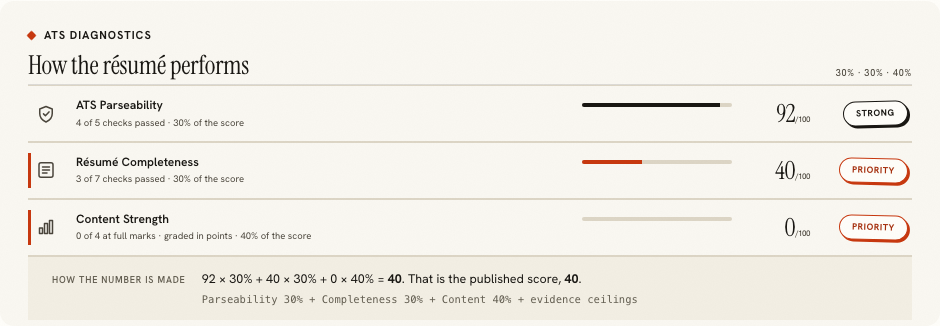
Whether the text comes out of your file cleanly, weighted at 30%. Whether the seven recruiter-facing essentials are present as evidence, weighted at 30%. How strong the achievement writing is, weighted at 40%. Then four ceilings. That is the whole of it, and the checker prints the sum.
The first thing it cannot tell you: whether the work was good
An invented candidate in this estate scores 97 on a résumé that took four minutes to write. The document is readable, complete and evidenced. Nothing in the measurement inspects whether the settlement pipeline was worth rebuilding or whether the person was any good at it, because nothing in a text file could.
The second: whether you fit the job
This check never takes a job description. The same document scores the same whichever advert you are answering, which is a deliberate separation described in parsing against screening. Fit is a judgement made by a person with a posting in front of them.
The third: what an employer's system will do
We have no access to one, and neither does any other checker. A tool offering a percentage chance against a named system is describing a guess, as why checkers disagree with each other sets out.
The fourth: what a reader will think
Nothing here models attention, taste or a bad morning. The folklore around that is examined in the myth of the six-second scan.
What it is genuinely good for

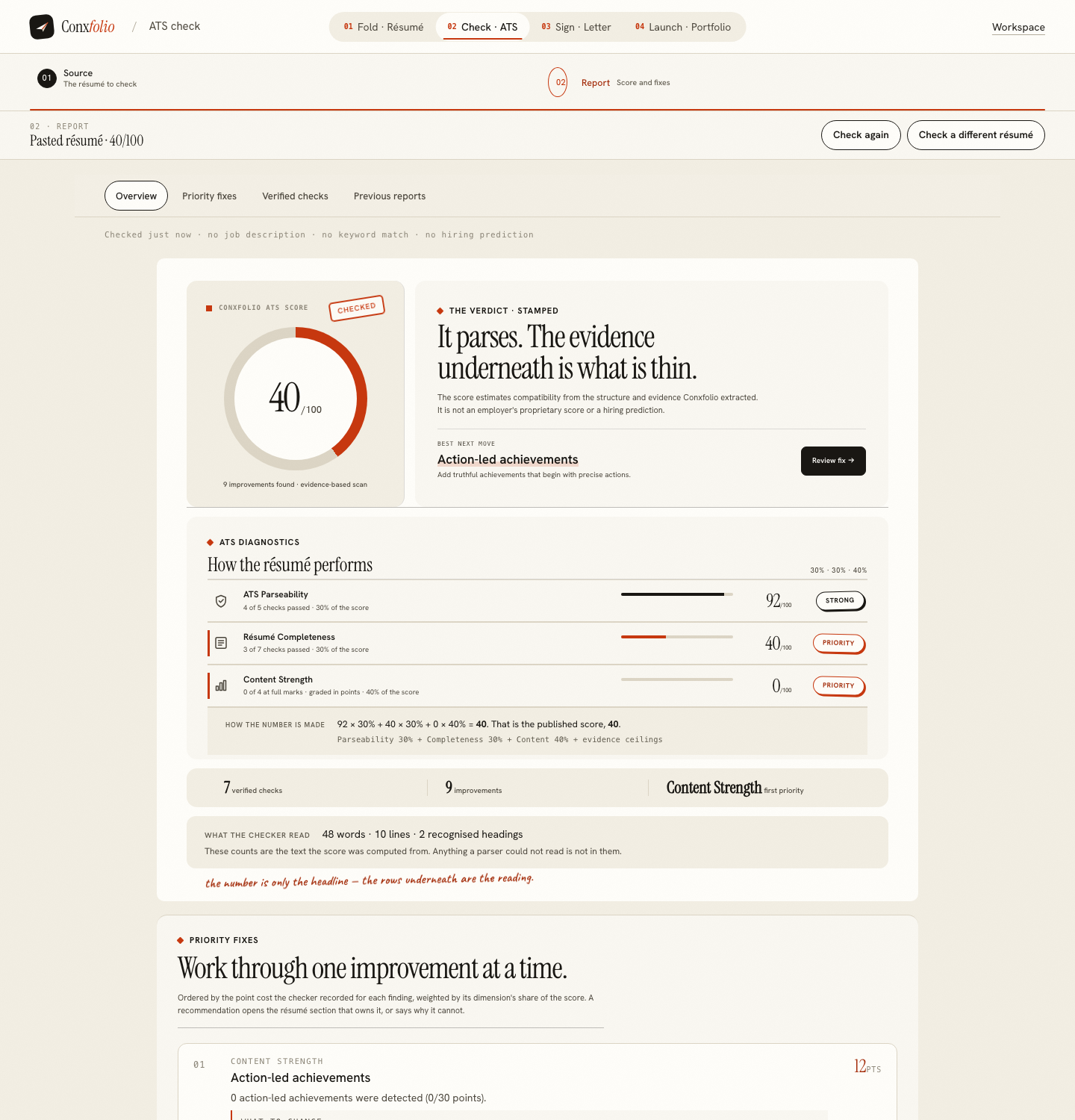
Measuring a change. Run the check, make one fix, run it again. A weak fixture measured 92 × 30% + 40 × 30% + 0 × 40% = 40, with a best next move naming action-led achievements. The same estate's specimen measured 97. The distance between those two is a document problem with a known fix, and watching it move is the use of the number.
Why a low score is not a verdict
Because the commonest cause is that the evidence never reached the scorer. Missing experience alone costs 30 of the completeness 100 and leaves the content dimension with nothing to grade. That is the subject of what a bad extraction costs and of evidence ceilings explained.
The two numbers worth keeping
Not the score. The reading counts, which tell you whether your document was read at all, and the content row, which tells you whether your work is written as evidence. A specimen read 162 words, 18 lines and 4 recognised headings with content at 92. A weak document read 48, 10 and 2 with content at 0. Those pairs describe two different problems and two different afternoons of work, and the single headline number describes neither. A report that prints its parts lets you ignore the summary, which is the most useful thing it can offer.
What this page does not claim
That the number is worthless. A document that will not extract, is missing an email address, or contains no achievement lines is genuinely not ready to send, and a measurement that says so is doing you a favour. What it is not is a rating of a career. The report says as much on its own face, next to the ring, which is the one place a résumé tool is usually silent.
If you want a rule for how much attention to give it, here is a defensible one. Use the score twice: once at the start, to find the structural problems that are invisible on your screen, and once at the end, to confirm that an edit did not break the extraction. Everything in between belongs to the writing, and the writing is the half that how to write experience bullets and quantifying achievements exist for.
A last thought about what a number does to attention. A score invites you to optimise it, and optimising a measurement is not the same as improving the thing measured. The protection here is that the rules are printed: you can see that the content dimension rewards action-led lines with real figures, which is also what makes a document convincing to a person. Where a rule and a good document ever pulled in different directions, the good document is the one to write, and the report would show you the trade rather than hiding it.
Read the findings, not the number
Every finding names its rule and prices its fix. The score is the summary; the rows are the work.
Open the ATS checkerWhy the checker prints its arithmeticQuestions
- Is a high score good news
- It means the document is readable and evidenced. An invented candidate's four-minute résumé scores 97 in this estate, which is the honest scale of the compliment.
- Does the score predict an outcome
- No. It has no access to an employer's system, uses no job description, and the report says so beside the ring.
- Is a low score bad news about me
- No. A weak fixture scored 40 while describing real work, because the evidence never reached the scorer. The number is about the document.
- What is the number good for
- Tracking a change. Run the check, make one fix, run it again, and the difference is what that fix was worth.
- Should I aim for 100
- No. Clear the floor and spend the remaining time on the writing, which is the part a score cannot grade.
Conxfolio is a free set of four career tools: a résumé builder with 37 rendered layouts, an ATS résumé checker that prints its own arithmetic, a cover letter builder that traces every proof paragraph back to the line it came from, and a portfolio builder with 20 authored designs. There is no account to create, nothing is held back for a paid plan, and no language model is used anywhere in the product, so the readers, the score and the letter are deterministic code you can check.