CV and résumé: the same document, two vocabularies
The two words mean different things in different places, and the confusion costs people the wrong document at the wrong moment.
— read the advert's vocabulary, then send what it means.
Two words, three meanings, and a lot of avoidable confusion. Here is what each one means where, with the guidance that says so.
In the United Kingdom
A CV is the ordinary job-application document: a page or two, contact details, a personal statement, work history, education and skills. The UK National Careers Service publishes guidance on what goes in each section (nationalcareers.service.gov.uk), and nidirect's guidance adds that one A4 page is preferable (nidirect.gov.uk). Nobody in the UK sends a résumé.
In the United States
The everyday document is a résumé, and the Department of Labor publishes tips for writing one for federal roles (dol.gov). A CV in American usage is an academic document, and it is long by design because it lists publications, teaching, grants and conference papers rather than summarising them.
In continental Europe
CV is the common word, and the European Union publishes the Europass format with its own conventions (europass.europa.eu). Germany has its own established shape again, the tabular Lebenslauf described by the federal employment agency (arbeitsagentur.de).
What actually differs between the documents
Length, the conventions about personal details, and whether achievements are summarised or listed exhaustively. What does not differ is the structure that makes a document legible: one column, plain headings, contact details in the body, dates that parse. That is why the checker applies the same rules to either.
The measurement does not care which word you used
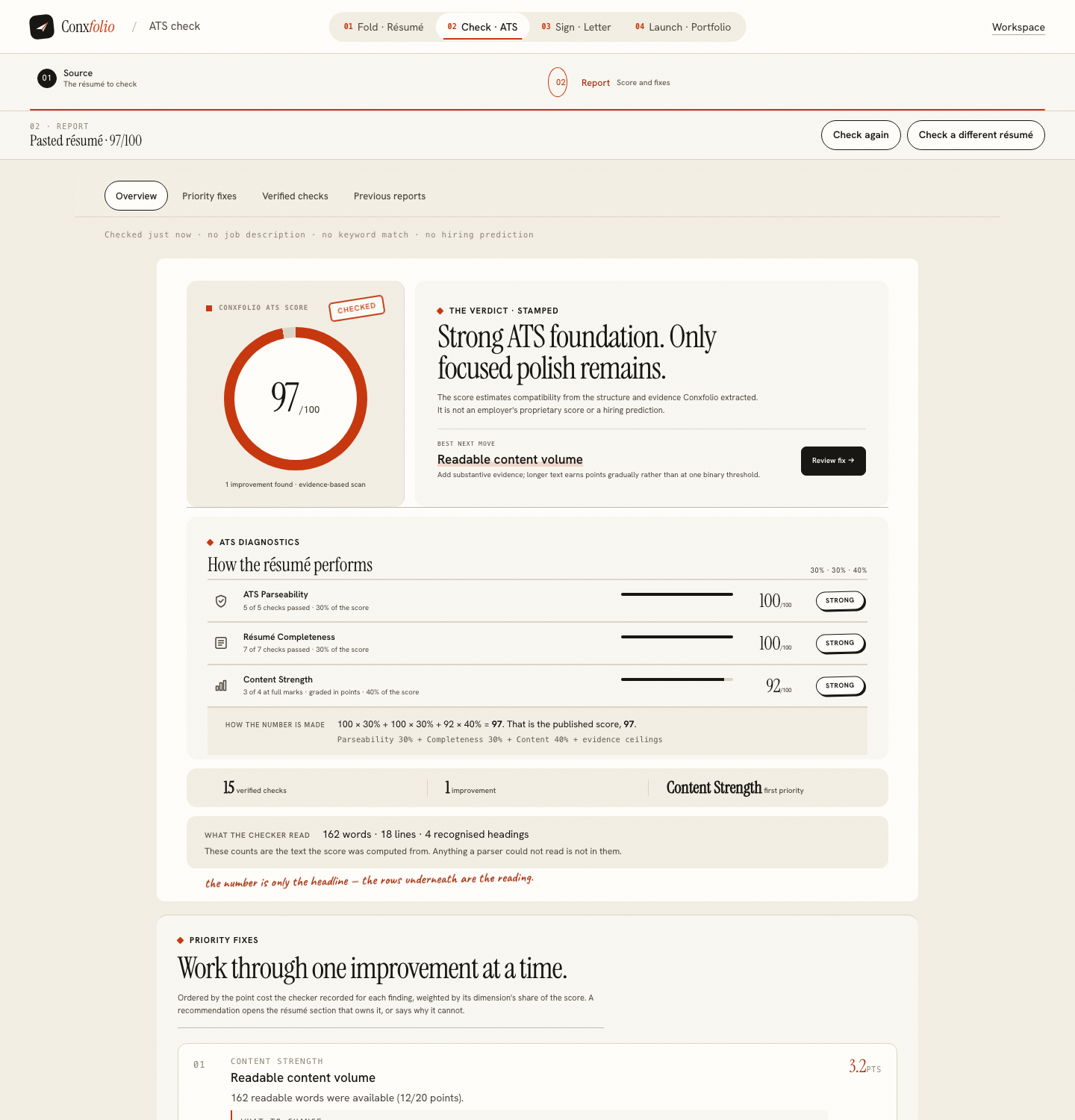
Parseability, the seven essentials and the four content rules apply to both. An academic CV will score well on volume and may score poorly on measurable evidence, which is a real signal about the document rather than a category error, and is what academics leaving academia is about.
Which word to put on the file
The one the advert used. Our exports name the file from the name in the document, which is described in emailing a résumé, and renaming it to match the advert's vocabulary takes a second.
The practical rule for an international application
Follow the destination rather than your habit. If you are in the UK applying to an American employer, they will expect a résumé of the length their guidance describes and will not expect a date of birth. If you are applying into Germany, the expectations are different again and are set out by the federal employment agency. The document underneath barely changes: the same roles, the same evidence, the same structure. What changes is the length, the personal details and the word on the file, and all three take ten minutes once you have read the guidance for that country.
What this page does not claim
That the distinction is enforced anywhere. Plenty of UK adverts say résumé, plenty of international employers use both words interchangeably, and nobody has ever been rejected for the noun. What matters is sending the document the reader expects, at the length they expect, with the personal details their country's convention expects. The country-by-country detail is in UK CV conventions, US résumé conventions and German Lebenslauf conventions.
One genuinely important case sits underneath the vocabulary question. If you are applying across borders, the conventions about personal details differ far more than the word does. A German Lebenslauf commonly carries a date of birth, and UK guidance says explicitly not to include age, date of birth, marital status or nationality. Getting that wrong is a substantive mistake where the noun is a cosmetic one, and the photo conventions by country covers the other half of it.
A final note for anybody in academia, where the two words diverge most sharply. An academic CV is genuinely a different document: exhaustive, chronological, and structured around publications, teaching and funding rather than around achievements. Converting one into a job-market résumé is not a formatting exercise, because the selection principle changes entirely. That conversion has its own page in this estate, and the checker's content rules are a useful mirror for it, since an academic CV typically scores well on volume and poorly on measurable evidence.
Check whichever document you are sending
The same rules apply to both: extraction, the seven essentials, and evidence. No job description and no account.
Open the ATS checkerThe full CV and résumé guideQuestions
- What is a CV in the UK
- The ordinary job-application document. The UK National Careers Service publishes guidance on its sections, describing the standard document a jobseeker sends.
- What is a CV in the US
- An academic document, usually long, listing publications, teaching, grants and conference papers. The everyday job document there is called a résumé.
- Do I need two different documents
- Usually no. A UK CV and a US résumé are close enough that the same material works, with the length and the conventions adjusted.
- Which word should I use on the file
- The word the advert used. It costs nothing and it removes a moment of doubt at the other end.
- What about Europass
- Europass is a European Union CV format with its own template and conventions. It is right in some contexts and wrong in others, which its own guide covers.
Conxfolio is a free set of four career tools: a résumé builder with 37 rendered layouts, an ATS résumé checker that prints its own arithmetic, a cover letter builder that traces every proof paragraph back to the line it came from, and a portfolio builder with 20 authored designs. There is no account to create, nothing is held back for a paid plan, and no language model is used anywhere in the product, so the readers, the score and the letter are deterministic code you can check.