Turning an eleven-page academic CV into a two-page résumé without losing the argument
An academic CV is a complete record by design. A résumé is an argument by design. Converting one into the other is a translation, and most of the work is deciding what the evidence was for.
— eleven pages of record, two pages of argument.
The academic CV is an honest document that answers the wrong question. It records everything because the sector reads everything: the conference posters, the departmental committee, the module codes, the third-author papers. A commercial reader gives the page ninety seconds and wants to know what you can do. The résumé builder is a two-page instrument, and the conversion starts with accepting the loss.
Import the whole thing first
Paste or upload the CV as it stands. The reading sorts it into fields, prints what it found, and reports anything it could not fill rather than filling it in. That gives you the material laid out in sections you can switch off, which is faster than retyping and less painful than deleting from the original file. The mechanism is described in what the import review catches.
Education comes off the top
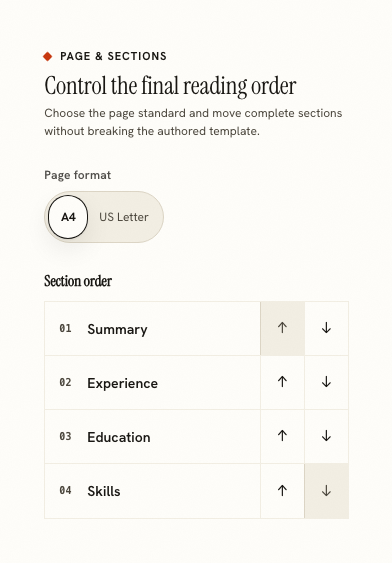
An academic CV opens with degrees because the degrees are the credential. A commercial résumé opens with what you have done, because the reader is buying that. The panel above moves whole sections without touching the design you chose, so both orders can be looked at as rendered documents before you commit.
Four translations that do most of the work
A grant becomes a budget you were responsible for. Doctoral supervision becomes people you were accountable for, with a number. A module becomes a course you designed and ran, with a cohort size. A collaboration becomes a project across institutions, with a duration. Each of those is the same fact written as scope, and each one gives the checker's content rules something to grade. How to write experience bullets has the pattern, and a teacher's outcome lines is the same problem one sector over.
Publications, and what they are for now
Three that bear on the role are evidence. Forty are a filing cabinet. The builder has a certifications section and an additional section whose heading you choose, which is where a short selected list goes. What it does not have is a publication type with authors and venues, because that is an academic CV's structure and this is not one.
What the checker makes of the result
The ATS résumé checker has no rule for publications, citations or grants. It grades whether the text comes out in order, whether the seven completeness essentials are present with real content under them, and whether the achievement lines carry action, figures, depth and volume. An academic page filed under Projects rather than Experience risks the completeness rule's experience check outright, which our own measurements show costing thirty of its hundred points and triggering a ceiling; that is in evidence ceilings explained.
The two-page question, with a source
There is no page limit in this product. Where a system publishes one, the system wins: United States federal applications are limited to two pages under the Office of Personnel Management's 2025 Merit Hiring Plan (opm.gov). How long a résumé should be and one page or two carry the rest.
The letter does the explaining
Leaving academia needs a sentence that a résumé cannot carry. The cover letter builder selects its proof paragraphs from your own résumé lines and will not invent a motivation, and the optional field for what only you know is where the reason for the move belongs. Requirements the posting asks for that your evidence cannot support come back as gaps rather than claims.
What is not offered
No summarisation, no rewriting, no model anywhere in the product. Nothing here predicts what a commercial employer will make of an academic record, and no page on this site claims a document gets anybody hired. The tools are free with nothing held back, including every design and both export formats, and the Europass page covers the one format that is sometimes required.
A word about the skills section, which academic CVs usually lack entirely. The completeness rule wants at least three distinct entries and our measured examples registered between seven and nine. For somebody leaving research, this is the section that translates a methods chapter into vocabulary a commercial reader searches for: the languages, the statistical tools, the data work, the teaching and the project management that a grant actually was.
Write it truthfully and stop. A list of thirty is a list nobody reads, and the rule pays nothing beyond the first three. The skills section guide covers the selection, and hard skills and soft skills covers what belongs there at all.
Start the two-page version
Import the CV you have and cut it into an argument. Free, no account, and the file stays in this browser.
Open the résumé builderRead the résumé and CV guideQuestions
- Is a résumé the same thing as a CV
- Outside academia, mostly. European institutions generally say CV, and the European Union's own Europass format is called a CV (europass.europa.eu); United States federal guidance says resume (dol.gov). An academic CV is a different document from both.
- Where do publications go
- Into an additional section you name yourself, if they belong at all. Three that are relevant to the role earn their space; forty do not, and the page has to choose.
- Does teaching count as management
- It counts as whatever it truthfully was. Supervising four doctoral students is line management with a different vocabulary, and it should be written as scope rather than as a title.
- Is there a page limit here
- Not in the product. Where a public system publishes one, follow it: United States federal applications are limited to two pages under the Office of Personnel Management's 2025 Merit Hiring Plan (opm.gov).
- Will the tool cut it down for me
- No. It has no model and it does not summarise. It imports what you give it, prints what it read, and leaves the editing to you.
Conxfolio is a free set of four career tools: a résumé builder with 37 rendered layouts, an ATS résumé checker that prints its own arithmetic, a cover letter builder that traces every proof paragraph back to the line it came from, and a portfolio builder with 20 authored designs. There is no account to create, nothing is held back for a paid plan, and no language model is used anywhere in the product, so the readers, the score and the letter are deterministic code you can check.