An apprenticeship application is written before the evidence exists, and that is fine
Every apprenticeship application is made by somebody who has not done the job yet. The document's task is to show what has been done instead, in a shape a reader recognises.
— a saturday job is work. write it as work.
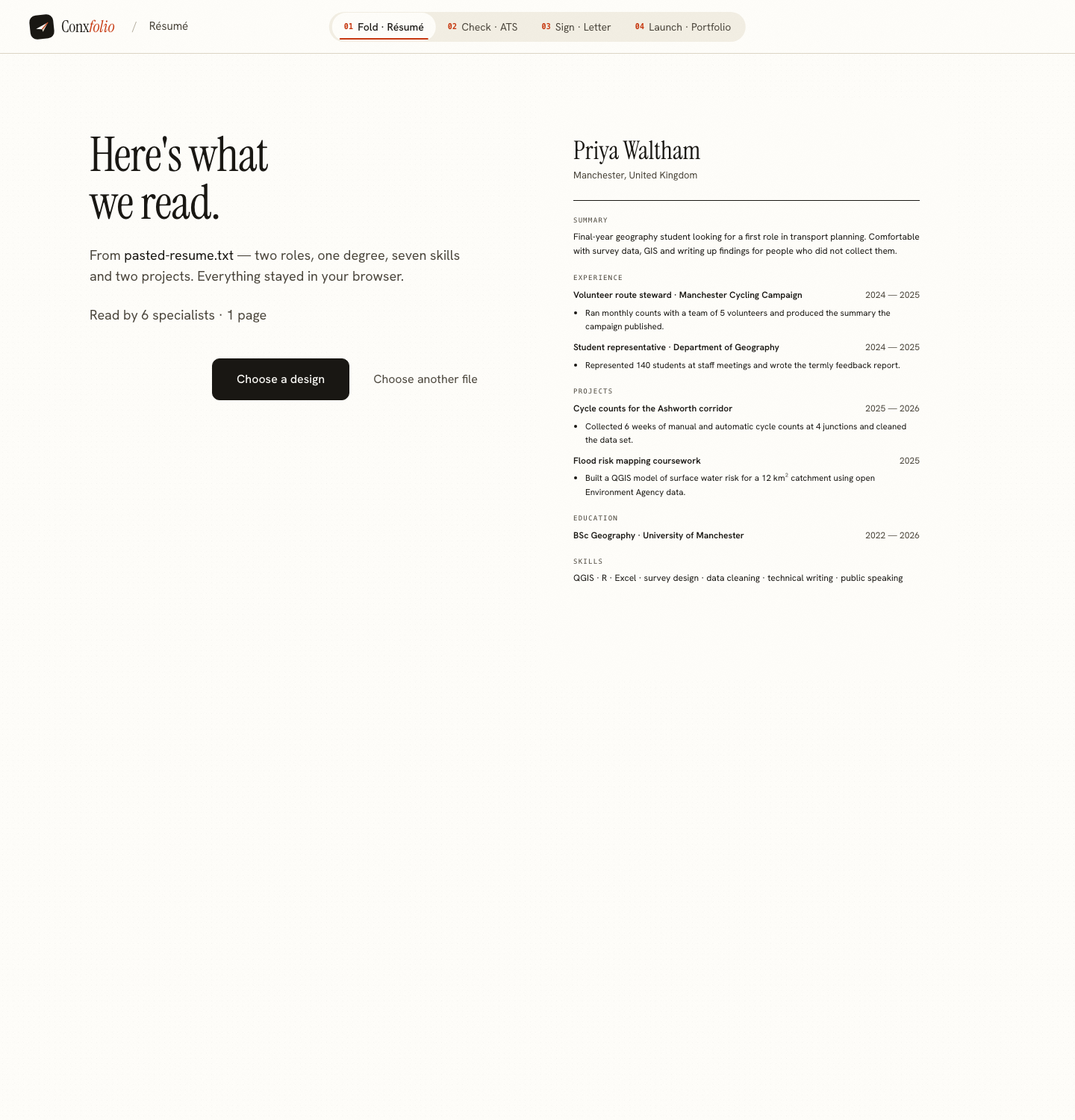
An apprenticeship application is the hardest document in this whole family, because it has to argue from almost nothing and it is usually the first one the writer has ever made. The résumé builder starts from a blank sheet as readily as from an import, and the sections are the same ones a twenty-year career uses.
What actually goes on it
School and the subjects that bear on the trade. A placement, however short. Any paid work at all, including the Saturday job. A project you finished, at school or otherwise. A responsibility you held: a team, a stall, a fundraiser, a rota. Written as things you did, with a date and a number where a number is true, each of those is evidence. Written as a list of nouns, none of them is.
What a page like that measures
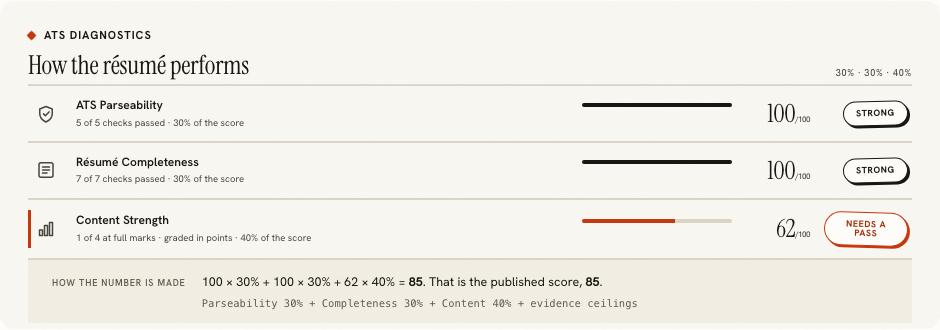
We ran an invented student page with no paid work through the ATS résumé checker. On 12 September parseability scored 100, completeness 70, content 12, and the published score was 55. The completeness loss turned out to be a misreading in our own heading rule rather than a fact about the page, so the rule was changed. Re-measured on 13 September the same page returns parseability 100, completeness 100 and content 62, published as 85, with the remaining points sitting in the content rules that count achievement lines. Either way it is what the shape of the document does, not a verdict on the person, and the report says on its own face that it is not a hiring prediction.
The part worth copying
On that same page, on 12 September, rewriting one line so that it began with a role rather than with a status took the published score from 55 to 75 on identical words. That gap was the defect, and after the repair both phrasings score 85. The whole experiment is in a student résumé with no paid jobs on it, and the writing lesson survives it: every entry starts with what you were, then who it was for, then what you did.
Three lines that carry an apprenticeship application
One about reliability with a number in it, such as a year of Saturday shifts without a missed one. One about a thing you made or fixed, with what it was for. One about a responsibility, with how many people or how much money. Those three do more than a paragraph about being hardworking and eager to learn, which is a sentence every reader has seen four hundred times.
The letter, and the one thing it will not do
The cover letter builder selects its proof paragraphs from sentences already on your résumé, so a thin page produces a short letter rather than a padded one. It will not invent a reason for wanting the apprenticeship. That reason is the strongest thing a sixteen-year-old has and it goes in the optional field for what only you know, in your own words. The no-experience letter guide has the shape.
Keep it to one page, and make it legible
There are 37 designs in the gallery and 21 of them are marked ATS-safe in the catalogue. For a first application the plainest ones are the right ones, and single column against two column covers why. How long a résumé should be covers the length.
What to do with the application form
Many apprenticeship applications are forms rather than documents, and the form asks for the same material in boxes. Writing the résumé first is still worth the hour, because the boxes are then filled from something you have already thought about rather than composed at the keyboard under a word limit. The document is also what you take to the interview and what you send when a form is not involved.
Where the form asks for your full education and employment history, that is a declaration rather than a selection, and it has different obligations from a résumé. The distinction is set out in whether to list every job. Fill the form completely, and keep the résumé as the version that argues.
What this costs, and what it does not claim
Nothing. All four tools, every design, PDF and DOCX with no watermark, and no account to create, which is explained in why there is no account. No page here says a document gets anybody a place, and the checker is a readability measurement rather than an employer's system. Relevant coursework on a résumé and hobbies and interests cover what else belongs at this stage.
A last word on length and honesty, because they are connected at this stage. A first résumé that runs to two pages has almost always been padded, and padding is visible: a list of school subjects with no grades, a hobbies section three lines long, a skills list containing Microsoft Word. One honest page with four real entries reads as somebody who knows what evidence is, which is the impression the document exists to make. The checker's volume rule pays gradually rather than at a threshold, so a short page is not being punished for being short.
Write the first one
Start from a blank sheet and add what exists: school, a placement, a job, a project. Free, no sign-up.
Open the résumé builderRead the first-job guideQuestions
- What goes on the page when I have never had a job
- School and its subjects, any placement, any part-time or holiday work, a project you finished, a responsibility you held. All of it is evidence if it is written as something you did.
- How long should it be
- One page. There is no rule in the product and no page limit, and at this stage a second page is padding rather than evidence.
- Does a low score mean the application is weak
- No. The score measures whether a document is readable and evidenced, and a page with little history on it will score lower by construction. It is not an employer and it predicts nothing.
- Should I include my school grades
- Where they are recent and relevant, yes. The completeness rule looks for a qualification and an institution rather than a grade, so the grade is for the human reader.
- Is it really free
- Yes, all four tools, every design, both export formats, no watermark and no account. The only email the product asks for is claiming an address for a published portfolio.
Conxfolio is a free set of four career tools: a résumé builder with 37 rendered layouts, an ATS résumé checker that prints its own arithmetic, a cover letter builder that traces every proof paragraph back to the line it came from, and a portfolio builder with 20 authored designs. There is no account to create, nothing is held back for a paid plan, and no language model is used anywhere in the product, so the readers, the score and the letter are deterministic code you can check.