Parsing and screening: two different things people call the ATS
Most advice about beating the system muddles two separate stages. Separating them tells you which half you can actually control.
— fix the reading; the deciding was never yours.
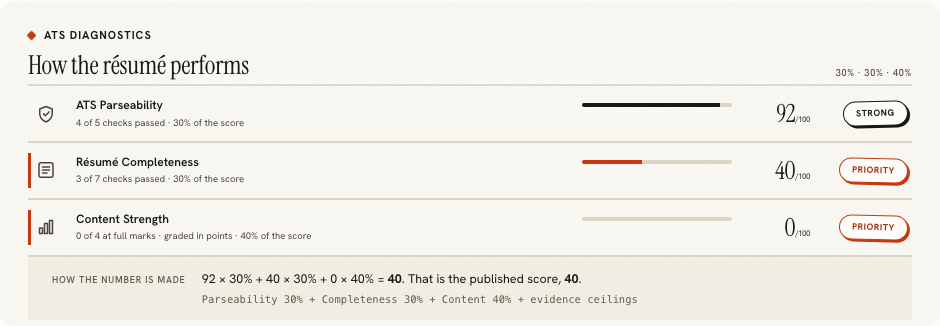
Two different things happen to an application, and almost all confusing advice comes from treating them as one. The first is a reading. The second is a decision. Only one of them is visible from where you are standing.
Parsing is a reading
Software takes your file, extracts the text and tries to work out which part is a name, which is an email address, which lines belong to which role, and where each date range begins. It succeeds or it fails, and it fails on layout rather than on merit. A document with a sidebar can produce a record where your job title sits inside an education field, which is covered in why résumés get scrambled.
Screening is a decision
Somebody decides who to look at. They may search the stored text for a licence, filter by a required qualification, or read the first forty in the order they arrived. The software makes those actions convenient; the choices belong to the person who made them. There is no shared algorithm to outwit, because there is no algorithm doing the choosing.
Why the distinction matters to you
Because they have different fixes. A parsing failure is repaired with structure: one column, plain headings, contact details in the body, no tables. A screening outcome is not repaired at all from your side, and any tool that promises otherwise is selling a guess.
What our checker does about it
The ATS checker stays on the first side of the line. It measures whether your text extracts, whether the seven essentials are present as evidence, and how strong the achievement writing is, then prints the arithmetic. On a specimen that was 100 × 30% + 100 × 30% + 92 × 40% = 97; on a weak document, 92 × 30% + 40 × 30% + 0 × 40% = 40. Neither number is a prediction about a hiring decision, and the report says so beside the score.
The part of screening you can prepare for
If a person searches the stored text, the useful thing is that the words for your work are actually in it. That is an argument for naming the tools, the qualifications and the systems you really use, in the roles where you used them, which is the honest version of keywords: ATS résumé keywords. It is not an argument for a list of terms at the bottom of the page, as keyword stuffing does not work sets out.
Where the reading ends and a person begins
Somewhere after the parse, a human reads. What they are doing in the first few seconds is a separate question with its own folklore, and it is taken apart in the myth of the six-second scan and what a recruiter looks for first.
What this means for the advice you read
Most résumé advice is written about screening and dressed as fact. Rules about how many bullet points, which font, whether to use a summary, and what a recruiter thinks are all claims about the second stage, and almost none of them carries a source. Advice about the first stage can be checked, because extraction is mechanical: you can open your own file, select the text, and see what comes out. Preferring the checkable half is not a stylistic choice. It is the only half where a claim can be shown to be true, which is why every measurement on this site belongs to it.
What this page does not claim
That screening is fair, or that it is unfair. We have no view of it and no data about it, and neither does any résumé tool. What we have is one measurable stage and a document you control. Making that document extract cleanly, carry its essentials and evidence its claims is the whole of what is available to you, and it is more than most people do.
One practical consequence worth acting on. Because parsing happens before anybody reads, it is the only stage where a formatting decision can cost you an application without anyone noticing. That asymmetry is the reason to spend your first hour on structure rather than on wording, and the reason the ATS format guide comes before the writing guide in every sensible order of work.
There is a comfort in this distinction that is worth naming. A great deal of job-search anxiety attaches to the invisible half, where nothing you do can be verified and every piece of advice is a guess. Moving your attention to the half you can measure is not avoidance: it is the only place where effort reliably produces a better document. The document is also the thing that persists across applications, which is why an hour spent there pays over months and an hour spent guessing at filters pays once, if at all.
Measure the half that is yours
Parseability, completeness and content strength, each with its own weight and its own findings. No job description, no prediction.
Open the ATS checkerWhat an ATS actually readsQuestions
- What is parsing
- Turning a document into structured fields: name, contact details, roles, dates, education, skills. It is a reading, and it either works or it does not.
- What is screening
- Deciding who to look at. In practice that is a person applying filters, running searches and reading, inside software that makes those things easy.
- Which one does your checker measure
- The first, and the quality of the evidence a screener would find. It has no access to anybody's filters and does not use a job description.
- Can a résumé be rejected automatically
- An employer can set a filter that excludes applications, which is a configuration choice made by a person. That is not the same as software forming an opinion about you.
- So is keyword matching real
- Search is real: a recruiter can search the stored text for a term. That is an argument for using the true words for your work, and not for stuffing.
Conxfolio is a free set of four career tools: a résumé builder with 37 rendered layouts, an ATS résumé checker that prints its own arithmetic, a cover letter builder that traces every proof paragraph back to the line it came from, and a portfolio builder with 20 authored designs. There is no account to create, nothing is held back for a paid plan, and no language model is used anywhere in the product, so the readers, the score and the letter are deterministic code you can check.