What gets found first, and how to make it findable
We cannot watch a recruiter read. We can show you which seven things our checker insists on, and what each is worth.
— present as evidence, not present as a heading.
Nobody here has watched a recruiter read a résumé, so this page does not describe eye movements. It describes something checkable instead: the seven things our scorer insists on, the points each one carries, and what that ordering implies.
The seven, with their prices
| Check | Points | Satisfied by |
|---|---|---|
| Identity | 10 | A name the reader can attach to the document |
| 15 | An address in the body of the page | |
| Phone | 5 | A number in the body of the page |
| Experience | 30 | A section with roles, dates and evidence under it |
| Education | 15 | A qualification with an institution |
| Skills | 15 | A section naming what you can do |
| Summary | 10 | A few substantive lines about your work |
They sum to 100 inside the completeness dimension, which is 30% of the published score.
The ordering is the argument
Experience carries three times what education carries, because a reader wants to know what you have done before they want to know where you studied. Email carries three times what a phone number carries, because an application nobody can reply to is not an application.
Present as evidence, not present as a heading
Each check looks for content, not for a label. An Experience heading with nothing under it fails the completeness check and costs parseability points as well, because a heading with no readable content beneath it is the signal of a document that did not extract. The same logic applies to a summary: a heading followed by two adjectives does not satisfy the check, and a teacher's fixture in this estate showed exactly that, scoring nothing for a summary that existed on the page.
What that means for the top of the page
Contact details in the body rather than in a header region, because header regions are skipped by some extractors. Then a summary that says what you do and at what scale, if you are writing one. Then experience, in reverse date order, with evidence under each role. The composition question is argued in objective or summary and in summary or no summary.
Then the part that is not a checkbox
Once the seven are present, the remaining 40% of the score is the content dimension, which grades the writing: action-led lines, measurable evidence, depth across roles and readable volume. That is where a complete document becomes a convincing one, and it is the subject of how to write experience bullets.
Reading your own report as a map
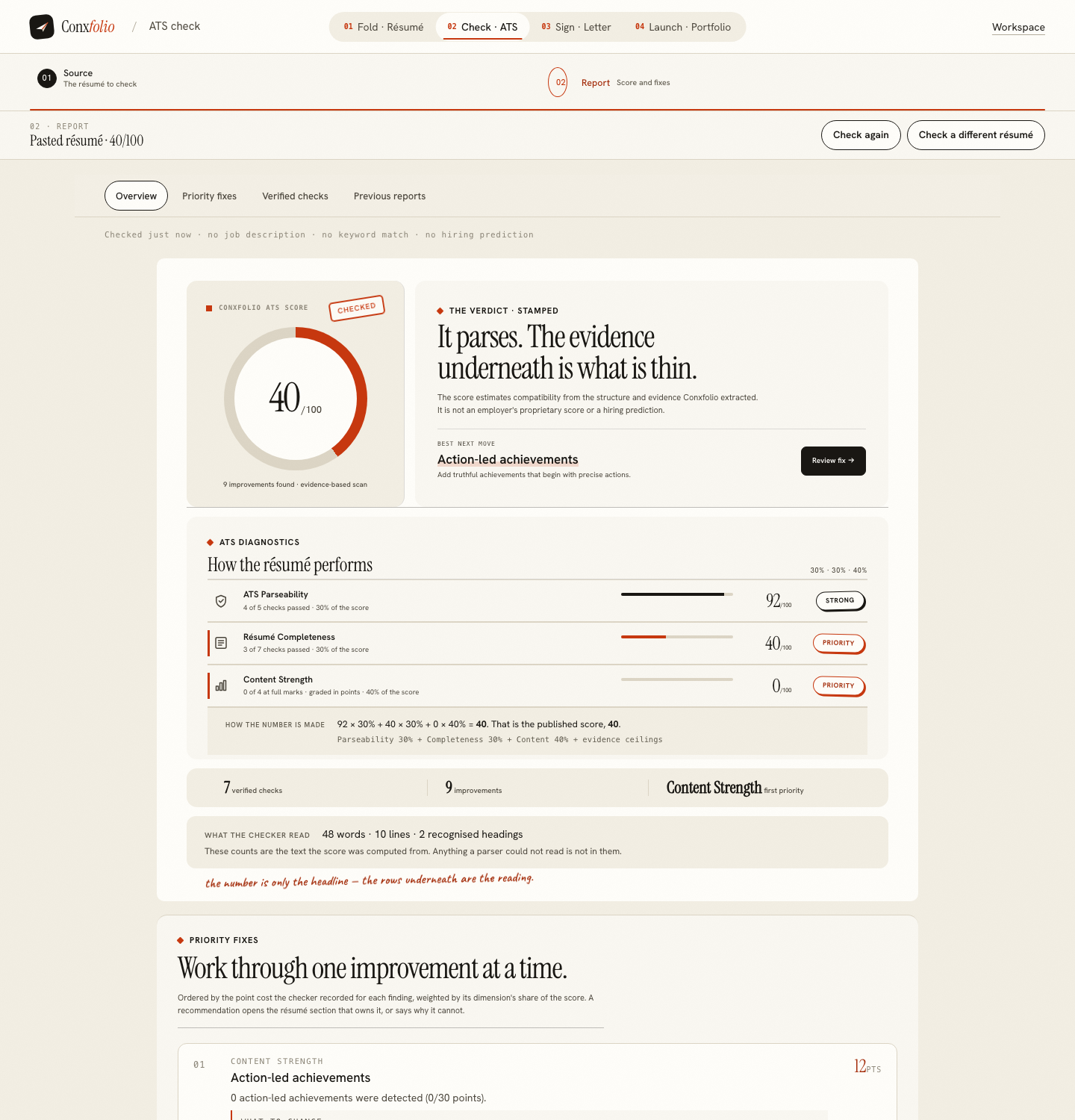
The ATS checker lists each check with its outcome and prices the fixes, so the order to work in is on the page rather than in your head. A weak fixture came back with three of seven passed and a best next move naming action-led achievements. The habit of ordering by cost is the difference between a list and advice, as previous reports and what a fix was worth shows.
The one the weights get wrong on purpose
A summary is worth 10 points, which is deliberately modest for something that occupies the top of the page. The reason is that a summary is the easiest section to write badly and the easiest to skip entirely. A document with three strong roles and no summary is complete enough for any reader; a document with an excellent summary and no evidence underneath is not. The weights are arranged so that the section carrying the most words is not the section carrying the most credit, which is a corrective to the instinct that makes people spend an evening on four sentences.
What this page does not claim
That these seven are what a particular recruiter reads first, in this order, in real life. They are what our scorer requires, with the weights the engine actually uses, and those weights are a defensible map of what a document needs rather than a study of human attention. The timing folklore is dealt with separately in the myth of the six-second scan.
One practical exercise that uses the list properly. Cover everything on your page except the first third and ask whether the seven essentials are either present there or clearly signposted. Most documents fail that on two counts: the contact details have drifted into a decorative band that extracts badly, and the first role is pushed below the fold by a summary that says nothing. Both are structural, both take ten minutes, and both are measurable afterwards in the same report.
A final practical note about the top of the page. Contact details are worth 30 points between identity, email and phone, and they are also the section most likely to be placed in a decorative band that extracts badly. That combination makes them the highest-value ten minutes on most documents: moving them into the body of the page usually costs nothing visually and can recover 20 points that were being lost silently. The header guide covers where to put them and what to leave out.
See which of the seven you are missing
The report names each check, says whether it passed, and prices the fix. No job description and no account.
Open the ATS checkerThe header and contact details guideQuestions
- What are the seven
- Identity 10 points, email 15, phone 5, experience 30, education 15, skills 15 and a summary 10. They sum to 100 inside the completeness dimension, which is 30% of the score.
- Why is experience worth 30
- Because a résumé with no experience section is missing the thing the document is for. It is the largest single check for that reason.
- Why is email worth more than phone
- Because an application that cannot be replied to is not an application, and email is how most replies arrive. A missing email costs 15 points; a missing phone number costs 5.
- Does a heading count as a section
- No. The check looks for a section with readable content under it. An Experience heading with nothing beneath it fails, and the parseability dimension deducts separately for it.
- Is a summary required
- No. It is worth 10 points of completeness, which is a real amount and not a large one. Whether to write one is a judgement covered in its own page.
Conxfolio is a free set of four career tools: a résumé builder with 37 rendered layouts, an ATS résumé checker that prints its own arithmetic, a cover letter builder that traces every proof paragraph back to the line it came from, and a portfolio builder with 20 authored designs. There is no account to create, nothing is held back for a paid plan, and no language model is used anywhere in the product, so the readers, the score and the letter are deterministic code you can check.