The six-second rule, and what can honestly be said instead
The six-second scan is quoted everywhere and sourced almost nowhere. We have no recruiter data, and this page does not pretend to.
— no data means no claim, and that is the whole page.
You have read the figure. A recruiter spends about six seconds on a résumé before deciding. It appears in careers advice, in software marketing and in a great many blog posts, usually with no link attached.
Why this page does not repeat it
Because the rule here is that a claim about the outside world needs a public source, and a number we cannot check is a number we do not print. We have no recruiter data. We have never watched anybody read a résumé under instrumentation. Repeating a figure because it is popular is how it became popular.
What the figure does to advice
It turns every page into an argument for compression. Shorten everything, put the best thing at the top, remove anything that might be skipped. Some of that is good practice for its own reasons. Some of it produces a document that says very little quickly, which is the worst outcome for a reader at any speed.
What can be said without a stopwatch
That a document which extracts cleanly is legible to every reader, human or otherwise. That the seven essentials being present as evidence rather than as empty headings is what a first glance is looking for. That specific lines are faster to read than vague ones, because the reader does not have to work out what you mean. None of those needs a timing study.
The measurable version of first impressions
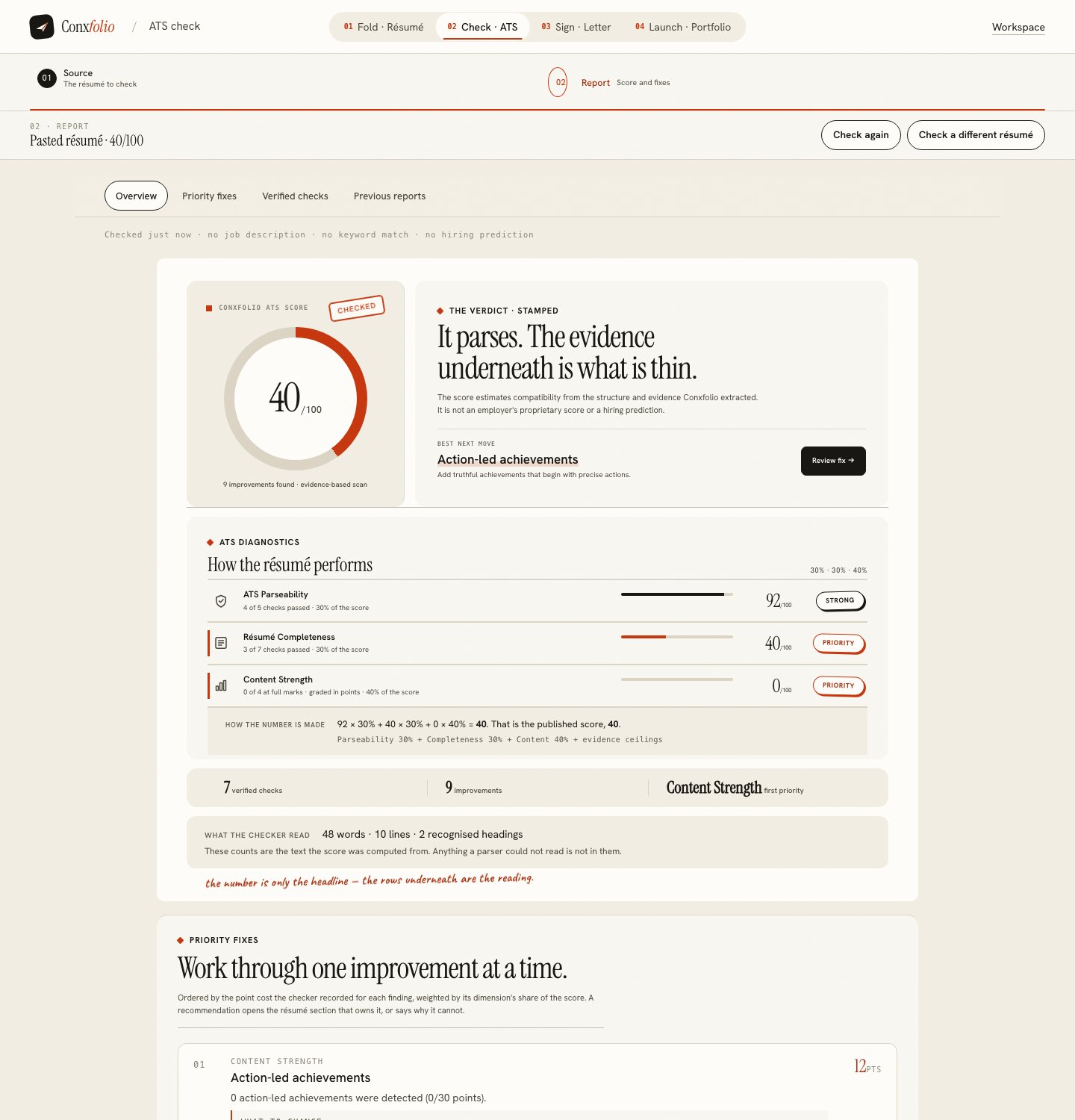
The ATS checker prints what it read: on a specimen, 162 words, 18 lines and 4 recognised headings; on a weak document, 48 words, 10 lines and 2 headings. Recognised headings are close to what a glance uses to navigate, because they are the landmarks. A document with four of them in a predictable order is easy to move around in, whoever is doing the moving.
Where speed genuinely is a constraint
A recruiter with two hundred applications is not going to read them all closely, and that is true whether the number is six seconds or sixty. The response is the same either way: make the first third of the page carry the role, the scope and the strongest evidence. What that looks like in practice is in what a recruiter looks for first and the summary guide.
Why unverifiable numbers persist
Because they are useful to whoever is repeating them. A figure makes advice sound like research. It is the same mechanism that produces résumé checkers with confident percentage predictions about employer software nobody has seen, which is taken apart in why checkers disagree with each other and in what a score cannot tell you.
The rule this replaces
Not a timing rule at all. A document should be legible to somebody who is skimming and to somebody who is reading closely, and the same properties serve both: recognised headings in a predictable order, a first third that says what you do and at what scale, and lines that are specific enough to be understood in one pass. That is the whole design, and it is defensible without a study because each part of it is measurable. The checker prints the recognised headings it found, the content rules grade whether the lines are specific, and both numbers are on the report rather than in a claim about anybody's attention.
What this page does not claim
That the figure is false. It may be a fair summary of a real study, and we are not in a position to say either way. What is claimed is only this: we do not have the data, so we do not use the number, and none of the advice on this site depends on it. Everything here is argued from a document we measured and can show you.
If you want one practical rule that survives whether the number is six seconds or six minutes, it is this. A stranger should be able to say what you do, at what scale, and one thing you changed, from the top third of the first page. That is testable at home: hand the page to somebody, take it away after a moment, and ask them those three questions. It costs nothing, it uses a real reader rather than a statistic, and the writing it drives is the same writing that moves the content dimension, as how to write experience bullets explains.
One reason this matters beyond the number itself. Advice built on an unverifiable premise cannot be corrected, because there is nothing to check it against, so it persists through repetition rather than through evidence. That is how a category ends up with folklore about fonts, bullet counts and page lengths that nobody can source. Refusing to add to it is a small contribution, and it costs this page nothing, because everything useful about first impressions can be argued from a document you can measure.
Measure the document instead
Parseability, completeness and content strength, with the arithmetic printed. Nothing about recruiters, because we have no data about recruiters.
Open the ATS checkerWhat a recruiter looks for firstQuestions
- Is the six-second figure true
- We do not know, and we are not going to repeat it as a fact. It circulates as a rule of thumb attributed to eye-tracking work, and we have no data of our own on how long anybody spends reading.
- Why write a page about it at all
- Because it drives a great deal of advice, and most of that advice is about cramming rather than about clarity. The idea is worth separating from the practice it produces.
- Does your checker model recruiter attention
- No. It measures extraction, completeness and evidence in a document. It has no model of a reader and makes no prediction about one.
- So should I put the important thing first
- A document whose first third is legible and specific is easier for anyone to read, at any speed. That argument stands without a stopwatch.
- Does length matter
- Length matters for the reasons in the length guide, which are about relevance and structure. It does not need a six-second premise to be true.
Conxfolio is a free set of four career tools: a résumé builder with 37 rendered layouts, an ATS résumé checker that prints its own arithmetic, a cover letter builder that traces every proof paragraph back to the line it came from, and a portfolio builder with 20 authored designs. There is no account to create, nothing is held back for a paid plan, and no language model is used anywhere in the product, so the readers, the score and the letter are deterministic code you can check.