What an applicant tracking system is, and what ours is not
An applicant tracking system is a piece of employer software you never see. Here is what it does, and why our checker is a different thing entirely.
— we have never seen inside one, and neither has any other checker.
An applicant tracking system is employer software. It receives applications, stores them, and lets the people hiring search and sort what it holds. The part that concerns you is the doorway: a parser that reads your file and turns it into fields, because everything the system knows about you afterwards comes from that reading.
What the software is for
Organisation and record-keeping, mostly. An employer with two hundred applications needs somewhere to put them, a way to find the ones who mentioned a licence, and a record of what happened to each. Employers who contract with government have record-keeping obligations on top of that, which is why the United States Department of Labor's guidance for federal contractors takes it as read that they keep applicant data in such systems, including where self-identification data must be stored securely and separately (dol.gov, OFCCP VEVRAA FAQs).
The parser is the part that can hurt you
A parser has to decide which text is a heading, which lines belong to which role, and where a date range starts. A two-column layout, a table, a text box or a header region can all produce a reading in the wrong order. The result is a record with your job title inside somebody's education field, and no human involved in the mistake. That failure mode has its own page: why résumés get scrambled.
What is not true about these systems
They do not score you out of a hundred. They do not read a covering letter and form an opinion. There is no single algorithm shared between them, because they are different products from different companies, configured differently by each employer. A tool that offers to tell you how a named system will rank you is describing something it cannot see.
So what is our checker
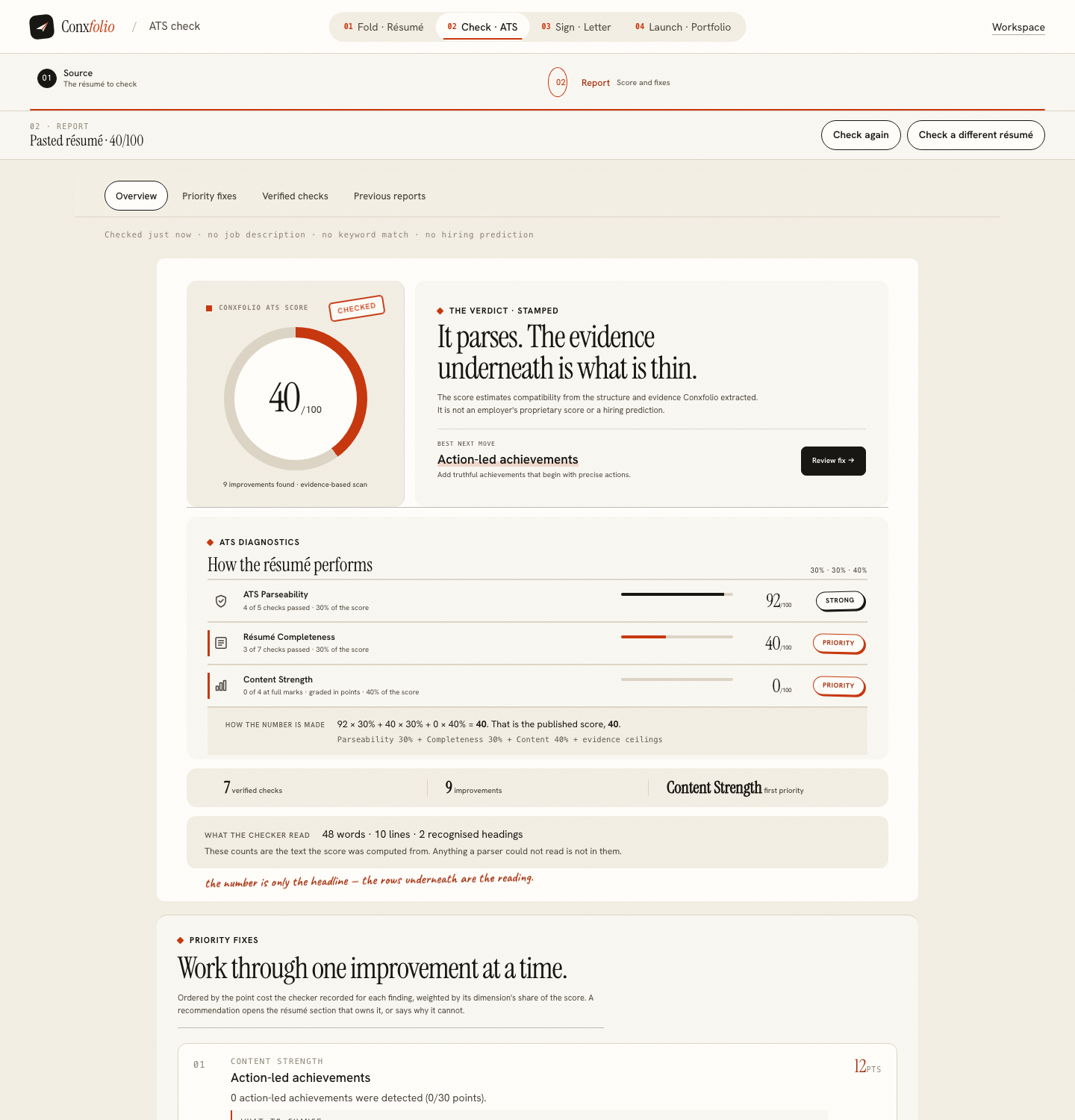
A readability and evidence measurement. The ATS résumé checker extracts your text, measures how cleanly it came out, whether the essentials are present as evidence rather than as empty headings, and how strong the achievement writing is. It weights those three at 30%, 30% and 40%, applies ceilings, and prints the sum. The full arithmetic is in how the ATS score is calculated.
Why that is still worth doing
Because every one of those systems begins by extracting text from your file, and a document that extracts cleanly here extracts cleanly there. We cannot tell you how a particular employer's filters are configured. We can tell you whether your experience section came out as an experience section, which is the failure you can actually fix.
What to do with the reading counts
The report prints the words, lines and recognised headings it read. On a specimen document that was 162 words, 18 lines and 4 recognised headings. If your résumé is two dense sides and the report says 90 words, the score is beside the point and the extraction is the problem. That line is explained in what the checker read counts, and the design side in single column against two column.
Why the name causes so much confusion
Because tracking is the accurate word and rejecting is the word people hear. The software tracks applications through stages, which is a record-keeping job. The decisions attached to those stages are made by people, using filters and searches they configured. A great deal of advice is written as though the software formed opinions, and once you assume that, every piece of guidance becomes an attempt to guess at a mind that is not there. Reading it as a filing system with a parser at the door produces better decisions, because it directs attention at the one part that can genuinely go wrong without anybody noticing.
What this page does not claim
That passing our check gets you through anybody's system, and that failing it means rejection. The check has no access to an employer's software, uses no job description and predicts nothing, and the report says so beside the score. What it can do is tell you whether the document you are about to send is legible to a machine, which is the part of the process that is entirely in your hands.
A last word on where the anxiety usually goes wrong. People spend hours guessing at a filter they cannot see, and minutes on a document that does not extract. The order to work in is the opposite: fix the extraction first, because that is measurable and yours; then write the evidence properly, which is what how to write experience bullets and quantifying achievements are for; then, if you want, read the advert carefully, which is a separate skill covered in how to read a job posting.
One consequence worth carrying into any advice you read about these systems. Where a claim is specific about behaviour, ask how the person writing it could know. Some of them work for employers and are describing their own configuration honestly, which is useful and local. Some are describing a product they sell. And a great deal is repetition of repetition. The claims on this page are deliberately narrow for that reason: what the software is for, that a parser stands at the door, and what our own measurement covers.
Measure what a parser can get out of your file
The report prints the words, lines and headings it could read, and the arithmetic behind the score. No job description, no account.
Open the ATS checkerWhat an ATS actually readsQuestions
- Is an ATS a robot that rejects people
- No. It is software for storing and organising applications, with a parser that turns a document into fields. Decisions in it are made by the people using it, through filters and searches they set.
- Do you have access to one
- No. No résumé checker has access to an employer's system, and any tool claiming to simulate a named one is describing a guess.
- Then what does your checker measure
- Whether your document extracts cleanly, whether the seven recruiter-facing essentials are present as evidence, and how strong the achievement writing is. Parseability 30%, completeness 30%, content 40%, then evidence ceilings.
- Does it use the job description
- No. This check never takes one, which is why a score from it is about your document rather than about a particular advert.
- Do all employers use one
- Large employers and government contractors commonly do, partly because record-keeping obligations make a system easier than a filing cabinet. Small employers often use an inbox.
Conxfolio is a free set of four career tools: a résumé builder with 37 rendered layouts, an ATS résumé checker that prints its own arithmetic, a cover letter builder that traces every proof paragraph back to the line it came from, and a portfolio builder with 20 authored designs. There is no account to create, nothing is held back for a paid plan, and no language model is used anywhere in the product, so the readers, the score and the letter are deterministic code you can check.