Keyword stuffing, and what the checker does with it
The white-text trick and the skills wall both survive on the belief that a machine counts words. Our scorer measures something else.
— a term with no line under it is not evidence.
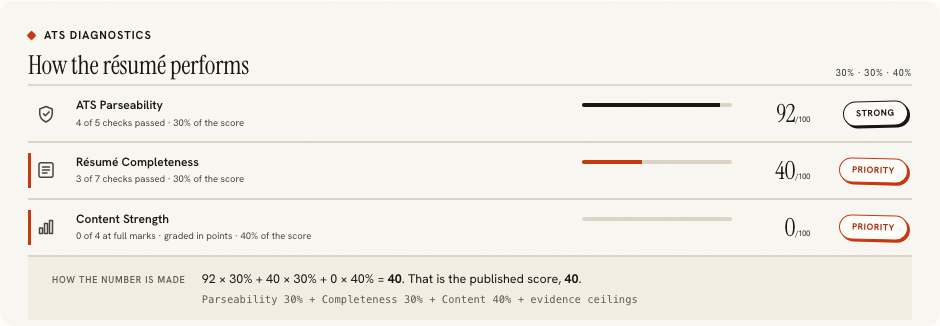
Keyword stuffing rests on one belief: that a machine at the other end counts how many times you said the word. Our scorer does not count it at all, and the arithmetic is printed on every report, so this is one piece of folklore that can be tested rather than argued about.
What the content dimension actually measures
Four graded rules, worth 100 points between them inside a dimension weighted at 40% of the score. Action-led achievement lines up to 30. Lines carrying measurable evidence up to 25. Evidence depth across roles up to 25. Readable volume up to 20. None of them counts a term, a tool name or a repetition.
The measurement, on a real document
A weak fixture was checked in the ATS résumé checker: skills present, project names present, no achievement lines. Parseability 92, completeness 40, content 0, published as 40. The vocabulary was fine. The evidence was absent, and the dimension that measures evidence returned nothing.
Why the trick also fails with a person
White text in a margin is still text. A reader who selects the page, copies it, or opens it in a different viewer sees it immediately, and what they see is somebody who tried to game the process. That is a worse outcome than a missing term, and it is irreversible.
The honest version of the same instinct
The instinct behind stuffing is sound: somebody may search for a word, and you want to be findable. The fix is to name the real tools, systems and qualifications inside the lines that describe the work you did with them. That is both findable and readable, and it is what ATS résumé keywords sets out in detail.
What a skills section is worth
Completeness gives 15 points to a skills section, and that check is satisfied by an ordinary one. Doubling its length earns nothing further. The composition question, and what belongs in it, is in the skills section guide and hard skills and soft skills.
Where the points actually are
In the achievement lines. Three or more action-led lines earn the full 30. Two or more lines carrying a measurable figure earn the full 25. Five or more evidenced lines across roles earn the full 25. That is 80 of the 100 in the largest dimension, and every one of them rewards writing about what you did. How to write experience bullets and quantifying achievements are the two pages that move those rows.
Where the belief came from
From a period when some systems really did rank by term frequency, and from a situation where nobody can see inside an employer's configuration to check whether it still happens. An untestable belief with a cheap remedy spreads easily, because following it costs an evening and disproving it costs access nobody has. Our scorer is the opposite case: the rules are printed on the report, so the claim that vocabulary earns points can be tested in a minute by checking a document made of nothing else. It measured 40, with the dimension that matters most returning zero, and that is as close to a disproof as this category allows.
What this page does not claim
That an employer's system ignores keywords. Somebody searching stored text is a real thing that happens, and we cannot see how any particular employer has configured their filters. What is claimed is narrower and checkable: our score contains no term-counting rule, a document of pure vocabulary measured 0 on the dimension that matters most, and the report printed the arithmetic that says so.
There is one more reason to abandon the tactic, and it is about your own time. Building a keyword list is a comfortable afternoon of work with no visible result, and rewriting four achievement lines is an uncomfortable hour with a measurable one. The checker will show you the second kind of change immediately, which is what what changed after one fix demonstrates on a real document, and the priced fix list makes the cheapest improvement obvious rather than guessable.
One reasonable objection deserves an answer. If a recruiter might search the stored text, does it not follow that more terms make you more findable. In a narrow sense yes, and the cost is the document a human then opens. A page carrying forty tools and no evidence answers the search and fails the read, which is the worst of both. Naming the tools inside the lines where you used them satisfies the search with the same words and leaves a document somebody can believe.
Check a document that is mostly vocabulary
The content dimension grades action-led lines, measurable evidence, depth and volume. A list of terms moves none of them.
Open the ATS checkerThe honest keywords guideQuestions
- Does white text in the margin work
- It is text, so an extractor reads it, and a person opening the file can select it and see it. It contributes nothing to our score, because nothing here counts vocabulary.
- What does the content dimension measure
- Four graded rules: action-led achievement lines up to 30 points, measurable evidence up to 25, evidence depth across roles up to 25, and readable volume up to 20.
- So keywords never matter
- The real words for your work matter, because a person may search the stored text for them. Putting them in the lines that describe the work is the version that also reads well.
- Would a skills wall raise my score
- Skills are one of the seven completeness checks, worth 15 points, and that check is satisfied by a normal skills section. A longer wall does not earn more.
- Why do people still recommend it
- Because it is easy advice to give and impossible to disprove without seeing inside an employer's system. Our scorer is open about its arithmetic, so here it can be disproved.
Conxfolio is a free set of four career tools: a résumé builder with 37 rendered layouts, an ATS résumé checker that prints its own arithmetic, a cover letter builder that traces every proof paragraph back to the line it came from, and a portfolio builder with 20 authored designs. There is no account to create, nothing is held back for a paid plan, and no language model is used anywhere in the product, so the readers, the score and the letter are deterministic code you can check.