Repairing a two-column résumé, in the order that works
A sidebar is the single most expensive layout decision on a résumé. Undoing it takes about an hour, in a fixed order.
— one column, then the design, then the check.
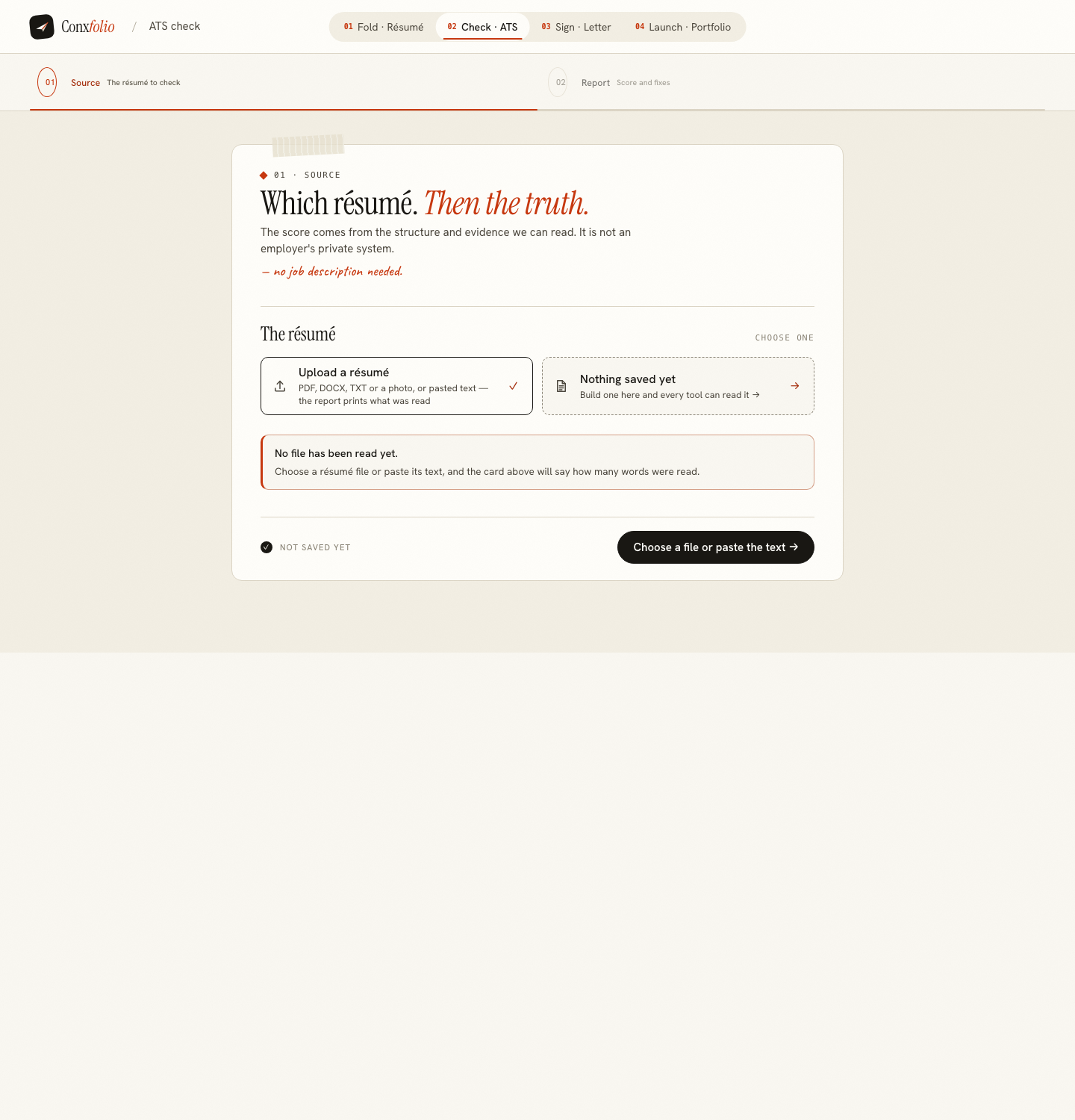
This is the repair people put off longest, because the document looks good and the damage is invisible. It takes about an hour and it goes in a fixed order.
Step one: measure the damage
Run the ATS checker on the current document and write down three numbers: words, lines and recognised headings. On a specimen this estate measured 162 words, 18 lines and 4 recognised headings; on a broken one, 48 words, 10 lines and 2 headings. Those three numbers are the before, and without them the rest of this is a feeling.
Step two: read the parseability findings
The report names what it detected. A table or multi-column pattern costs 22 points. A section heading with no readable content under it costs 24, or 8 if only one is affected. Decorative characters cost 8, unreadable glyphs 18. Those findings tell you whether the sidebar is the only problem or the first of three.
Step three: rebuild in one column
Import the old document into the résumé builder rather than retyping it. Whatever the reading recovers is reused, and the review shows what it could not fill, which is exactly the material the columns were hiding. What that review reports and refuses is in what the import review catches.
Step four: put the sidebar content where it belongs
Skills become a skills section. Contact details go into the body of the document rather than a band across the top, as the header guide sets out. Anything that was in the sidebar because it did not fit elsewhere is usually the thing to cut, and what not to put on a résumé covers that.
Step five: choose a design that stays single-column
21 of the 37 designs carry the ATS-safe mark, and it is a structural promise rather than a plain-looking one. What the mark actually guarantees is in what ATS-safe means on a design, and the argument for the arrangement is in single column against two column.
Step six: export, then measure again
Export the PDF and run the check on the exported file rather than on the text in the editor. The export is the thing an employer receives, and it is the only fair comparison with step one. A repaired document should report reading counts close to what is on the page, and the difference between the two runs is the whole proof.
What it looks like when it has worked
The reading counts match the page. A two-page document reports a few hundred words rather than fifty. The recognised headings are the ones you wrote, in the order you wrote them. The completeness checks that failed because a section was invisible now pass, which typically moves more points than the parseability deduction you set out to fix. And the content rules have something to grade for the first time, because the achievement lines are inside a role that was detected. That compounding is why an hour on layout often produces a larger change than an hour on wording.
What this page does not claim
That a one-column document is prettier. It is not, necessarily, and people attached to their sidebar are usually attached for a good reason. What is claimed is mechanical: a side-by-side arrangement makes the order of your text ambiguous, our checker deducts 22 points for detecting one, and the sections it hides cost their completeness points as well. The compounding is described in what a bad extraction costs.
One thing worth doing before you start, because it makes the hour feel shorter. Copy the old document's text into a plain notes file first. The purpose is to have the achievement lines somewhere you can read them without the layout in the way, rather than to retype from. Most people discover at that point that the sidebar was carrying half the résumé's evidence in a format nothing could read, which makes the rebuild a rewrite as well, and how to write experience bullets is the page for that part.
One thing to expect during the rebuild, because it surprises people. The one-column version will look longer, and it often is, because a sidebar was compressing content that now has to sit in the flow. That is not a regression. A second page carrying evidence is a better document than one page whose skills were unreadable, and the length question is weighed separately in why two pages is usually fine. Fix the extraction first and decide about the length afterwards, with a working document in front of you.
Measure the document before you change it
The report prints the words, lines and recognised headings it read. Keep that number; it is the before.
Open the ATS checkerSingle column against twoQuestions
- What does a second column cost
- 22 points of parseability when a table or multi-column pattern is detected, which is the largest single deduction in that dimension. Parseability is 30% of the score.
- Can I keep the sidebar and fix the extraction
- Not reliably. The order of the text in the file is what a reader follows, and a side-by-side arrangement is what makes that order ambiguous.
- Do I have to retype everything
- No. Import the old document; whatever the reading recovers is reused, and the review shows what it could not fill.
- Which designs are safe
- 21 of the 37 designs carry the ATS-safe mark, which is a structural promise about single-column layout and predictable headings.
- How do I prove the repair worked
- Run the check again on the exported file and compare the reading counts with the ones you kept from step one.
Conxfolio is a free set of four career tools: a résumé builder with 37 rendered layouts, an ATS résumé checker that prints its own arithmetic, a cover letter builder that traces every proof paragraph back to the line it came from, and a portfolio builder with 20 authored designs. There is no account to create, nothing is held back for a paid plan, and no language model is used anywhere in the product, so the readers, the score and the letter are deterministic code you can check.