One document, several designs, and what actually changes
A design switch is a rendering decision, not an edit. Here is what moves and what stays fixed when you change one.
— the words are yours; the design is a view of them.
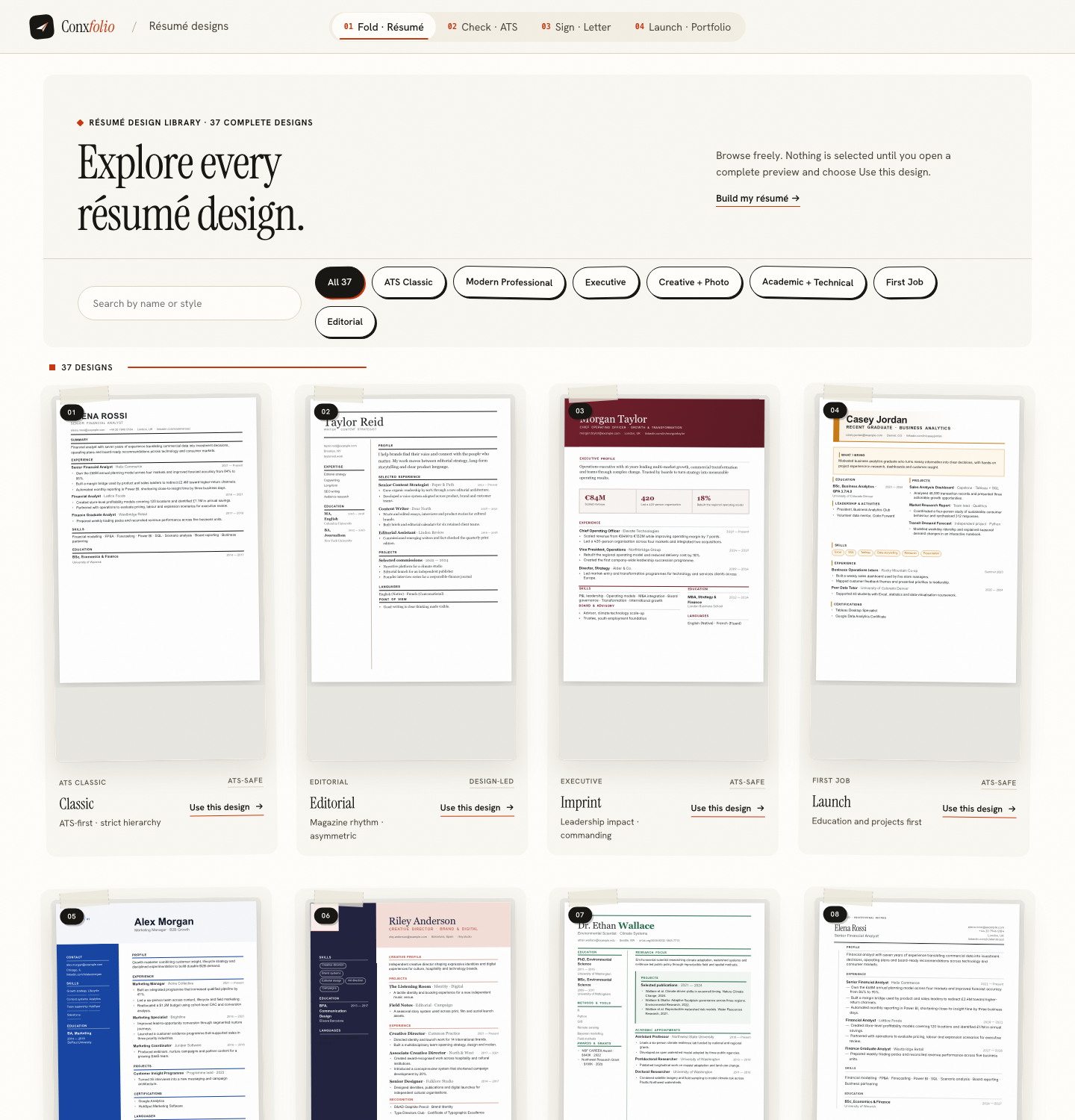
People treat a design change as though it were a rewrite, and it is not. The document and its rendering are separate things here, which is worth understanding because it makes trying four designs a two-minute exercise rather than an afternoon.
What a design is in this product
A complete rendering of your document rather than a theme applied to a template. Each of the 37 is authored, which is what what an authored design means sets out, and a design is not a rewrite explains why the two stay separate.
What changes when you switch
Typography, spacing, the treatment of headings, how dates sit beside roles, and where the page breaks fall. That last one is the practical surprise: a document that fits on one page in a compact design runs to two in a generous one, with the same words. Margins and spacing are the lever, and white space and the second page is the page for it.
What never changes
Your words. Every section, every line, every date. Switching design does not drop a field, reorder your roles or shorten a sentence, because the content is held separately from the rendering.
The one thing a design can affect in the score
Parseability, and only parseability. A layout that puts a sidebar beside your experience makes the reading order ambiguous, which costs 22 points of that dimension. Completeness and content are about what you wrote and are untouched. The measurement is in what a bad extraction costs, and the design promise in what ATS-safe means on a design.
A sensible way to try four
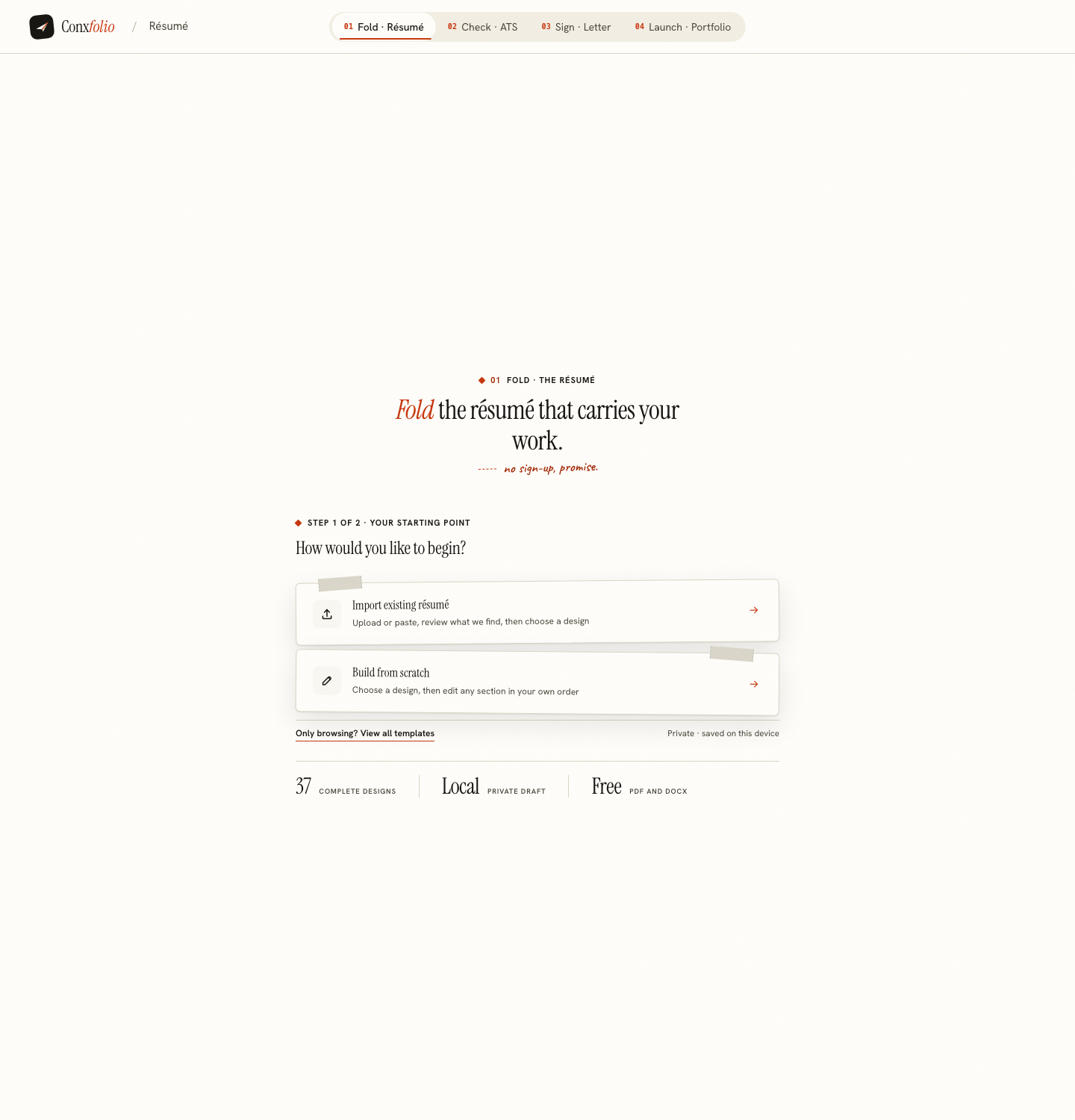
Finish the writing in the résumé builder, then open the design step and pick one from each family: an ATS-first layout, a modern one, an editorial one and a compact one. Look at where each breaks the page and how the oldest role is treated. Export the two you like and read them as files rather than as previews, because the export is the document.
Choosing, once you have four in front of you
The reader is the tiebreak. A conservative sector, a public body or an international application rewards the plainest of the four; a studio does not. The decision procedure is in choosing between two designs, and the typography and colour halves in typography on a résumé and colour on a résumé.
The families, and what they are for
The library groups its designs, and the grouping is a shortcut rather than a taste statement. The ATS-first family is the safe default for an unknown employer and a public body. The professional and executive families suit documents with a long history to lay out. The creative and editorial families suit work where the document is partly a sample. The academic and technical families handle documents with publications or long skill inventories. Picking a family first and a design second turns thirty-seven options into four, which is the difference between a five-minute decision and an evening.
What this page does not claim
That a design gets you read. Nothing here measures that, and a beautiful document with four vague lines under each role is a weaker application than a plain one with evidence. Design is the last decision rather than the first, and it is cheap precisely because it is reversible: the words are unaffected, both exports are free, and you can change your mind after sending one.
One practical caution about printing, since a design that looks excellent on a screen can behave differently on paper. Most printers drop background colours by default, so a design that fills a band with colour prints as a white band with pale text inside it. Look at the export on paper before you commit to a colour-heavy layout for an interview copy, which is the argument in printing a résumé, and choose the page format before exporting rather than after.
One last practical benefit of the separation between content and rendering. It means a design decision can be deferred indefinitely without blocking anything. You can write the entire document, run the check, fix the findings and be ready to apply, all before choosing how it should look, and then pick a design in five minutes. People who choose the design first usually spend that time twice, because a layout chosen before the content exists rarely survives contact with a long third role.
Try four and keep one
Switching design re-renders the same document. Nothing is retyped and nothing is lost.
Open the résumé builderChoosing between two designsQuestions
- Does changing design rewrite my text
- No. The content and the rendering are separate. A design change re-renders the same words.
- Can I switch after exporting
- Yes, and then export again. Both exports are free in every design, so trying four costs nothing.
- Does the design change my score
- It can change parseability, because layout decides how cleanly the text extracts. It cannot change completeness or content, which are about what you wrote.
- What does the ATS-safe mark mean
- A structural promise: single column, predictable headings, and a layout that extracts in one order. 21 of the 37 designs carry it.
- Are any designs paid
- No. All 37 are free, with both exports and no watermark.
Conxfolio is a free set of four career tools: a résumé builder with 37 rendered layouts, an ATS résumé checker that prints its own arithmetic, a cover letter builder that traces every proof paragraph back to the line it came from, and a portfolio builder with 20 authored designs. There is no account to create, nothing is held back for a paid plan, and no language model is used anywhere in the product, so the readers, the score and the letter are deterministic code you can check.