The letter, four steps, and what each one asks of you
The letter builder has four steps and only one of them is writing. Here is what each asks for, walked end to end.
— it selects; it does not compose.
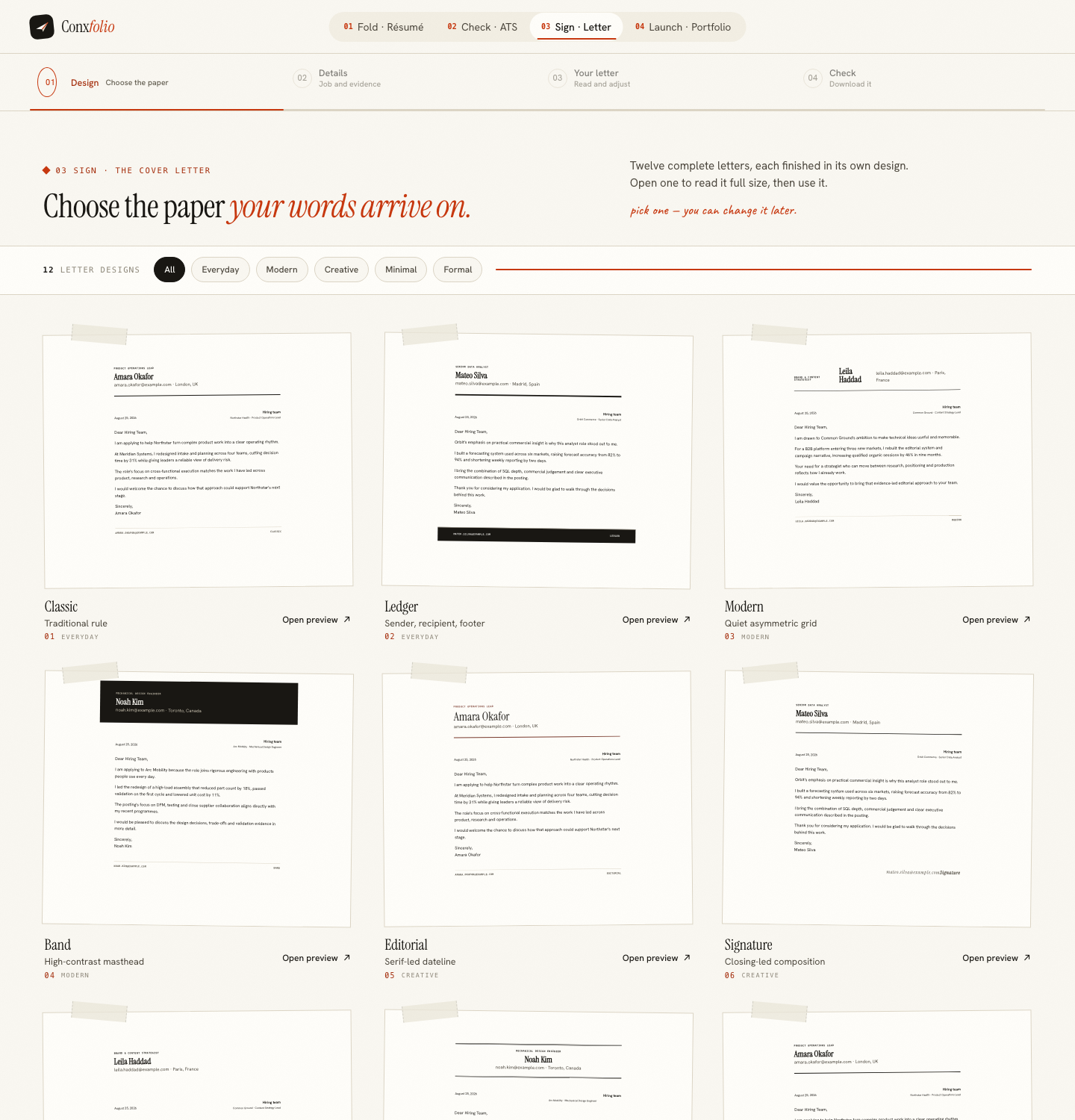
The cover letter builder has four steps and only one of them involves typing prose. What follows is the journey as it runs, with what each step actually asks for.
Step 01, Design: choose the paper
The gallery shows complete letters rather than thumbnails, which is deliberate and is argued in why a letter gallery shows whole letters. Pick one and change it later if you want; the decision is reversible and costs nothing.
Step 02, Details: the job, and your evidence
The company, the role and the posting, plus your motivation in your own words and a tone. The posting is read to find what the employer is asking for. Your evidence comes from the résumé already in this browser, which is why the letter is quick: the slow part was done when you wrote the document.
What the engine does with that
It selects. Every evidence paragraph is a sentence from your own résumé, carried with a reference to the line it came from, so the surface can show where each claim came from. It never composes a new claim. Where it cannot find real evidence it returns fewer paragraphs rather than padding, which is described in why a letter only claims what the résumé shows.
Step 03, Your letter: read and adjust
Every block is an editable field with its own word count, and blocks can be added, removed and reordered. The three voices are direct, warm and formal; changing voice rewrites the letter and keeps the previous draft as a version first, so nothing is lost by trying one. Versions are covered in versions and restoring a draft.
Step 04, Check: the part worth slowing down for
The review reports the letter's length against a guide, whether it names the opportunity, whether it carries a number, and the gaps: requirements in the posting your evidence cannot support, named and unclaimed. If there is no name on the letter, it says so. That refusal is the unsigned-letter rule.
Then the export
PDF and DOCX, free, in any of the 12 designs. If you would rather paste it into the message body, that decision is weighed in the cover letter in the email body, and the envelope around it in emailing a résumé.
What to change before you export
Three things are worth a minute each. The opening, because a letter that names the role and the company reads as written for this application rather than adapted to it. The order of the evidence paragraphs, because the strongest one should answer whatever the posting put first. And the closing block, which is where a required detail goes if the advert asked for one. Every block is an editable field with its own word count, so all three are direct edits rather than a rewrite, and the previous draft is kept as a version if you change your mind.
What this page does not claim
A time. The slug says twelve minutes and we have not stood over anybody with a stopwatch, so this page will not pretend to a measurement it did not take. What is true is structural: three of the four steps are choices rather than writing, the evidence paragraphs are selected rather than composed, and the only part that takes real thought is the motivation sentence, which nothing here will write for you.
There is a reason the product will not write that sentence, and it is worth stating. A motivation paragraph is the one part of a letter that cannot come from a résumé, because the résumé does not contain your reason for wanting this job. A generator would produce a plausible one, you would send it, and you would be asked about it in an interview. The engine returns a shorter letter instead, which is the same principle as what we refuse to generate and the reason the gaps list exists at all.
One final thing the four steps make possible that is worth using. Because the evidence comes from the résumé rather than from you, a weak letter is usually a signal about the document rather than about your writing. If the draft comes back with two thin paragraphs, the material is not in the résumé yet, and the repair is in the builder rather than in the letter. That diagnosis arrives free with every draft, and it is more useful than any amount of rewriting at the letter stage.
Walk the four steps
Choose the paper, give it the posting, read the draft it selected, and check it before exporting.
Open the cover letter builderReading your own gaps listQuestions
- What are the four steps
- 01 Design, choose the paper. 02 Details, the job and your evidence. 03 Your letter, read and adjust. 04 Check, then download.
- Does it write the letter for me
- It selects sentences out of your own résumé as evidence, each carried back to the line it came from. It does not compose new claims and it does not invent a reason for wanting the job.
- What happens to a requirement I cannot evidence
- It is listed as a gap and never asserted. On a measured run the product named the requirements the evidence could not support.
- Can I edit the paragraphs
- Yes. Every block is an editable field with its own word count, and blocks can be added, removed and moved.
- What if I have not signed it
- The product says so. A letter with no name on it is reported as one that will go out unsigned.
Conxfolio is a free set of four career tools: a résumé builder with 37 rendered layouts, an ATS résumé checker that prints its own arithmetic, a cover letter builder that traces every proof paragraph back to the line it came from, and a portfolio builder with 20 authored designs. There is no account to create, nothing is held back for a paid plan, and no language model is used anywhere in the product, so the readers, the score and the letter are deterministic code you can check.