The four things this product will not write for you
A tool that cannot invent has nothing to invent with. That is a design decision rather than a missing feature.
— a shorter letter is better than a fictional one.
The interesting part of a tool is often what it will not do. Here are four refusals, each of which could have been a feature, and the reason for each.
One: it will not invent work history
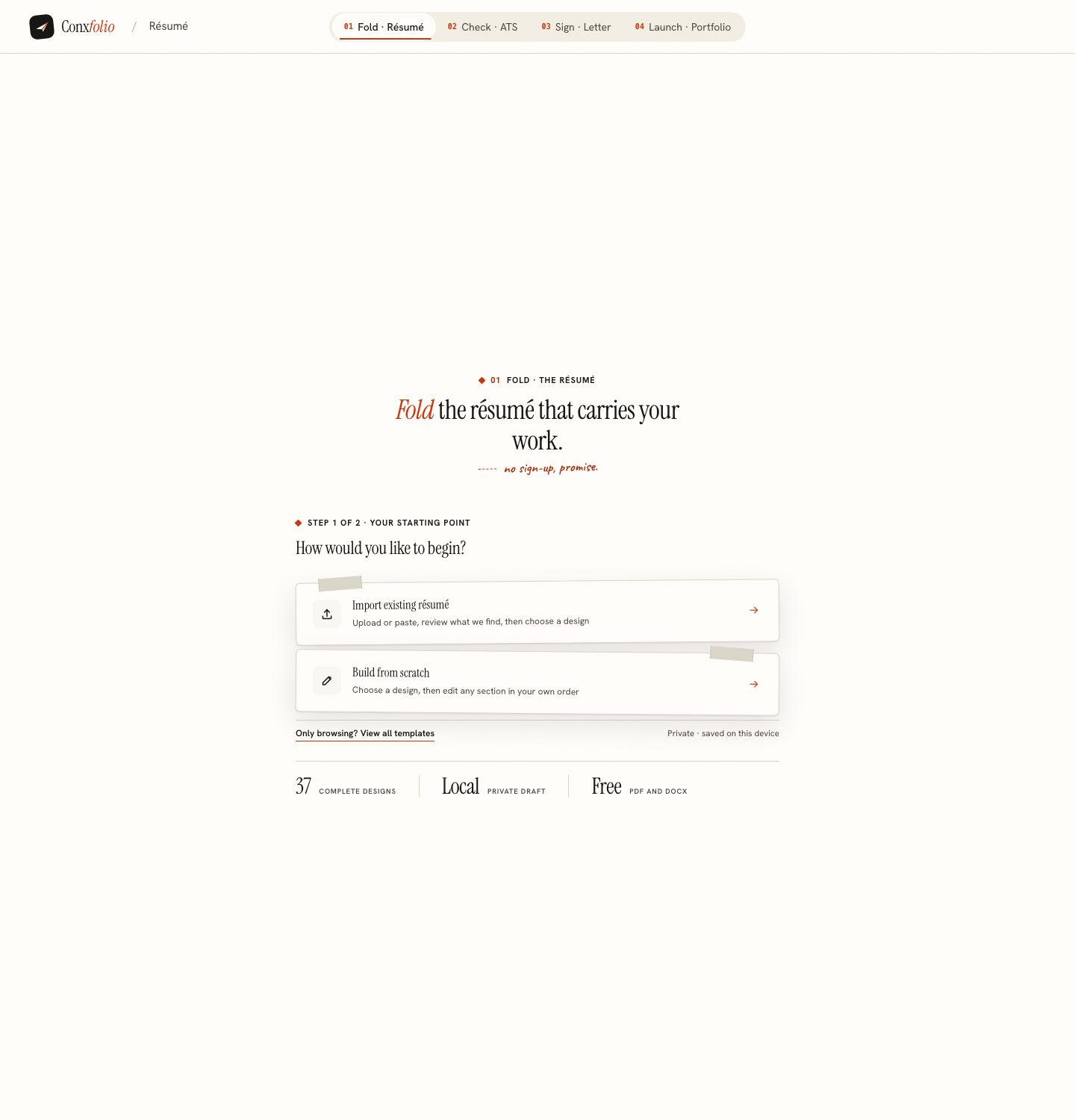
Import a document into the résumé builder and the reading fills what it can read. A field it could not read stays empty and is reported as not found. Every string a specialist emits is checked in code to be a span of your own document, and a value that fails that check is dropped and counted, which is described in dropped fields and why they are counted.
Two: it will not write your achievements
The content dimension grades action-led lines, measurable evidence and depth, and it would be trivial to offer to write those lines for you. Nothing in this product knows what you did. A generated achievement is a sentence about a fictional person with your name on it, and it survives exactly until somebody asks a follow-up question.
Three: it will not invent a reason for wanting the job
The cover letter builder selects evidence out of your own résumé. The motivation paragraph is the one thing a résumé cannot supply, so the product asks you for it and writes nothing if you say nothing. That is the same refusal described in why a letter only claims what the résumé shows.
Four: it will not claim what your evidence cannot support
Requirements in a posting that your résumé does not evidence come back as gaps, named, and are never asserted. Where evidence runs out, the letter is shorter rather than padded. What to do with that list is in reading your own gaps list.
How this is possible at all
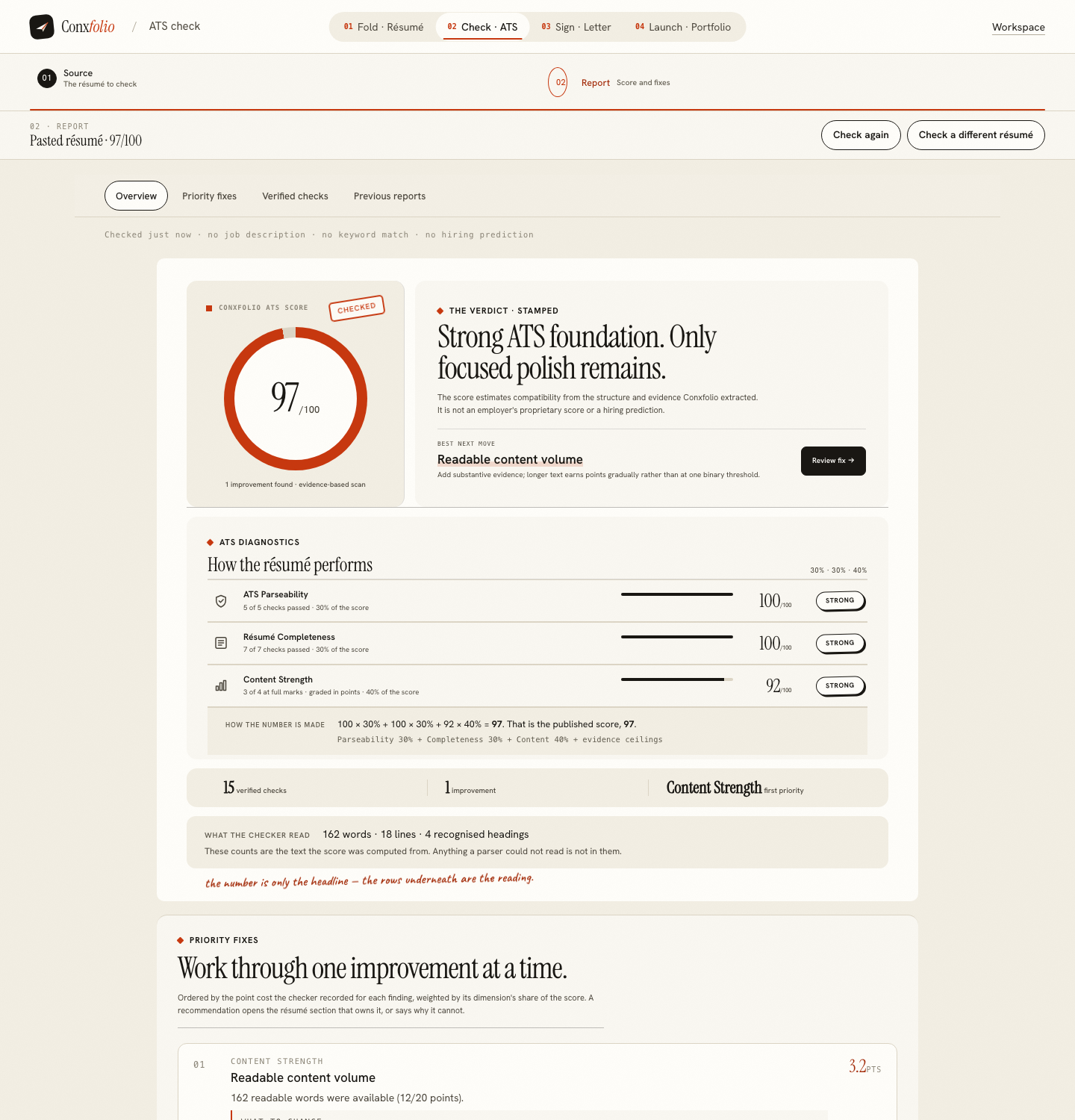
Because there is no model anywhere in the product. The readers, the scorer and the letter engine are ordinary deterministic code, which is set out in how the résumé reader works without a model. A system with nothing to hallucinate with cannot hallucinate, and that is a property of the architecture rather than a promise about behaviour.
What you get instead
Structure, measurement and selection. The checker tells you which rule is failing and what fixing it is worth. The letter finds the evidence you already have and shows where each sentence came from. The builder renders whatever you write in 37 designs. The writing remains yours, which is the point.
What this costs the product, honestly
Two things. It is slower to start from nothing, because there is no button that fills the page while you read it. And it will disappoint anybody arriving to have a résumé written for them, which is a real segment of the people who look for a tool like this. Those costs are accepted deliberately. A product that produced plausible sentences about your career would be easier to use on the first evening and worse in the room where somebody asks about the best line on the page, and only one of those two moments belongs to us.
What this page does not claim
That generation is always wrong, or that other products are dishonest. Some people use a generator as a first draft and then rewrite it properly, and that can work. What this product will not do is put words about your career into your mouth by default, because the cost of that lands on you, in a room, some weeks later.
The practical consequence is that a blank field here stays blank, which some people find unhelpful at first. It is the same discipline that makes the import trustworthy: if the product were willing to fill a gap with something plausible, you could never be sure which parts of your own document you had written. Why empty stays empty is the page about that trade, and evidence you forgot you had is the one about filling the gaps truthfully.
A last point about where this leaves you. The product will do the mechanical work: read your file, sort it into fields, render it in any design, measure it, find your own sentences for a letter, and build a page from the same material. What it will not do is know anything about your career that you have not told it. That division is stable and it is easy to explain, which is more than can be said for a tool whose boundary moves depending on what it has been asked.
Start from something true
Import what you have or fill it in yourself. Nothing here writes a sentence about work you did not do.
Open the résumé builderHow the reader works without a modelQuestions
- Does Conxfolio use a language model
- No, nowhere. The readers, the scorer and the letter engine are deterministic code with no model call and no vendor.
- So what writes the cover letter
- Selection. The engine picks sentences out of your own résumé and carries each back to the line it came from. It composes no new claim.
- What happens when there is no evidence
- The letter comes back with fewer paragraphs, and the requirement is listed as a gap rather than asserted.
- Why not offer generation as an option
- Because the output would be about a career you would then have to defend in an interview. A shorter honest letter is a better document.
- Does the import invent missing fields
- No. A field it could not read stays empty and is reported as not found, and a value that fails its source check is dropped and counted.
Conxfolio is a free set of four career tools: a résumé builder with 37 rendered layouts, an ATS résumé checker that prints its own arithmetic, a cover letter builder that traces every proof paragraph back to the line it came from, and a portfolio builder with 20 authored designs. There is no account to create, nothing is held back for a paid plan, and no language model is used anywhere in the product, so the readers, the score and the letter are deterministic code you can check.