Why an invented line is expensive later rather than now
Exaggeration on a résumé is cheap at the moment of writing and expensive at every point afterwards. That asymmetry is the argument.
— you will be asked about the best line on the page.
This is not a page about ethics. It is a page about timing, because the cost of an exaggeration and the moment of writing it are a long way apart, which is exactly what makes it tempting.
Where the line does not fail
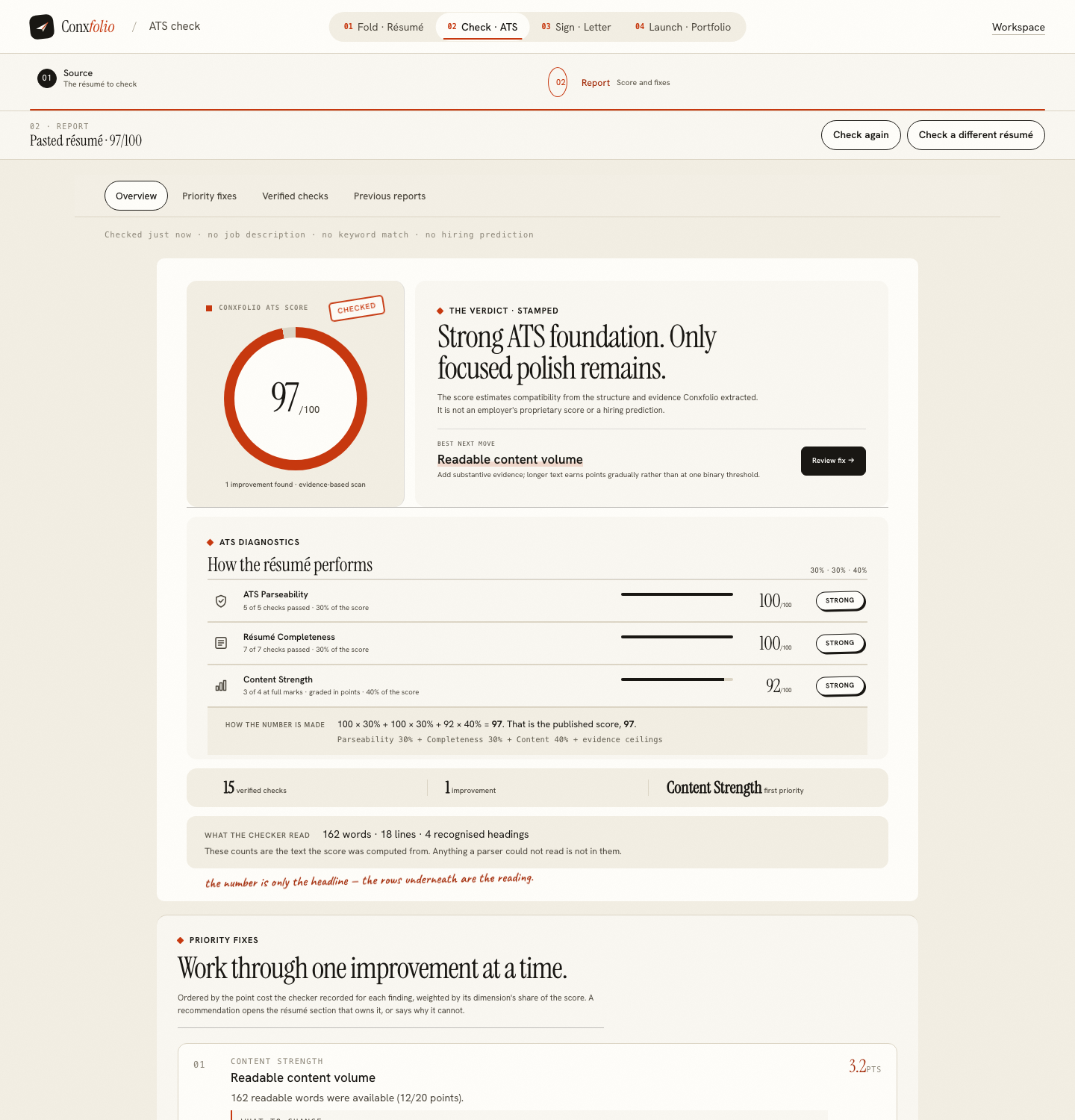
Not in the checker. Its content rules reward a line that begins with an action and carries a figure, and an invented line satisfies both. Not in the reading, which quotes your document rather than questioning it. And not in the export. Everything mechanical will pass it through.
Where it does fail
In a room, weeks later, because the strongest line on the page is the one people ask about. A number invites a follow-up: how was it measured, over what period, what did you change. Somebody who did the work answers those without effort. Somebody who did not begins to qualify, and the qualifying is what is noticed rather than the answer.
The asymmetry
Writing the line costs nothing. Defending it costs an interview, and occasionally a job after it has started. The file also stays on record with an employer, which is a quiet long tail people rarely think about while typing.
The three honest repairs
For a figure you are unsure of, say about, and keep the shape of the number right. For a title you did not formally hold, write the real title and describe the scope underneath, where a reader is looking anyway. For work a team did, name your part precisely, which is the whole of how to describe a team effort.
Why the tool cannot help you here, and how it does
Nothing in the résumé builder generates a claim, so there is no line in your document that you did not write or import. That does not stop you exaggerating, and it does remove the commonest route to it, which is accepting a generated sentence because it sounds good. The reasoning is in what we refuse to generate.
The letter inherits whatever you wrote
The cover letter builder selects sentences out of the résumé, so an invented line becomes an invented paragraph with a traceable reference to itself. The engine's own discipline about gaps, described in the gaps list is the interview, only helps if the source document is true.
The grey area, and where the line actually is
Rounding a figure you can explain is fine. Describing scope you genuinely held under a title somebody else was given is fine, as long as the official title is on the page. Claiming a result your team produced, with your own verb on the front, is fine. What is not fine has one property in common: you could not answer a follow-up question without inventing a second thing. That is a usable test at the moment of writing, and it is more reliable than any rule about percentages, because it simulates the exact situation where the line will be tested.
What this page does not claim
That employers verify everything, or that they verify nothing. Practice varies by sector and by country, and we have no data on it and will not invent any. The argument here does not depend on being caught by a check: it depends on being asked a question, which happens in every interview.
The practical version of all of this is duller than the moralising version, and more useful. Most people who exaggerate are compensating for a document that undersells them, which is a writing problem rather than a character problem. The work is usually there and unwritten, which is what evidence you forgot you had is about, and the numbers are usually obtainable, which is what numbers you can actually get is about. Both produce lines you can defend.
One closing thought about why this page exists at all on a tool's website. A product that scores documents has an obvious incentive to stay quiet about a score that cannot detect honesty, because the silence makes the number look more powerful. Saying it plainly is cheaper in the long run: a reader who knows what the measurement covers can use it properly, and a reader who assumes it validates content will be disappointed at the worst possible moment.
Write the true version instead
Nothing here generates a claim, so every line in the document is one you can defend.
Open the résumé builderEvidence you forgot you hadQuestions
- Can the checker detect a lie
- No, and it does not claim to. It measures whether a line is written as evidence, not whether the evidence is true.
- Where does an invented line actually fail
- In an interview, because the strongest line on the page is the one people ask about. A number you cannot explain is worse than no number.
- Is rounding a figure a lie
- Say about, and keep the shape of the number honest. A figure you can explain is defensible whether or not it is exact.
- What about a job title I did not officially hold
- Write the official title and describe the scope in the line beneath it. The scope is the part a reader cares about.
- Does the letter builder protect me here
- It selects sentences from your own résumé, so an invented line in the résumé becomes an invented line in the letter. The discipline has to start with the document.
Conxfolio is a free set of four career tools: a résumé builder with 37 rendered layouts, an ATS résumé checker that prints its own arithmetic, a cover letter builder that traces every proof paragraph back to the line it came from, and a portfolio builder with 20 authored designs. There is no account to create, nothing is held back for a paid plan, and no language model is used anywhere in the product, so the readers, the score and the letter are deterministic code you can check.