Why a field it could not read is left blank and reported
A tool that fills gaps with plausible text produces documents nobody proofreads. Here the gap is left, and named.
— a blank you can see beats a sentence you did not write.
Every builder faces the same temptation: a field it could not fill, and a plausible sentence that would make the page look complete. Filling it is the single worst thing a résumé tool can do, and here is why.
Placeholder text gets sent
A blank field is obviously unfinished, so it gets fixed. A sentence that reads like a summary looks finished, so it gets skimmed, and then it gets exported and attached and sent. Every recruiter has read a document that still says something about a results-driven professional, because nobody noticed a sentence that was already there.
What happens here instead
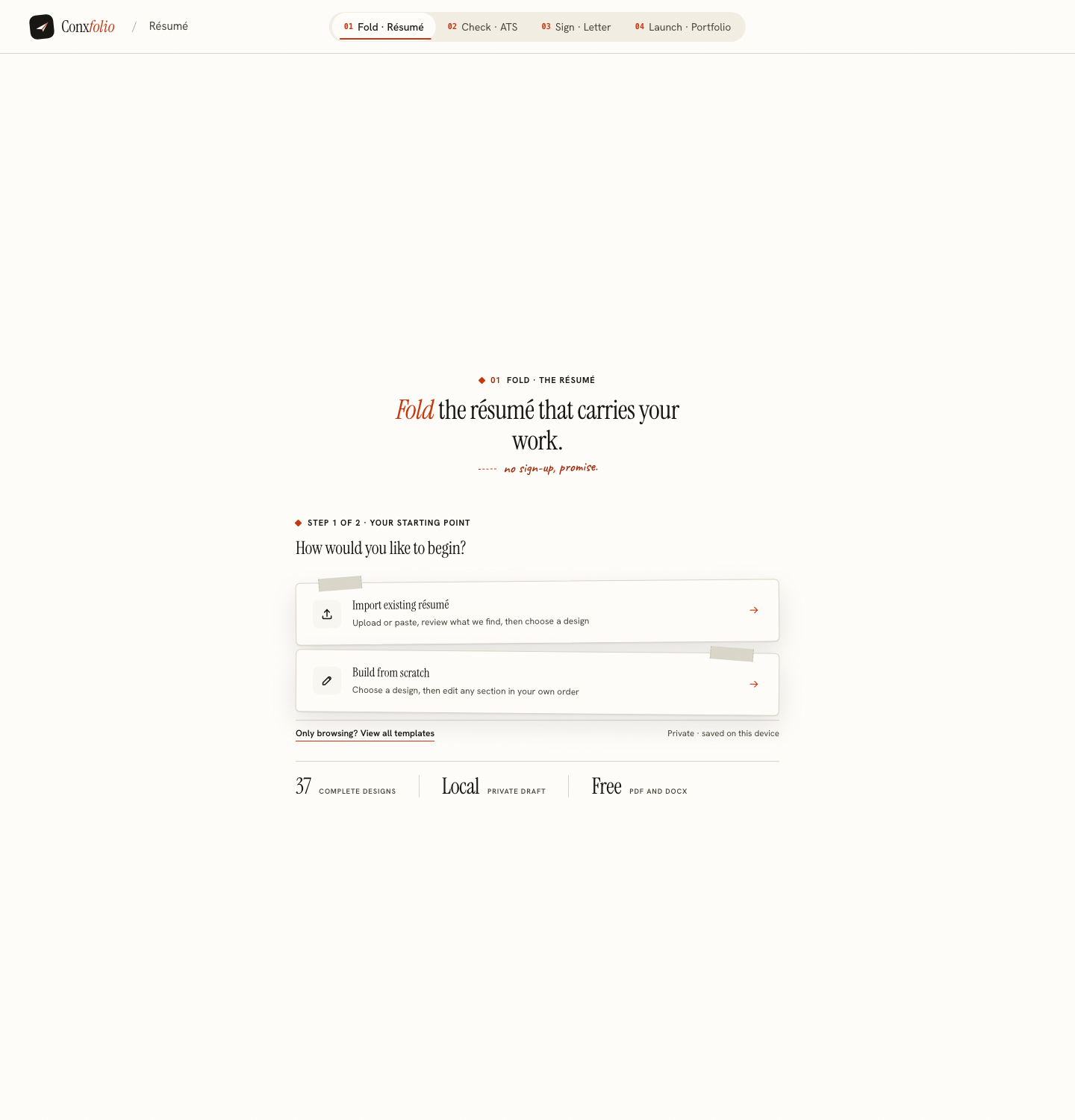
Import a document into the résumé builder and the review names what it filled and what it did not find. On a measured import it reported several fields as not found rather than putting anything in them. The mechanism behind that is in what the import review catches.
The rule underneath it
Every string a specialist emits is checked in code to be a span of your own document. A value that fails that check is dropped and counted rather than kept, which is described in dropped fields and why they are counted. There is no path by which a sentence can enter your document without having been in the source or typed by you.
Uncertainty becomes a question, not a guess
Where the reading is unsure, it asks, and nothing is applied until the question is answered. That is a slower interaction than filling it in and a much better one, and it is covered in reading questions instead of guesses.
How the checker treats a blank
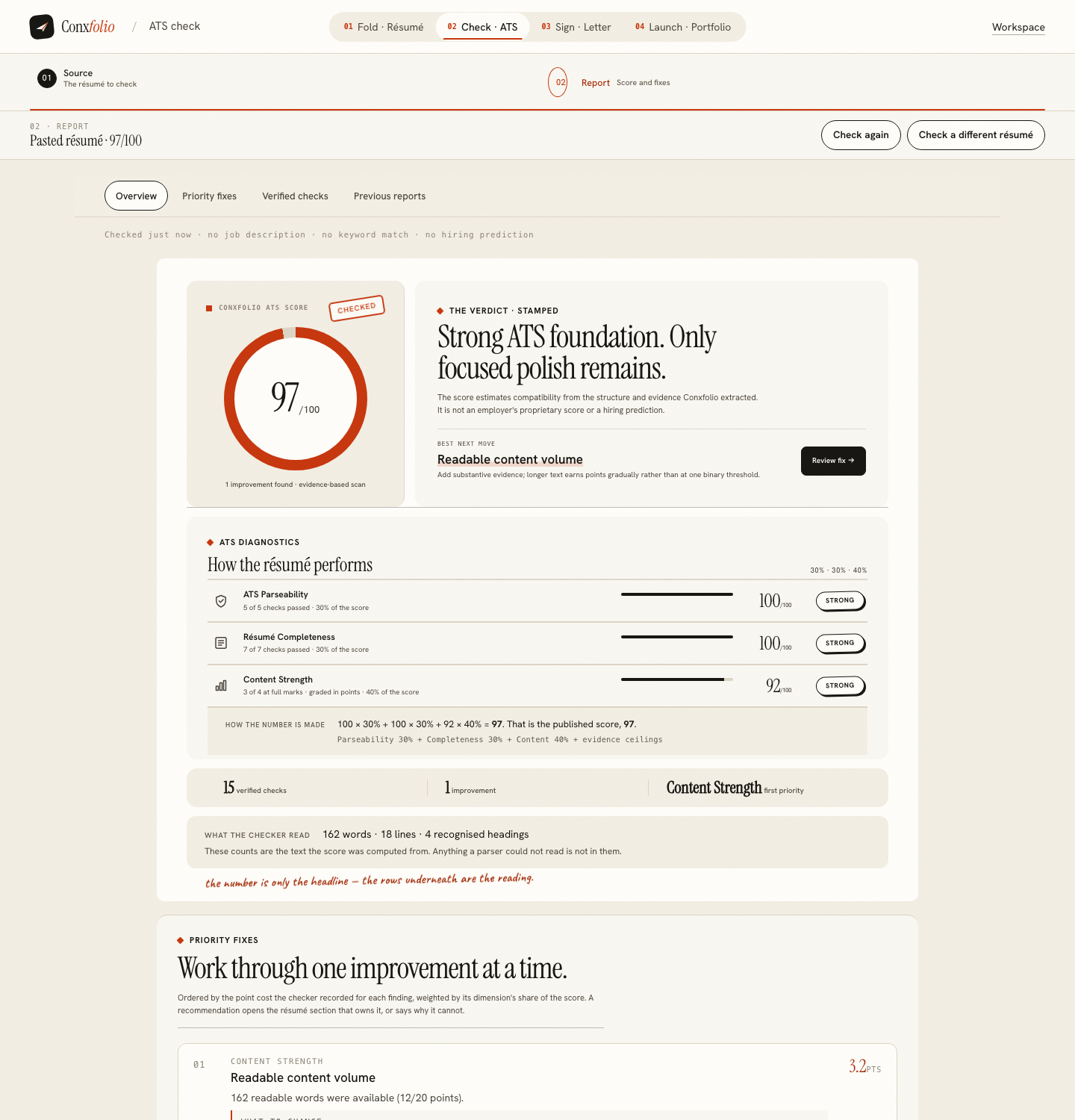
The ATS checker reports it with a price. Experience is worth 30 of the completeness 100, education 15, skills 15, email 15, summary 10, identity 10, phone 5. A missing section is a named finding, so you can decide whether it is worth filling rather than discovering the absence later.
The one case where a blank is correct
A section you genuinely have nothing for. A first-job résumé with no employment history is better with a strong projects and education section than with an Experience heading over nothing, which costs parseability points as well as completeness. A résumé with no experience is the page for that shape.
The same rule inside the letter
It applies there too, and it is more visible. Where the letter engine cannot find real evidence for a requirement, it returns fewer paragraphs rather than writing a paragraph of general enthusiasm to fill the space. A shorter letter with three evidenced paragraphs is a better document than a full page with two invented ones, and the review says so by reporting the length against a guide rather than against a target. That consistency matters: a product that refused to invent in one place and padded in another would be making a style choice instead of a commitment.
What this page does not claim
That blanks are good. An empty experience section is a real problem and the report says so. The claim is narrower: a visible gap is a problem you can solve, and an invented sentence is a problem you cannot see. Given a choice between the two, the product leaves the gap, which is the same principle as what we refuse to generate.
There is a version of this that applies to your own writing, and it is worth carrying away. When you cannot think how to describe a role, the temptation is to write a general sentence about responsibilities so that the space is no longer empty. That sentence will still be there in three weeks, and it will still be saying nothing. Leaving the space and coming back is the better habit, and writing the line you are avoiding is about the case where the space is empty for a reason.
One last observation about how this feels in use. The first import is the moment people notice it, because a review reporting five fields as not found looks like a failure of the reader. It is usually a fault of the source document instead: fields that were in a header region, a sidebar, or a table. The report is telling you something true about the file you have been sending, which is more useful than a filled form would have been, and the import review page explains how to read it.
See what it could not fill
The review lists every field it read and every field it did not, rather than filling the difference with something plausible.
Open the résumé builderWhat the import review catchesQuestions
- Why not fill a gap with an example
- Because example text looks finished. A document with a plausible sentence in it gets sent; a document with a visible blank gets fixed.
- How do I know what was left empty
- The review names it. Fields that were not found are reported as not found rather than omitted silently.
- What if the reading got something wrong
- Correct it in the review. Everything the reading produced is editable before it becomes your document.
- Does the checker punish a blank
- It reports it. The seven completeness checks each carry point values, so a missing section shows up as a named finding with a price on it.
- Is a summary field allowed to stay blank
- Yes. A summary is worth 10 points of completeness and is genuinely optional, which is its own decision.
Conxfolio is a free set of four career tools: a résumé builder with 37 rendered layouts, an ATS résumé checker that prints its own arithmetic, a cover letter builder that traces every proof paragraph back to the line it came from, and a portfolio builder with 20 authored designs. There is no account to create, nothing is held back for a paid plan, and no language model is used anywhere in the product, so the readers, the score and the letter are deterministic code you can check.