How to put a portfolio website online without hosting it
No server to rent, no static host to configure and no build step. Three steps to a real page, and one email code at the moment you claim the address.
— the page, not the plumbing.
The usual gap between having work worth showing and having a page showing it is not design. It is infrastructure: a host, a domain, a build step, a deploy, a certificate, and a set of decisions that have nothing to do with your work. Most people stop somewhere in the middle of that list.
The portfolio builder removes the list. Three steps, and none of them is a server.
Step 01, choosing a world
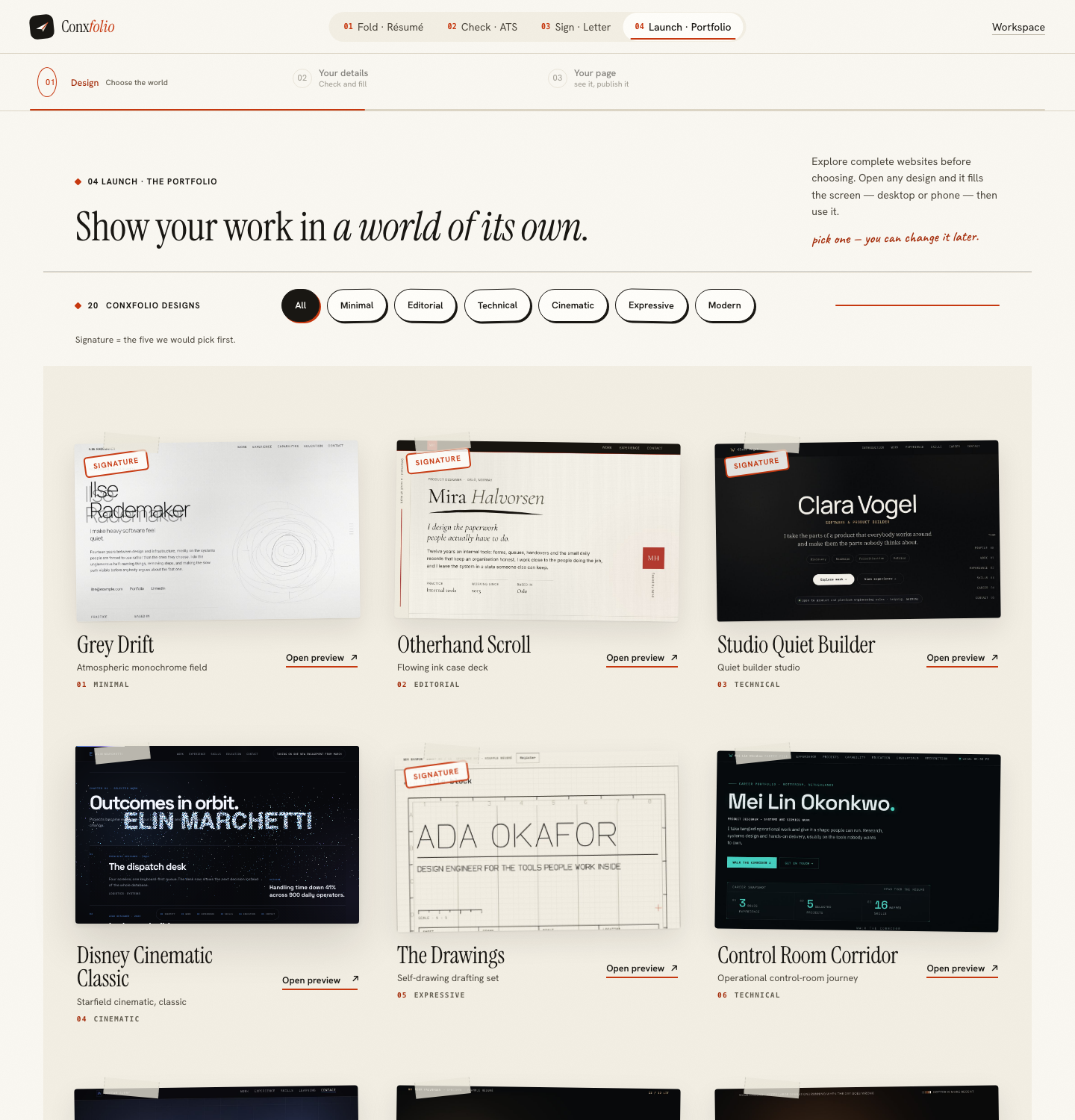
The gallery holds 20 designs across 6 directions: Minimal, Editorial, Technical, Cinematic, Expressive and Modern. Each one is a complete page that was drawn and built rather than a theme applied to a shell, which is what an authored design means and why they do not look like each other.
A card opens full size, with Desktop and Phone views of the same page, so the judgement you make is about a page rather than a thumbnail. The choice is reversible: changing design later leaves your entries alone.
Step 02, your details
The material comes from the roles, projects and outcomes already in your résumé. The step says so at the top: everything below came from your résumé, correct anything, switch off what should not be on the page. Sections carry their own counters, and empty fields do not print.
A project here is a name, a year and one line about what changed, with an optional description, link, image and tags. That shape is deliberate, and the guide on what to put in a portfolio covers choosing between entries.
Step 03, the page itself
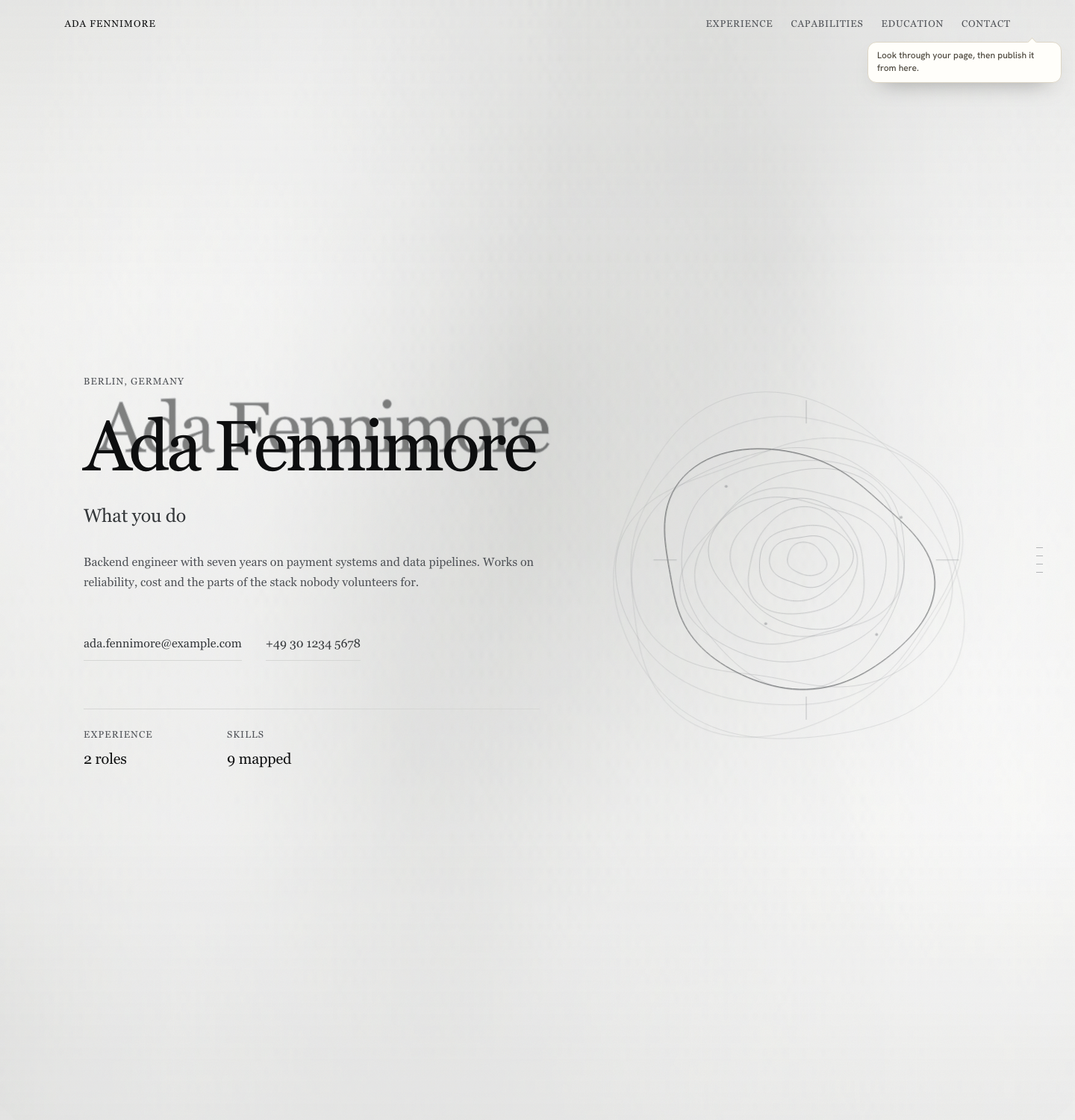
The third step opens your own page over the builder, rendered, with a Desktop and Phone switch and a control to change design. This is the page, not a preview of a page, which is the point: the thing you approve is the thing that goes out. The phone frame renders at 390 pixels, which is covered in phone width is the page that publishes.
Publishing, and the one email
Publish opens a sheet over the page. It states what it needs: two things before publishing, an address and a proven email. The address field takes lowercase letters, digits and dashes, between 3 and 63 characters, and it is checked against a reserved list and the addresses already taken. Checking it directly over its own endpoint returns a plain answer: a free name comes back available, a two-letter name comes back as an invalid format, and words like admin and resume come back as reserved.
Then one code is sent to an email address, and entering it completes the claim. The sheet says why in one clause: we send one code to prove it is you, nothing else. This is the only place in the entire product that asks for an email, and it asks at the moment it becomes necessary rather than at the door.
The sheet also states that the page is private and noindexed until you press Publish, so nothing is exposed while you are still deciding. Taking it down again is covered on unpublishing a portfolio.
What this does not give you
It does not give you your own domain name. The address is a name under the site's own domain, which is the subject of a portfolio address without buying a domain. It does not give you arbitrary pages, a blog engine or custom code, because the designs are finished pages rather than a framework. And it does not write your entries: a project you have not done will not appear because a builder wanted the section to look full.
When hosting is the better answer
If you want a site with many pages, your own domain from the first day, a writing habit, or code you control, rent hosting and build it. That is a genuinely different project with a genuinely better outcome for those goals. This is for the common case, which is one good page about your work, online this evening.
What goes on the page
Fewer things than you expect. Three or four pieces of work, each with a name, a year and one line about what changed, will read better than eleven entries with nothing said about any of them. The builder takes the material from your résumé precisely so that the editing work is subtraction rather than invention, and the sections carry counters so you can see what is switched on.
If the work is confidential or unphotographable, say what changed rather than showing the artefact. The guide on case studies covers writing an entry when the output cannot be shown, and the one on how many projects covers the count. The page renders at desktop and phone width before anything is public, so both readings are checked.
Build the page, skip the plumbing
20 authored designs across 6 directions, built from the work already in your résumé. Free.
Open the portfolio builderLook at the designsQuestions
- Do I need to buy hosting
- No. The page is served from here once you publish it, so there is no server to rent, no static host to configure and no deploy step.
- Do I need to write any code
- No. The designs are complete pages that render your entries. There is no template language and no build.
- Why does it want an email address
- Only to claim the address. A public address has to belong to somebody, so a one-time code is sent to prove the claim. It is the only place in the whole product that asks for an email.
- Is the page public before I publish it
- No. The publish sheet says it plainly: the page is private and noindexed until you press Publish.
- Can I take it down again
- Yes. Unpublishing is a control on the same step, and it needs the session that claimed the address.
- What does the page cost
- Nothing, including publishing and the address.
Conxfolio is a free set of four career tools: a résumé builder with 37 rendered layouts, an ATS résumé checker that prints its own arithmetic, a cover letter builder that traces every proof paragraph back to the line it came from, and a portfolio builder with 20 authored designs. There is no account to create, nothing is held back for a paid plan, and no language model is used anywhere in the product, so the readers, the score and the letter are deterministic code you can check.