How to write a cover letter without making an account
No email address and no sign-in anywhere in the four steps. The letter is assembled from evidence you provide, and each proof paragraph is traced back to the line it came from.
— no sign-up, still your words.
A cover letter is four or five paragraphs. It is a strange thing to put behind a registration form, and the reason it usually sits behind one is that the letter is a lead, not a product. The cover letter builder here has no registration, so this page can be a straight walk through the four steps.
The screens below are from a browser that had never opened this site and never created anything.
Step 01, the paper
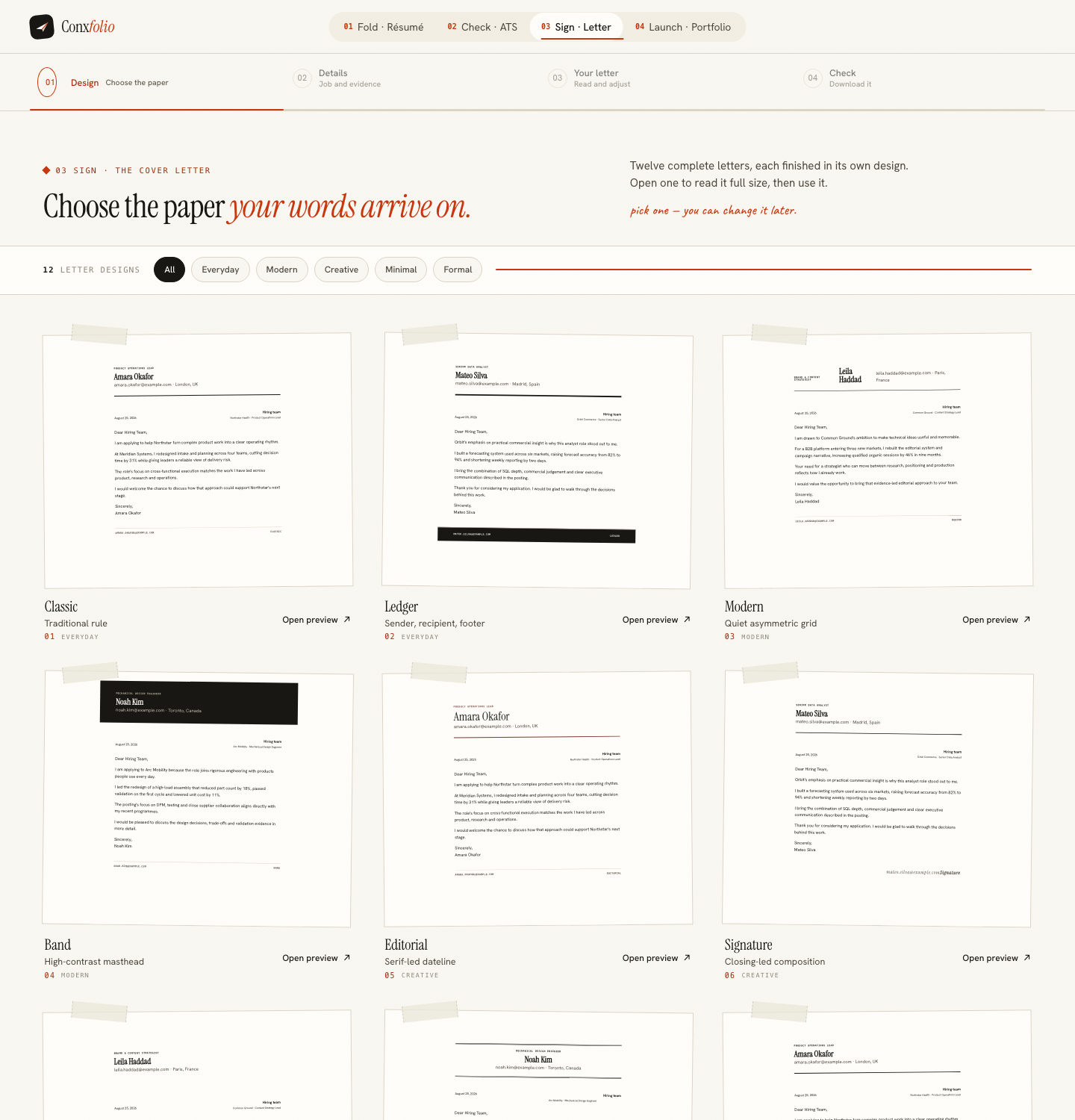
The first screen is a gallery of 12 complete letters across 5 families, filterable and numbered. Each card is a whole letter rather than a swatch, and opening one fills the screen so it can be read at full size before it is chosen. The reasoning for showing entire letters is in why a letter gallery shows whole letters.
Nothing stands in front of the gallery, and the choice is not final: the design can be changed later without touching the words.
Step 02, the job and the evidence
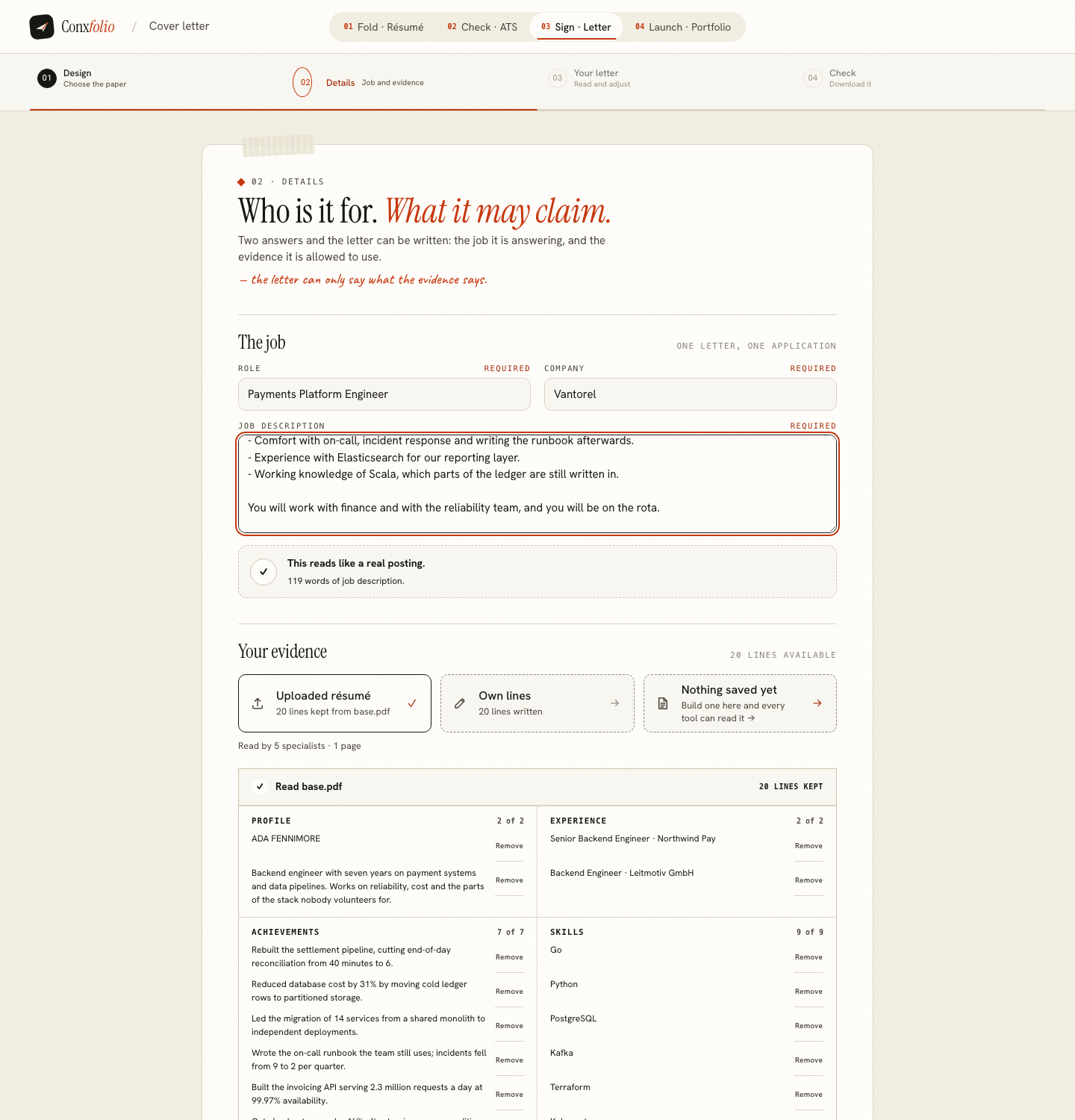
Three fields are required: the role, the company and the job description. The posting is required because a letter that answers no particular advert is a template, and this one is assembled against the requirements it can actually read.
Then the evidence, which is the part that decides what the letter is allowed to say. Three sources are offered: a résumé already saved in this browser, a file uploaded for this letter alone, or your own lines typed into a box, one fact per line. An uploaded file is read in the browser first, which is the route described on writing a letter from a PDF you already have.
An optional field asks why this role interests you. The product says under it that what you write there is used exactly as you wrote it, and that it never invents a reason for wanting the job. That is the line worth reading twice, because inventing enthusiasm is the single most common thing a letter generator does.
Step 03, the letter with its sources shown
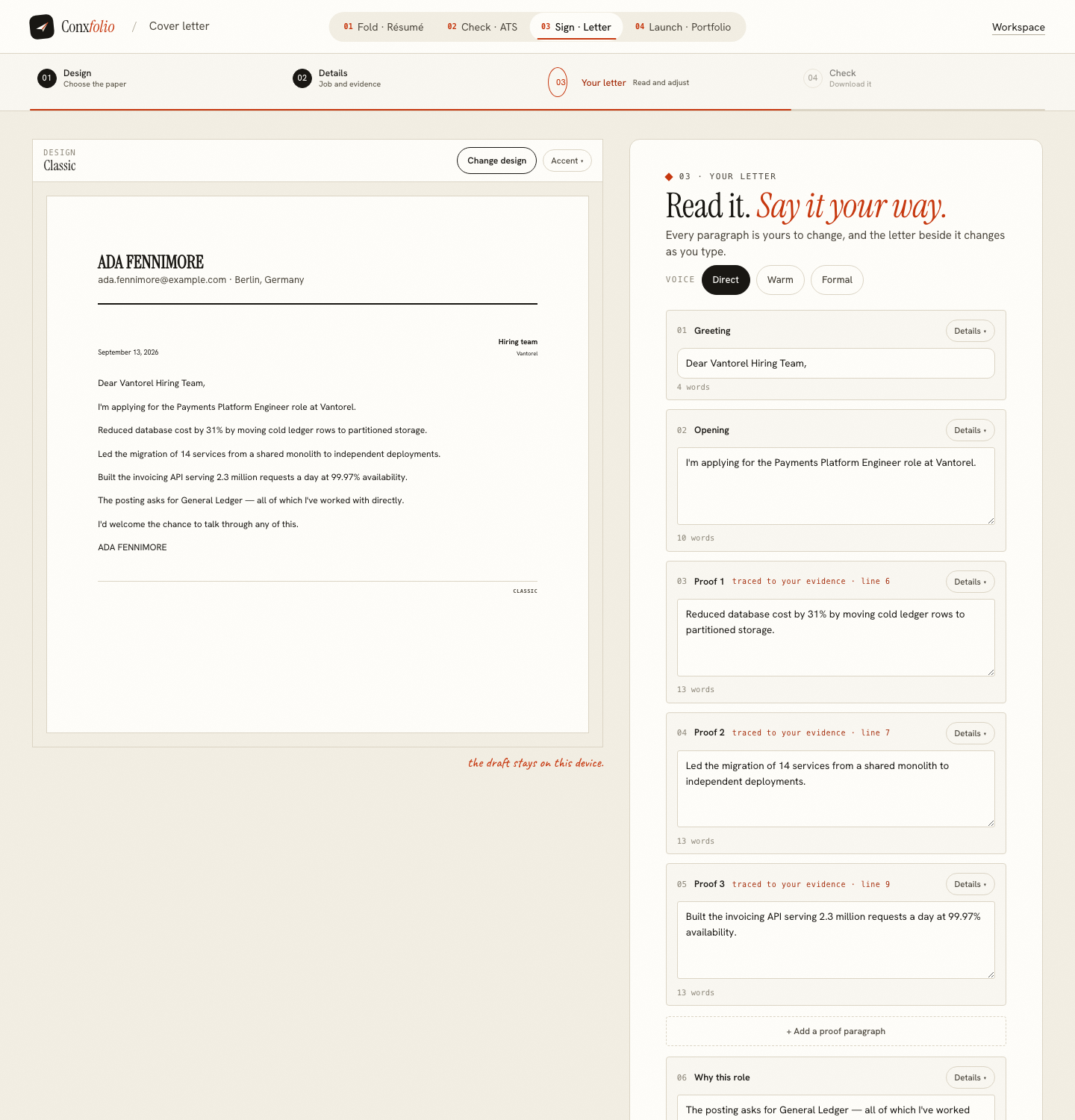
The draft arrives as numbered blocks: greeting, opening, the proof paragraphs, why this role, closing and signature. Each proof block is labelled with the line of your evidence it was taken from. That label is the product of a rule rather than a flourish: the engine selects sentences and carries the index of the source, so a claim in the letter can always be walked back to a line you wrote.
Three voices are offered, and each is shown as the opening sentence it will actually write for your role and company. Changing voice rewrites the letter and keeps the previous draft as a version first, so nothing is lost by trying one.
Step 04, the review before the export
The last step checks the letter and says plainly that nothing there blocks the export. It reports the reading length against a guide rather than a rule, whether the letter carries a number, whether each claim is traced to your evidence, whether a personal angle is present, and whether it is signed. A letter with no name on it says so, which is the subject of the unsigned-letter rule.
It also lists requirements from the posting that your evidence cannot support, as gaps. Those are never asserted in the letter. They are the most useful thing on the screen, because they are the questions an interviewer will ask.
What it will not do
It will not invent a project, a skill or a reason. It will not claim a requirement your evidence does not show. It does not use a language model, so nothing in the letter is a plausible sentence from somewhere else. Where the evidence is thin it produces a shorter letter, which is a better outcome than a longer one that is not true.
Export and keep
PDF and DOCX, free, in any design, with no watermark. Versions are kept in this browser, so a draft you liked yesterday is still there. If you want the structural advice rather than the mechanics, the writing guide and the structure guide cover the paragraphs themselves.
Why the posting is required
A letter that could be sent to any employer is a letter that says nothing, and it is obvious to the reader within two sentences. Requiring the posting is how this tool refuses to produce one. The advert is read for the requirements it states, and the letter is assembled against those, with anything your evidence cannot support listed as a gap rather than claimed.
It also gives you the most useful side effect of the whole process. The gaps list is a short, specific summary of where you are weaker than the advert asks, written before anyone has interviewed you. The article on the gaps list makes the case for reading it as preparation rather than as bad news.
Write one now, without signing up
12 designs, evidence-traced paragraphs, PDF and DOCX export. No account and no email address.
Open the cover letter builderSee the designsQuestions
- Is an email address asked for at any point
- Not in the letter builder, the résumé builder, the checker or any gallery. One place in the whole product asks: claiming the public address of a portfolio you want to publish.
- Where is the draft kept
- In this browser, under one storage key, together with any versions you save. There is no account holding a copy.
- What is sent to the server
- When you ask for a draft, the evidence text, the posting, the company, the role, your name, your motivation line and the chosen tone are sent so the letter can be assembled, and the letter comes back. Nothing else is sent, and nothing is kept against an identity, because there is not one.
- Does it write the letter for me
- It selects. Every evidence paragraph is a sentence from the material you gave it, carried with the line number it came from. Where there is no real evidence it returns fewer paragraphs instead of padding, and requirements your evidence cannot support come back as gaps rather than claims.
- Can I download it without paying
- Yes, as PDF or DOCX, in any of the 12 designs, with no watermark.
Conxfolio is a free set of four career tools: a résumé builder with 37 rendered layouts, an ATS résumé checker that prints its own arithmetic, a cover letter builder that traces every proof paragraph back to the line it came from, and a portfolio builder with 20 authored designs. There is no account to create, nothing is held back for a paid plan, and no language model is used anywhere in the product, so the readers, the score and the letter are deterministic code you can check.