How to write a cover letter from a PDF résumé you already have
You do not have to rebuild the résumé first. Upload the PDF at the letter's evidence step, and the lines it reads become the only material the letter is allowed to use.
— the file you already send people.
Most people applying for a job already have a résumé. It is a PDF, it is two years old, it is fine, and the last thing they want is to retype it into a builder in order to get a cover letter out the other end.
The cover letter builder takes the file directly. This page is that route, done and photographed on a browser holding nothing.
Where the file goes in
Step 02 is called Details, and it has two halves: the job, and what the letter may claim. The second half is a strip of evidence sources. The first card is an upload, described in the product as PDF, DOCX, TXT or a photo, read in this browser. Choosing it opens the ordinary file picker.
The file is read locally. The text is extracted from the PDF's own text layer where it has one, and a page without a text layer goes through recognition in the browser, which is the mechanism described in pulling text back out of a PDF.
The number to look at
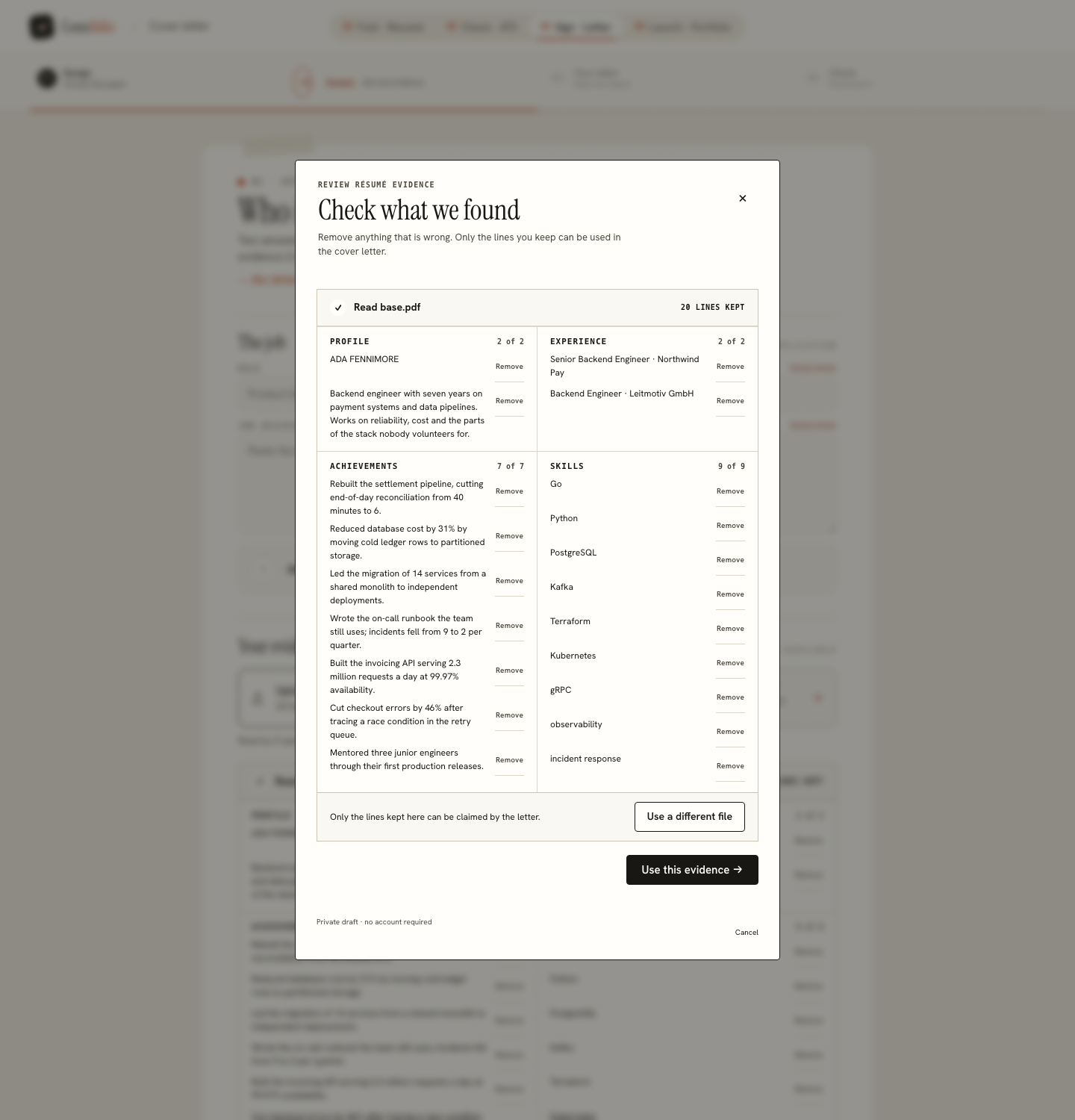
After the reading, the card reports what it kept. On the run photographed here it read 20 lines kept from base.pdf. That number is the honest preview of everything after it, because those lines are the entire pool the letter is allowed to draw from.
If the count is much smaller than the page you know you have, the PDF is losing text before anything reads it, which is a problem worth fixing before you write a letter at all. Run the same file through the ATS checker, which prints the words, lines and recognised headings it extracted, and read the format guide for the layout habits that cause it.
The job half
Role, company and the job description are all required. The posting is what the letter is answering, so it is read for requirements, and the field reports back that it looks like a real advert and how many words of it were given.
The optional motivation field is the one place the letter carries something that is not in your résumé. What you write there is used exactly as written. The product says under the box that it never invents a reason for wanting the job, and it does not.
What comes back
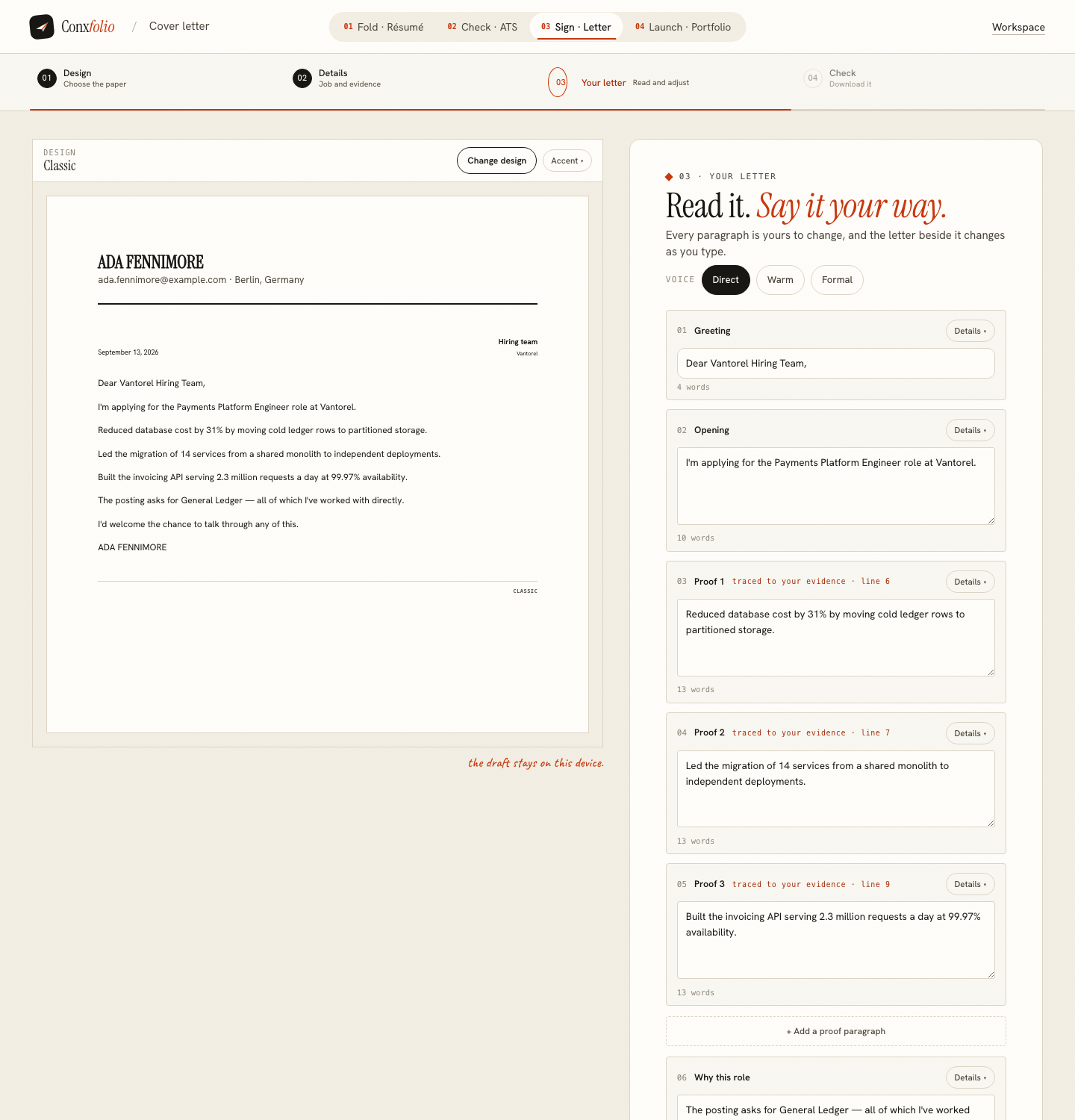
A letter in numbered blocks, with the proof paragraphs each labelled with the line of the uploaded résumé they came from. That label exists because the engine selects sentences rather than writing them, and carries the source index along with each one. The effect is described in what evidence tracing looks like.
Where the posting asks for something your file does not evidence, it appears in a gaps list instead of in a sentence. A posting that wants two technologies your résumé never mentions produces a letter that does not mention them either, and a list of two things to be ready to talk about.
The old PDF is still the old PDF
Worth saying plainly: using a two-year-old file as evidence gives you a letter written from a two-year-old record. The letter can only be as current as the material. If the last eighteen months are missing from the PDF, they will be missing from the letter, and the gaps list will quietly show you that by listing requirements you have actually met.
If that happens, the fix is to import the same file into the résumé builder, correct and extend it there, and draft the letter from the updated version.
Export, and what is kept
PDF and DOCX, free, in any of the 12 designs, with no watermark and no account. The draft and its versions stay in this browser. The uploaded file is not stored anywhere on our side; the text is sent when the draft is requested, and that is the whole of it.
For the four steps in full, including what the review at step 04 reports, see writing a cover letter without an account.
A scanned or photographed résumé
If what you have is a photograph of a printed page, or a PDF that is really a scan, the same upload accepts it. The image goes through text recognition in this browser before anything is read, so no file leaves the tab to be turned into text. The result is usually good enough to draft from and worse than a text PDF, because recognition loses bullet marks and occasionally a date.
Check the line count on the evidence card before trusting it, and read checking a scanned résumé for what recognition does and does not keep. If the numbers look thin, type the six or seven facts you want the letter to use into the Own lines box instead. A short, accurate pool produces a better letter than a long, garbled one.
Use the résumé you already send people
Upload the PDF at the evidence step. It is read in this browser, and every claim is traced back to a line of it.
Open the cover letter builderScore that PDF firstQuestions
- Do I have to import the résumé into the builder first
- No. The letter's evidence step accepts a file on its own, so a PDF you already have is enough and nothing needs to be rebuilt.
- What formats does it accept there
- PDF, DOCX, plain text and images. An image or a scanned page goes through text recognition in the browser, the same path a scanned résumé takes at the checker.
- Is the file uploaded
- It is read in this browser first. Only the text it contains is sent on when you ask for the draft, and only if this browser could not read the file is the file itself sent instead.
- How do I know it read the PDF properly
- The evidence card says how many lines it kept and names the file. On the run photographed here it reported 20 lines kept. If that number is far below your page, the PDF's layout is losing text and the checker will say the same thing in more detail.
- Can the letter claim something the PDF does not say
- No. The evidence is the boundary. Requirements in the posting that your file does not evidence come back as gaps and are never asserted.
Conxfolio is a free set of four career tools: a résumé builder with 37 rendered layouts, an ATS résumé checker that prints its own arithmetic, a cover letter builder that traces every proof paragraph back to the line it came from, and a portfolio builder with 20 authored designs. There is no account to create, nothing is held back for a paid plan, and no language model is used anywhere in the product, so the readers, the score and the letter are deterministic code you can check.