A profile export is a data dump, and a résumé is not
A profile export carries everything you ever entered, in profile order. Turning it into a document is mostly deciding what to remove.
— the import does the typing; you do the deciding.
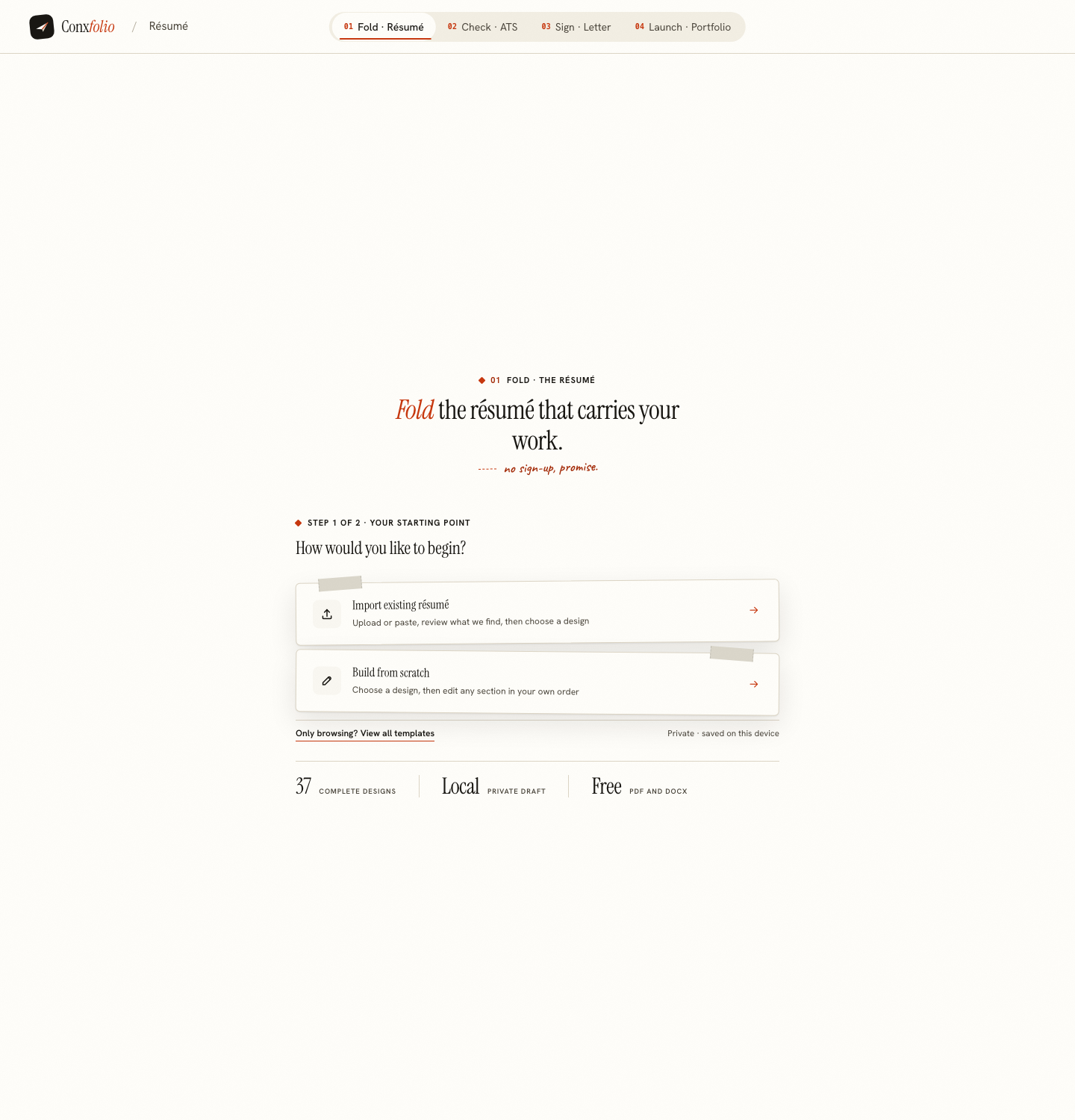
A profile export is a complete record of everything you have ever entered, in the order the profile keeps it. A résumé is a selective argument for one job. The import does the retyping; the work that remains is the part that matters.
Getting it in
Save the profile as a PDF or copy its text, and import it into the résumé builder. The file is read here before anything is sent, and only the text goes to be sorted into fields. If this browser cannot read the file, the file itself is sent instead, which is the whole of what leaves your machine and is listed in what happens to your uploaded résumé.
Reading the review honestly
The review reports what it filled and what it could not find, rather than filling gaps with plausible text. On a measured import it printed how many specialists read the document and over how many pages, and listed the fields it did not find rather than inventing them. That behaviour is described in what the import review catches and in reading questions instead of guesses.
The first cut: roles
Profiles keep everything. A résumé keeps what is relevant and recent. Ten or twelve years is the usual working answer, with older roles compressed to a line, which is set out in how far back a résumé should go.
The second cut: the endorsements and the noise
Skill endorsements, recommendations and profile headlines do not belong on the document. Nor do the profile's own section names. What not to put on a résumé is the list.
The real work: turning responsibilities into achievements
Profile bullets are usually descriptions of a job rather than evidence of what changed. The content dimension grades four things: action-led lines, measurable evidence, depth across roles and readable volume, and responsibilities move none of them. Rewriting is covered in how to write experience bullets, and finding the numbers in quantifying achievements.
Then measure it
Run the ATS checker and read the content row. An imported profile typically scores well on completeness and poorly on content, which is a precise and useful diagnosis: the facts are all present and none of them is evidence yet. The distance that can travel is shown in taking a résumé from 40 to 97.
The order that keeps it short
Cut before you write. Decide which roles stay, decide how far back to go, and delete the rest before touching a single line, because editing a document you are about to shorten wastes the effort twice. Then write the achievement lines for the roles that survived, which is the real work. Then choose a design, which takes minutes. People do this in the opposite order, spend an evening polishing lines under a job from 2011, and arrive at a three-page document they then have to cut anyway.
What this page does not claim
That an import produces a finished résumé. It produces a filled form with your own words in it and nothing invented, which saves an hour of typing and none of the thinking. Anything that claimed otherwise would be inventing content about your career, which is the one thing this product refuses to do, as what we refuse to generate explains.
One detail about profile exports specifically, because it catches people. The export's layout is often a single column of short lines with dates in a separate run, which extracts cleanly and then reads as a long list of fragments. That is why the review sometimes reports fewer roles than you expect from a document that looks complete: the entries are there, but the lines that would evidence them are not. Check the role count in the review against the profile before you start editing, and if it is short, dropped fields and why they are counted explains what happened to the rest.
One final check before you call it finished. Read the document as somebody who has never seen your profile, and ask whether the first role says what you did rather than what the company does. Profile entries often lead with an organisation's description, which reads naturally on a profile page and reads as filler on a résumé. Replacing it with a line about your own scope takes a minute and is usually the single largest improvement the imported document needs.
Import it and see what survives
The review shows every field it filled and every field it left empty. Nothing is invented on the way in.
Open the résumé builderWhat the import review catchesQuestions
- Can I import a profile PDF
- Yes. PDF, DOCX, TXT and a photograph are all accepted. The file is read in this browser first, and only the text is sent unless this browser cannot read it.
- Will it fill everything in
- It fills what it can read and reports what it could not. A field it could not read stays empty rather than being guessed at.
- Why is the result too long
- Because a profile is cumulative and a résumé is selective. The import gives you the material; the cutting is yours.
- Does it invent achievements
- No. Every string a specialist emits is checked in code to be a span of your document, and a field that fails that check is dropped and counted.
- What is the first thing to fix
- The achievement lines. Profile bullets are usually responsibilities, and the content dimension grades achievements.
Conxfolio is a free set of four career tools: a résumé builder with 37 rendered layouts, an ATS résumé checker that prints its own arithmetic, a cover letter builder that traces every proof paragraph back to the line it came from, and a portfolio builder with 20 authored designs. There is no account to create, nothing is held back for a paid plan, and no language model is used anywhere in the product, so the readers, the score and the letter are deterministic code you can check.