What leaves your browser, when, and what is kept
Uploading a document to a website you have not used before is a reasonable thing to be careful about. Here is the full list of what goes where.
— the honest answer includes the parts that do get sent.
The privacy claim most tools make is a mood. This one is a list, because a list can be checked. Here is what leaves your browser, at which moment, and what happens to it.
The canonical sentence
Your work is kept in this browser. A file you import is read here first, and only the text it contains is sent to be sorted into fields. If this browser cannot read the file, the file itself is sent instead. The text of a résumé or a letter is sent to our server when you run the ATS check, ask for a draft, or export a PDF.
The three moments the text travels
The ATS check sends the text of the résumé, because the score is computed on the server. A letter draft sends the text along with the posting, the company and the role, because the engine selects sentences out of your own evidence. A PDF export sends the document data so it can be rendered. Nothing else in ordinary use goes anywhere.
What the PDF route does with it
Renders it and returns the file. That route writes nothing to disk and nothing to the database, which is worth stating plainly because it is the one moment your whole document crosses the wire.
What is kept on your side
One local key in your browser, holding the state of your work, plus a draft token. On a measured import those came to 7 882 bytes with the candidate's name inside. That is a privacy feature and a housekeeping problem at the same time, which is why applying on a shared computer exists.
The one account-shaped thing
Claiming a portfolio address verifies an email with a one-time code, because an address has to belong to somebody. That is the only place in the product that asks for an email at all. The mechanism is in publishing a portfolio or keeping it private, and the absence of everything else in why there is no account.
Why the local-first arrangement exists
Partly privacy and partly cost. A product that keeps your work in your browser has no database of résumés to run, which is one of the reasons everything here is free. The reading itself is deterministic code with no model anywhere, described in how the résumé reader works without a model.
The parts we cannot speak for
Two of them, and both sit outside this product. What an employer does with the file you send them is invisible from here, governed by their policies rather than ours, and no résumé tool can tell you otherwise. And your own browser keeps your work on your machine, which means the security of that machine is the security of your document. Neither is a dodge: they are the honest boundary of what a claim about this product can cover. Everything inside that boundary is listed above, with the moment each thing travels and what the receiving route does with it.
What this page does not claim
That nothing is ever sent. It is, three times, and this page names each occasion rather than burying it. It also does not claim anything about what an employer does with the file you send them, which is outside our view entirely and outside every other tool's view as well.
If you want the strictest version of the arrangement, there is one available and it costs nothing. Paste the text of your résumé rather than uploading the file, which means the file never moves at all; build the document here; and export the DOCX, which is assembled in the page and made zero server calls in a measured export. That path uses the network for the check alone, and if you skip the check it uses the network only for the first page load, which is measured in low-bandwidth applications.
One detail about the import worth understanding, because it decides whether your file moves at all. The reading happens in your browser first, using code running in the page, and only the text it produces is sent. The file itself travels only when that local reading fails, which is typically an unusual PDF or a format the browser cannot open. Pasting the text yourself avoids the question entirely and is the strictest available path.
Run a check and see what was read
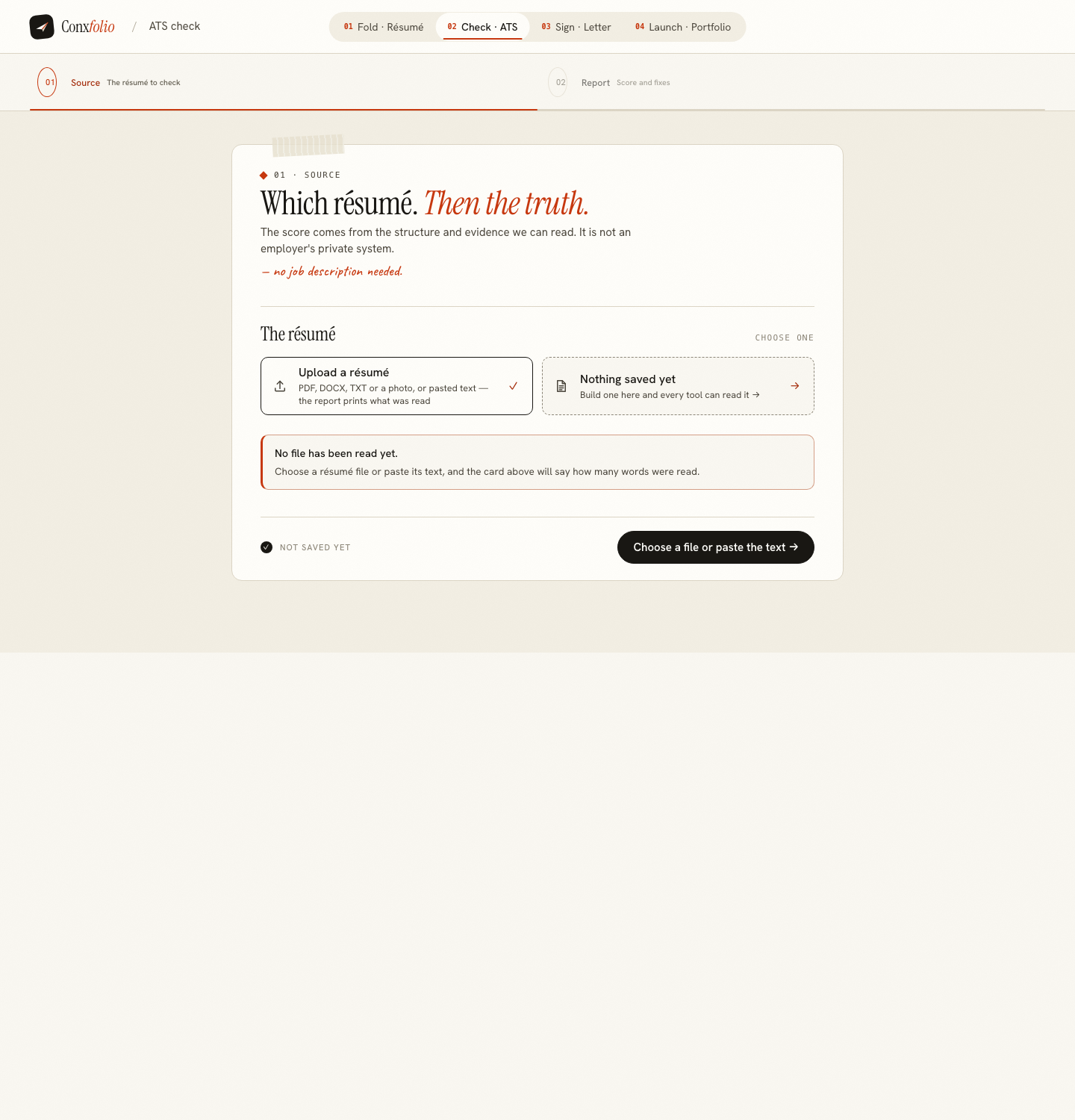
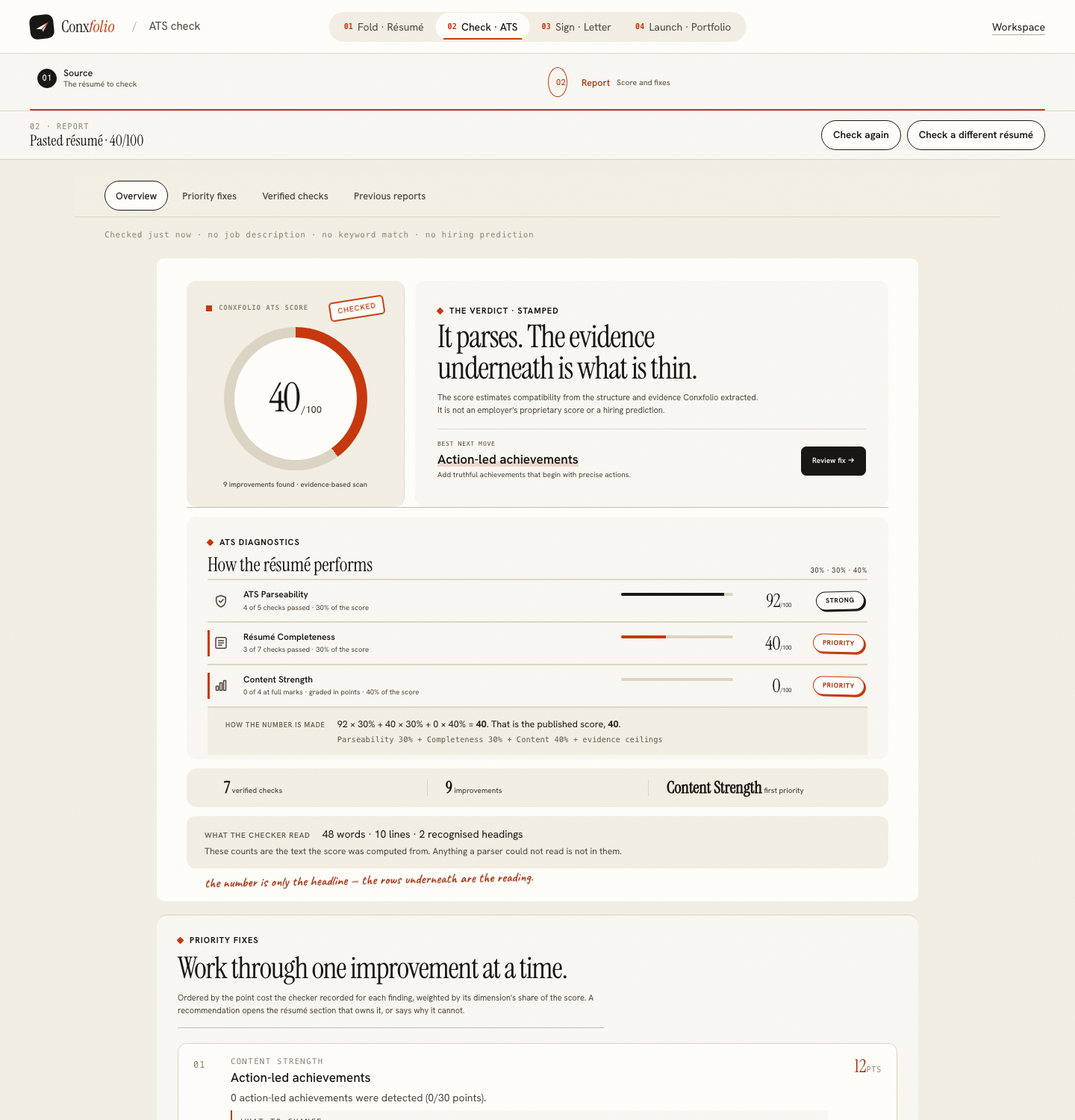
The report prints the words, lines and headings it extracted. Nothing else about you is needed for it.
Open the ATS checkerWhy there is no accountQuestions
- Does my file leave the browser
- Only when this browser cannot read it. A file you import is read here first, and the text it contains is what gets sent. If the reading fails locally, the file itself is sent instead.
- What is sent, and when
- The text of a résumé when you run the ATS check, ask for a letter draft or export a PDF. Design previews and portfolio saving use their own routes. That is the whole list.
- Is the PDF render stored
- No. The render route writes nothing to disk and nothing to the database. It returns the file.
- Where is my work kept
- In your browser, in one local key. There is no account and no server copy unless you claim a portfolio address, which is the only place an email is asked for.
- Does the DOCX export upload anything
- No. It is assembled inside the page. A measured export made zero server calls.
Conxfolio is a free set of four career tools: a résumé builder with 37 rendered layouts, an ATS résumé checker that prints its own arithmetic, a cover letter builder that traces every proof paragraph back to the line it came from, and a portfolio builder with 20 authored designs. There is no account to create, nothing is held back for a paid plan, and no language model is used anywhere in the product, so the readers, the score and the letter are deterministic code you can check.