How to get back to an earlier draft of a résumé
Save a version before a rewrite and the snapshot stays on the device, written once and never changed. This is where the control is and what it does and does not cover.
— save one before you delete anything.
The thing that stops people improving a résumé is not laziness. It is that the current version works, it took an afternoon, and a rewrite might make it worse in ways that are hard to see from inside. So the summary stays as it is for two years.
A snapshot removes that. If going back costs one click, a bold rewrite costs nothing to attempt.
Where the control is
In the document bar above the editor, in a menu labelled Versions. It opens onto a short panel: a heading saying the history is saved on this device, a button to save the current state as a version, the current draft, and any snapshots underneath it with when each was made.
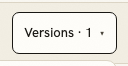
After one save, the menu on the run photographed here read Versions with a count of one, listing the current draft and a snapshot made just then.
Two different things, kept apart
The current draft moves as you type. It is what the editor is showing and what an export produces. A version is a snapshot that you asked for, written once, and never altered afterwards.
That separation is the reason the feature is trustworthy. Nothing in the product writes into a version after it exists, so a snapshot from Tuesday is Tuesday's document, not Tuesday's document with some of Thursday's changes in it. Versions and restoring a draft covers the model in more detail.
When to save one
Before anything you would be sorry to lose. Four moments are worth the click: before rewriting the summary, before deleting a role or a section, before reordering the page, and before tailoring the document for a specific posting.
That last one is the most common regret. A version cut down for one application is not the document you want to send to the next employer, and the general version is the one that took the afternoon. If the tailoring is going to be substantial, a duplicate is the better tool, because it gives you two documents to develop rather than one document with a history.
Going back
Open the menu and pick the snapshot. The document returns to that state, and the snapshot remains in the list, because it was never the live copy. The practical effect is that you can look at an old version, decide against it, and carry on, without having spent anything.
Measuring whether the change helped
This is where versions become more than an undo. Run the ATS checker before the rewrite and again after it. The previous reports chapter keeps both runs in the same browser, so the two scores sit next to each other with the arithmetic behind each one.
That turns a rewrite from a matter of taste into a measurement. It is not a complete measurement, because the checker reads structure and evidence rather than persuasion, and a rewrite that reads better to a person can leave the number where it was. It does catch the common mistake, which is tightening a page until the evidence is gone. Previous reports and what a fix was worth covers reading the pair.
What versions do not protect against
They live in the browser with the résumé. Clearing your browsing data removes the document and every snapshot of it, and there is no copy on a server to restore from, because nothing is stored on one. A different laptop has none of it either.
An exported file is the backup that survives all of that, and it takes one click. Export a DOCX after any session worth keeping, as described in moving a résumé between devices, and keep it where you keep things. A version history is for working; a file is for safety.
Versions on the letter as well
The cover letter builder keeps versions too, and it saves one for you at the moment it matters most: changing the voice rewrites the whole letter and keeps the previous draft first. That means trying a formal version of a warm letter costs nothing, which is the only way anybody ever actually compares two tones.
The same discipline applies to evidence. If a letter is drafted from an uploaded file rather than a saved résumé, the draft is the only record of what was selected, so save a version before changing the source. Writing a letter from a PDF you already have covers that route and the line count to check before trusting it.
When a version is the wrong tool
Two cases, and both are common. If you are about to keep editing both states, you want a duplicate rather than a snapshot, because a version is somewhere to return to and not somewhere to work. And if the change you are nervous about is a single sentence, the browser's own undo inside the field is faster than anything the product offers.
The third case is a document that came from somewhere else, such as a profile export, where the original file is the real safety net rather than any snapshot of your edits. The comparison with LinkedIn's Save to PDF covers keeping the source record intact while the résumé is shaped separately.
Change it without losing it
Save a snapshot before a rewrite and come back to it whenever you want. Kept on this device, free.
Open the résumé builderMeasure what the change was worthQuestions
- Where is the version control
- In the document bar above the editor, as a menu labelled Versions. It holds Save current as version, the current draft, and every snapshot you have saved, each with when it was made.
- Does it save automatically
- The current draft is kept as you type. A version is a snapshot you ask for, so it exists because you pressed the button. The distinction is deliberate: an automatic history of every keystroke is noise, and a version you chose is a landmark.
- Can a version be overwritten
- No. A version is written once and then read-only. A later save adds a snapshot, it does not replace an earlier one.
- Where are they stored
- On this device, in this browser, with the résumé itself. They do not travel to another machine, and clearing your browser data removes them along with everything else.
- Is there an undo for a single line
- The browser's own undo works inside a field while you are typing. Versions are for larger moves: a rewritten summary, a deleted section, a reordered page.
Conxfolio is a free set of four career tools: a résumé builder with 37 rendered layouts, an ATS résumé checker that prints its own arithmetic, a cover letter builder that traces every proof paragraph back to the line it came from, and a portfolio builder with 20 authored designs. There is no account to create, nothing is held back for a paid plan, and no language model is used anywhere in the product, so the readers, the score and the letter are deterministic code you can check.