A repository and a portfolio page answer different questions, and only one of them is read
Both links are evidence. They are evidence for different people, and the decision is about which of those people is reading your application this week.
— the page is read. the repository is checked, later, by one person.
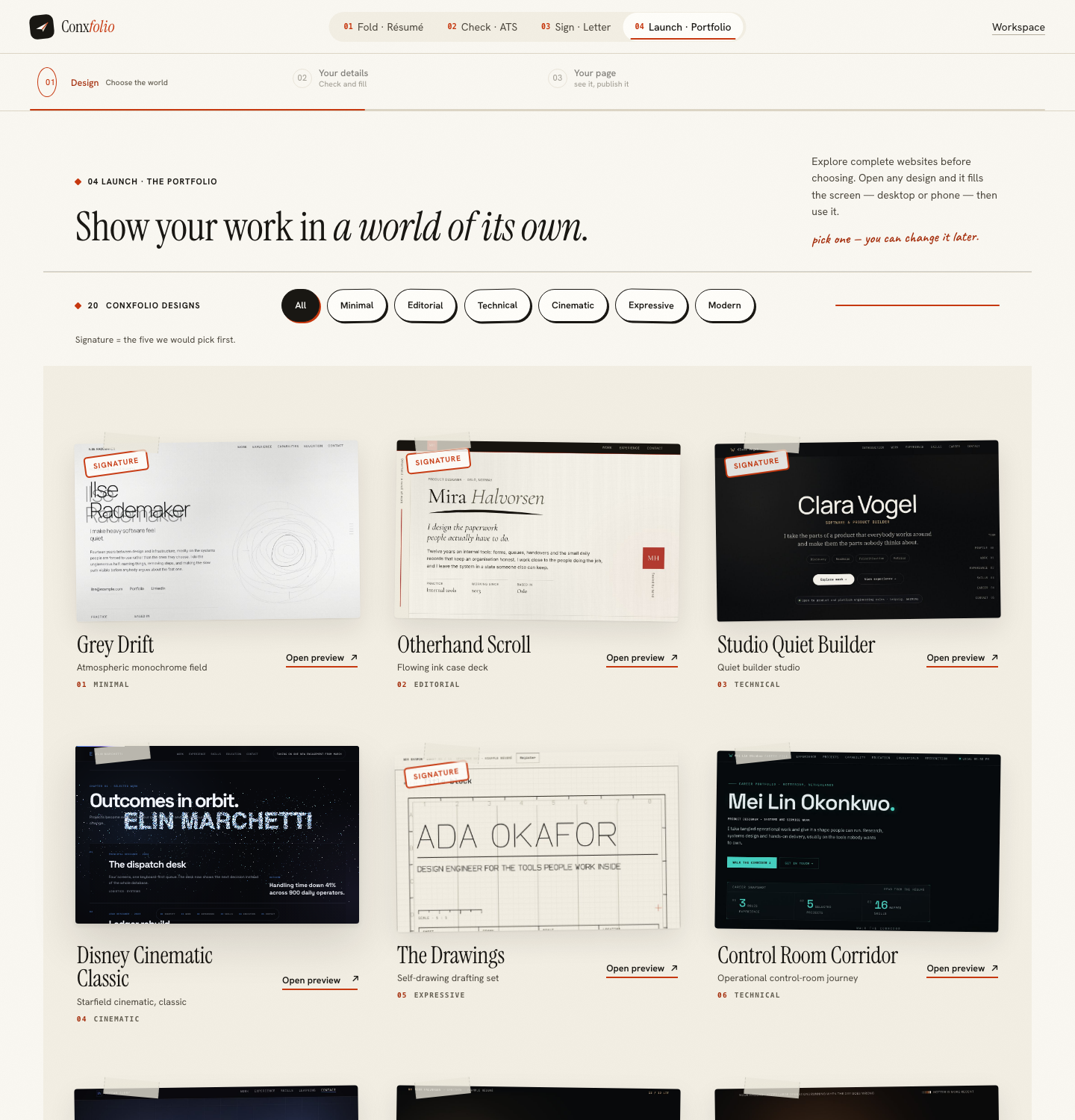
The two links look interchangeable on a résumé and they are not. A repository proves you can write code that runs. A page proves you can explain what you built and why, to somebody who is not going to read the code. Which one belongs on the document depends on who opens it, and usually the answer is both, in that order of effort. The portfolio builder exists because the second one is the one that never gets made.
What a repository is good for
A repository is checked rather than read. An engineer on the panel opens the front page, looks at the README, reads one file, and forms an impression in about three minutes. That impression is valuable and it is also narrow. Anything that requires clicking through five directories is not evidence, because nobody clicks through five directories for a candidate at the first screen.
What a page is good for
A page is read by anyone, including the people who decide whether the engineer ever sees your application. It carries the thing a repository cannot: what the problem was, what you chose, and what changed. There are 20 designs across 6 directions here, each a whole authored page rather than a theme, which is the subject of what an authored design means.
Both fields exist, and both are optional
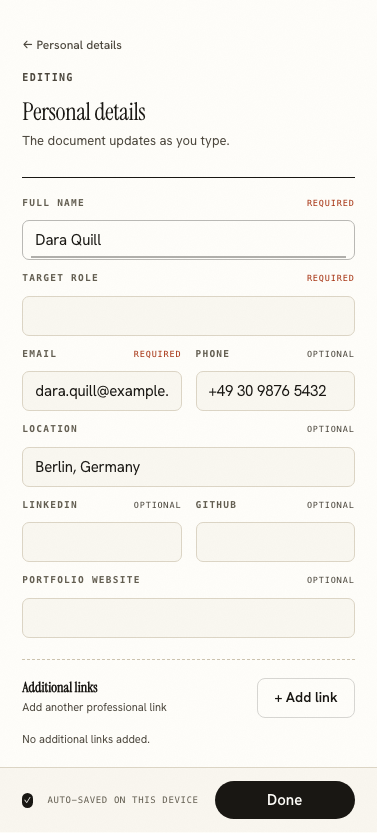
In the résumé builder's identity section, under professional links, beside LinkedIn. Put both on when both are ready and neither when neither is. A link to an empty repository is worse than no link, for the same reason a stale profile is, which is covered in whether the LinkedIn link earns its line.
How the page gets built
Three steps. Choose a design. Correct the details, which arrive from the roles, projects and outcomes already in your résumé, switching on what belongs and correcting each entry with a name, a year, a line about what changed and optionally a description, a link, an image and tags. Then look at the page, at desktop and at phone width, and publish it from there if you want to.
What publishing involves
An address and a one-time code sent to an email address, so the address belongs to somebody. That is the only part of the whole product that asks for an email, and a published page can be unpublished again. The alternative is to build the page, look at it, and never publish it, which is a legitimate outcome and costs nothing. Publishing or keeping it private takes that decision apart.
What neither link does
Neither is a substitute for the achievement lines on the page in front of the reader. A résumé that says see my GitHub instead of saying what was built has moved the argument somewhere the reader may never go. Linking a portfolio from a résumé and when a portfolio beats a résumé cover the balance, and portfolio without code covers building one when you do not want a repository at all.
What to write on the front page of each
For a repository, the README is the whole first impression: what it does, why it exists, and how to run it, in that order and in under a screen. For a portfolio page, the first entry is the equivalent, and it should be the work you most want to be asked about rather than the most recent thing you finished.
Both are versions of the same discipline, which is writing for somebody who has not been in the room. The portfolio builder enforces part of it by asking each entry for a name, a year and one line about what changed, which is a harder question than a project title and a technology list. What to put in a portfolio and how many projects to show cover the rest of the selection.
The honest limits
Nothing here writes your entries, invents a project or claims an outcome you have not recorded, and no page on this site says a link changes a hiring decision. The tools are free with nothing held back, including all the designs and both export formats on the résumé side.
One thing neither link can fix is an out-of-date front page. A repository whose last commit is three years old and a portfolio whose newest entry is from a previous job both answer a question the reader did not ask. Where you are not going to update either this month, the honest move is to leave the field empty and let the résumé carry the argument on its own, which it is designed to do.
Build the page version
Three steps: choose a design, correct your details, look at the page. Publishing is on the third step when you want it.
Open the portfolio builderRead the developer portfolio guideQuestions
- Can I put both links on
- Yes. The identity section has separate optional fields for GitHub and for a portfolio website, and each renders only when it has a value.
- Who reads a repository
- An engineer on the panel, usually after a first screen, and usually only the front page of it. A recruiter or a hiring manager is far less likely to open one.
- What does the portfolio builder actually build
- A page from the roles, projects and outcomes already in your résumé, in one of 20 authored designs across 6 directions, rendered at desktop and phone width before anything is published.
- Does it host the page
- Only if you publish it. Publishing claims an address and sends a one-time code to an email address, and a published page can be taken down again.
- Will it write the project descriptions
- No. It does not write your entries and it will not add projects you have not done.
Conxfolio is a free set of four career tools: a résumé builder with 37 rendered layouts, an ATS résumé checker that prints its own arithmetic, a cover letter builder that traces every proof paragraph back to the line it came from, and a portfolio builder with 20 authored designs. There is no account to create, nothing is held back for a paid plan, and no language model is used anywhere in the product, so the readers, the score and the letter are deterministic code you can check.