Whether to send a letter every time, with the guidance that actually publishes an answer
The received wisdom is that nobody reads cover letters. Two governments publish guidance describing what should be in one, which is a reasonable clue that somebody does.
— if the posting asks, it is not a question.
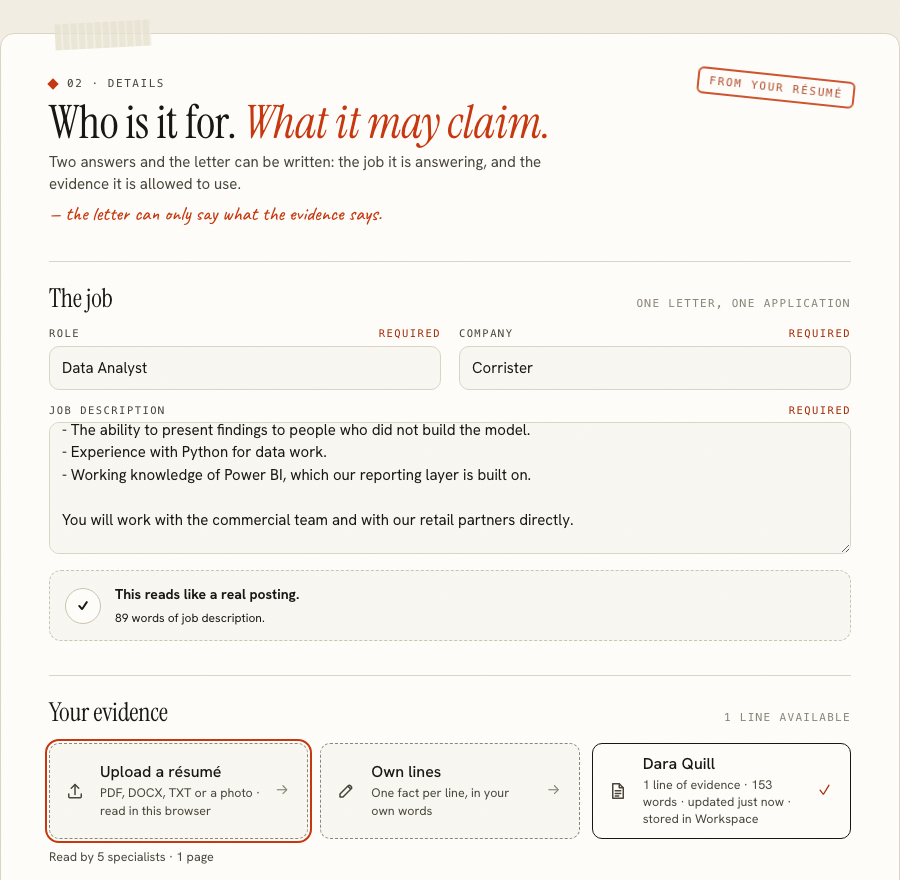
Cover letters are widely declared dead by people who have not looked at what public careers services publish. Two governments describe the document in detail, one treats it as a required part of an application, and both say the same thing about what it should do. The cover letter builder is built on that description rather than on the folklore.
Where it is part of the set
Germany. The Bundesagentur für Arbeit lists the components of a Bewerbung as the Anschreiben, the Lebenslauf and the Zeugnisse, with a Deckblatt as an optional addition, and it says of the Anschreiben's text that it "sollte daher passgenau auf die Stelle zugeschnitten sein", that it should be cut precisely to the position (arbeitsagentur.de). That is not a preference. It is the published shape of an application.
Where it is described rather than required
The United Kingdom. The National Careers Service calls a covering letter "a short letter, usually 3 to 5 paragraphs long" and says it should be tailored to the company and the role (nationalcareers.service.gov.uk). The nidirect service says "one A4 page is preferable" (nidirect.gov.uk). Neither says it is compulsory, and both describe it as though it will be read.
The rule that settles most cases
If the posting asks for one, send one. If the form has a field for one, fill it. Those two cover the majority of applications and neither is a judgement call. What is left is the posting that says nothing, and there the cost of the letter is the deciding factor.
What the letter costs here
One paste. The role, the company, the posting, and the résumé it is allowed to draw from. The engine selects proof paragraphs from sentences you already wrote, carries each back to its source line, and returns fewer paragraphs rather than padding when the evidence is thin. That is the whole input, and it is why the answer to should I write one is usually yes.
What the review reports
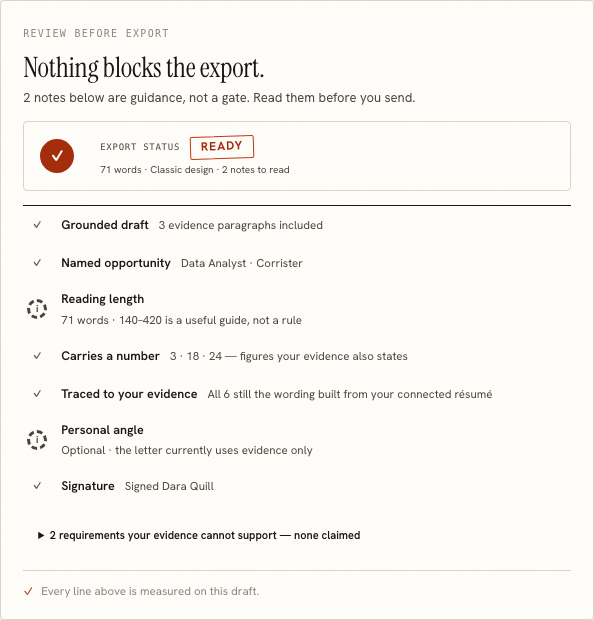
Whether anything blocks the export, how many evidence paragraphs went in, whether the role and company are named, the word count against a range it calls a useful guide rather than a rule, and whether the draft carries a figure. It also lists the requirements in the posting that your evidence cannot support, as gaps, and the letter asserts none of them.
The case for not sending one
A form that does not ask, a posting that says applications by CV only, or an application where the letter would be three sentences of nothing. A bad letter is worse than no letter, and the engine's refusal to pad is the mechanism that tells you which one you have: a draft that comes back very short is a signal about the evidence rather than about the tool. Do I need a cover letter works through the cases.
What a letter can carry that a résumé cannot
Three things, and they are the reason the document still exists. A reason for this employer rather than any employer. An explanation of something the page cannot state, such as a break, a move or a change of direction. And an account of how your evidence answers their requirements, which is the part the engine builds for you by selecting from your own lines.
Where none of those three applies, the letter genuinely has nothing to do and the honest version is short. Where at least one does, the letter is the only place it fits. That test is quicker than any general rule about whether letters are read, and it produces a different answer per application, which is the correct outcome. Applying at your own employer and writing after a referral are the two cases where the answer is always yes.
What is not claimed
That a letter changes a decision. Nothing here measures that, and no page on this site says a document gets anybody hired. The sources above describe conventions with publishers' names on them; the rest is a cost argument. How long a cover letter should be and cover letter structure carry the shape, and both exports are free with no watermark.
Write one and decide afterwards
Paste the posting, point it at your résumé, and read what it selected. It takes a minute and costs nothing.
Open the cover letter builderRead whether you need oneQuestions
- Does a German application include one
- Yes. The Bundesagentur für Arbeit lists the Anschreiben as part of a Bewerbung alongside the Lebenslauf and the Zeugnisse, and says the text "sollte daher passgenau auf die Stelle zugeschnitten sein" (arbeitsagentur.de).
- What does UK guidance say about length
- The nidirect government service says of a covering letter that "one A4 page is preferable" (nidirect.gov.uk), and the National Careers Service describes it as "a short letter, usually 3 to 5 paragraphs long" (nationalcareers.service.gov.uk).
- Is one letter per application really necessary
- It is the model this builder assumes and it says so on the details step. The engine rebuilds the argument against the posting you paste, so a second letter costs one paste rather than an hour.
- What does the review tell me
- Whether anything blocks the export, how many evidence paragraphs were included, whether the opportunity is named, the word count, and whether the draft carries a figure. Notes are guidance rather than gates.
- Does it use a model to write it
- No. It selects sentences from your own résumé and carries each back to the line it came from. Nothing in the product calls a language model.
Conxfolio is a free set of four career tools: a résumé builder with 37 rendered layouts, an ATS résumé checker that prints its own arithmetic, a cover letter builder that traces every proof paragraph back to the line it came from, and a portfolio builder with 20 authored designs. There is no account to create, nothing is held back for a paid plan, and no language model is used anywhere in the product, so the readers, the score and the letter are deterministic code you can check.