Writing a letter when somebody inside the company suggested you apply
A referral is the most valuable sentence a cover letter can carry and the one no tool can generate. It is also the one most often buried in the third paragraph.
— ask them first. then use the name.
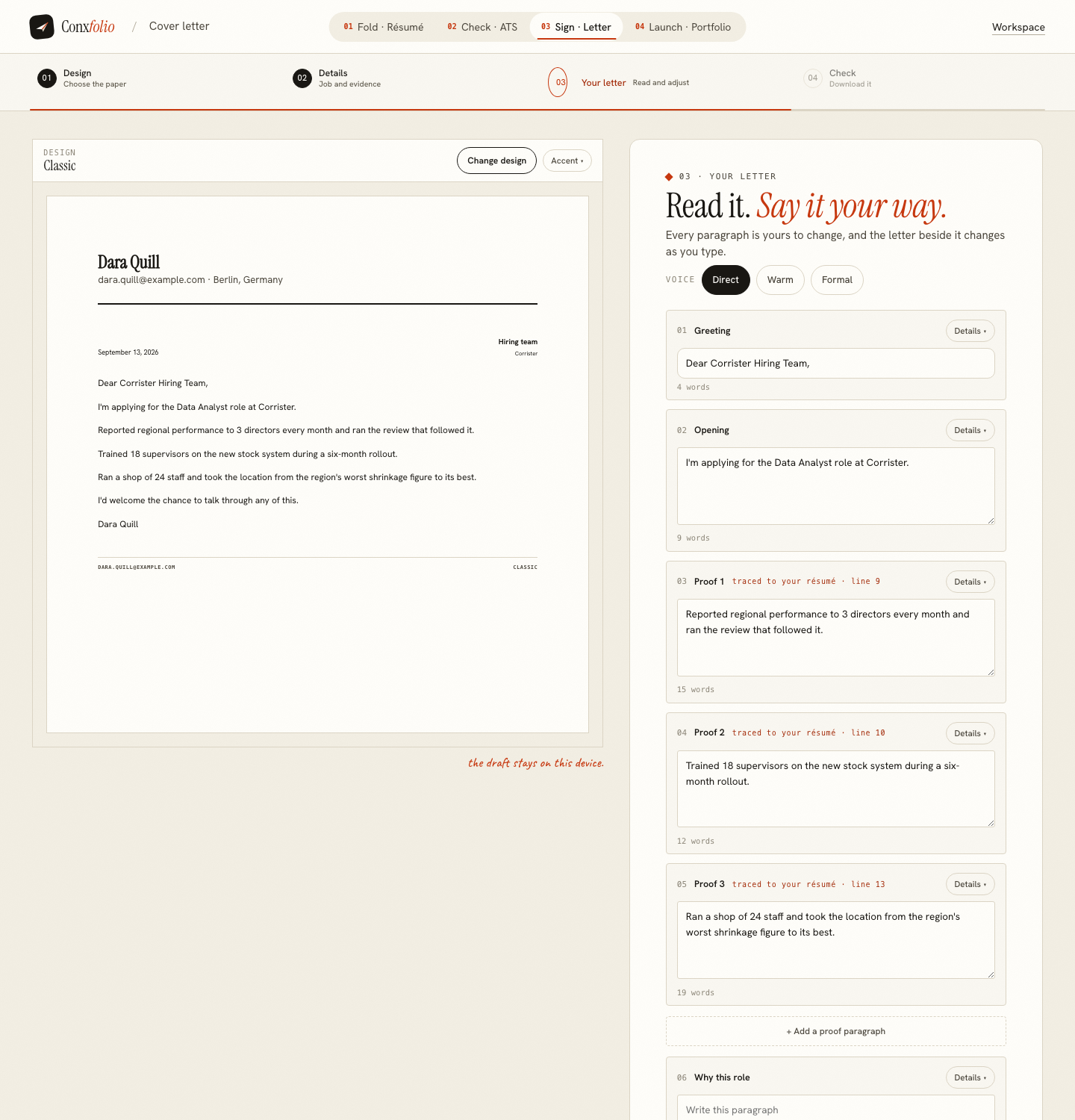
Somebody who works there told you to apply. That fact is worth more than any paragraph you can write, and it is the one thing the cover letter builder cannot help with, because it has no knowledge of any company and will not invent a person. What it does is build the rest of the letter so that the name has something to sit on top of.
Ask them first
Naming somebody in a letter commits them to an opinion in writing, to a reader who may be their manager. Ask. They will usually say yes, and they will often tell you something about the role or the panel that changes what you write, which is worth more than the sentence itself.
The name goes in the first sentence
Not the second paragraph, and not the closing. A reader decides how carefully to read in the first line, and a referral is the single most effective thing that line can contain. Written plainly: a colleague of yours, named, suggested this role would suit me, and here is why they were right.
What the engine builds around it
Proof paragraphs, selected from sentences already in your résumé and carried back to the lines they came from. Requirements the posting asks for that your evidence cannot support come back as gaps and are not claimed. A referral does not change any of that: it changes how carefully the proofs are read, which is precisely why they still have to be good.
Rewriting the opening

Each block of the letter is an editable field with its own word count, and proof paragraphs can be added, removed and reordered around it. Write the draft first and rewrite the opening afterwards, because the engine's version tells you what the argument is before you decide how to introduce it. Cover letter opening lines has the shapes.
Who to address it to
A person, where you can find one. The National Careers Service states it plainly: "It's important to try to address your cover letter to someone by name", with "Dear Sir or Madam" as the fallback when no name can be found (nationalcareers.service.gov.uk). A referral usually supplies the name, which is a second reason to ask them first. How to address a cover letter covers the cases where nobody is named.
The internal version of this
Where the referral is for a role at your own employer, the letter has a different job again, because the reader already knows you. That is worked through in applying for a job at your own employer, and the gaps list turns out to be more useful there than anywhere else.
When the referral is the only thing you have
Sometimes somebody suggests a role that is a reach. The letter then has a harder job, because the name gets it read and the evidence has to survive the reading. The engine's behaviour is useful here precisely because it will not help you overstate: it selects what your résumé supports, returns fewer paragraphs when there is less, and lists the requirements it cannot support as gaps.
A letter that names a referral, makes two honest claims and acknowledges the rest is a better document than one that claims six things loosely. It is also the version your referrer can defend when somebody asks them about you, which is worth remembering, since they are the person whose judgement you have borrowed. The gaps list is the interview covers what to do with the list you are left holding.
What is not claimed
That a referral changes a decision. Nothing here measures that and no page on this site claims a letter gets anybody hired. What is mechanical is that the engine has no knowledge of any company, invents no people, uses no model, and leaves the sentence that matters most entirely to you. Both exports are free and carry no watermark.
One last mechanical point. Keep the draft. The letter builder holds versions of a draft when you ask for one, and a referral letter is the one most likely to be needed again in a slightly different form, either for a second role at the same company or because the referrer suggests somebody else to write to. Rewriting the opening block for a new reader takes a minute when the proofs are already selected and traced, and none of it requires an account, because the work is kept in this browser rather than in a database we hold.
Write it, then rewrite the opening
Let the engine build the proof paragraphs from your evidence, then put the name in the first sentence yourself.
Open the cover letter builderRead the opening lines guideQuestions
- Will the engine mention my referral
- No. It has no way of knowing about it, it will not invent a person, and it selects only from sentences in your own résumé. The opening block is editable and that is where the name goes.
- Where exactly should the name appear
- The first sentence. A referral in the third paragraph has been read by somebody who already decided how carefully to read.
- Should I ask permission first
- Yes. Naming somebody commits them to an opinion in writing, and they may know something about the role that changes what you write.
- Does a referral replace the evidence
- No. It changes how carefully the letter is read. The proof paragraphs still have to be there, and the engine still returns fewer rather than padding.
- Who do I address it to
- Somebody by name where you can find one. The National Careers Service says "it's important to try to address your cover letter to someone by name" and gives "Dear Sir or Madam" as the fallback (nationalcareers.service.gov.uk).
Conxfolio is a free set of four career tools: a résumé builder with 37 rendered layouts, an ATS résumé checker that prints its own arithmetic, a cover letter builder that traces every proof paragraph back to the line it came from, and a portfolio builder with 20 authored designs. There is no account to create, nothing is held back for a paid plan, and no language model is used anywhere in the product, so the readers, the score and the letter are deterministic code you can check.