Following up after an application, and the honest list of what this product does not do
There is no follow-up tool on this site and this page is not going to pretend otherwise. What there is, is the letter you sent and the list of things it could not claim.
— one short note. the gaps list is the content.
This page begins with the refusals, because a page about following up on an application is exactly where a product would be tempted to imply features it does not have. Nothing in Conxfolio sends an email to an employer. Nothing tracks an application. Nothing reminds you about anything. There is no account to hold a tracker in, and no schedule anywhere in the product.
What does exist
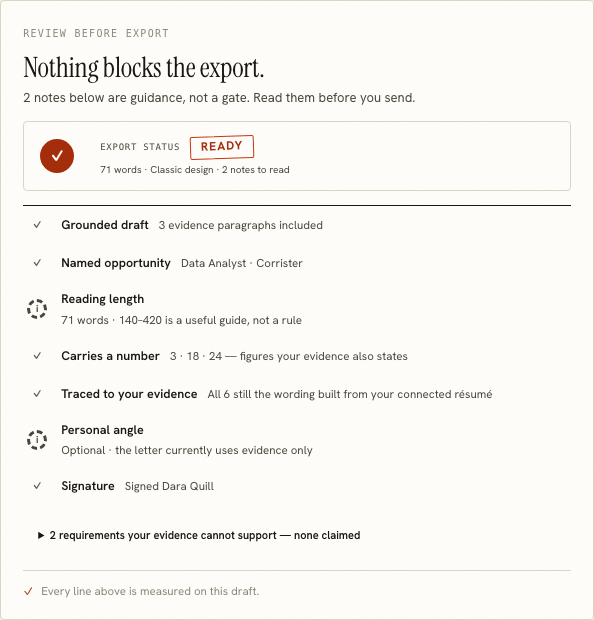
The letter you sent, in this browser, with everything the cover letter builder recorded about it. Which proof paragraphs went in and which résumé lines they came from. Which requirements in the posting your evidence could not support. How long the draft was and whether it carried a figure. That is a complete account of the argument you made, and it is the raw material for the note.
The gaps list is the content
A follow-up that says you are still very interested has said nothing. A follow-up that supplies one thing the original letter could not support has added a fact to the file. The gaps list names those requirements precisely, which is why the gaps list is the interview and why it is also the follow-up. Where you have since done the course, finished the project or found the evidence, that is a note worth sending.
Writing the note itself
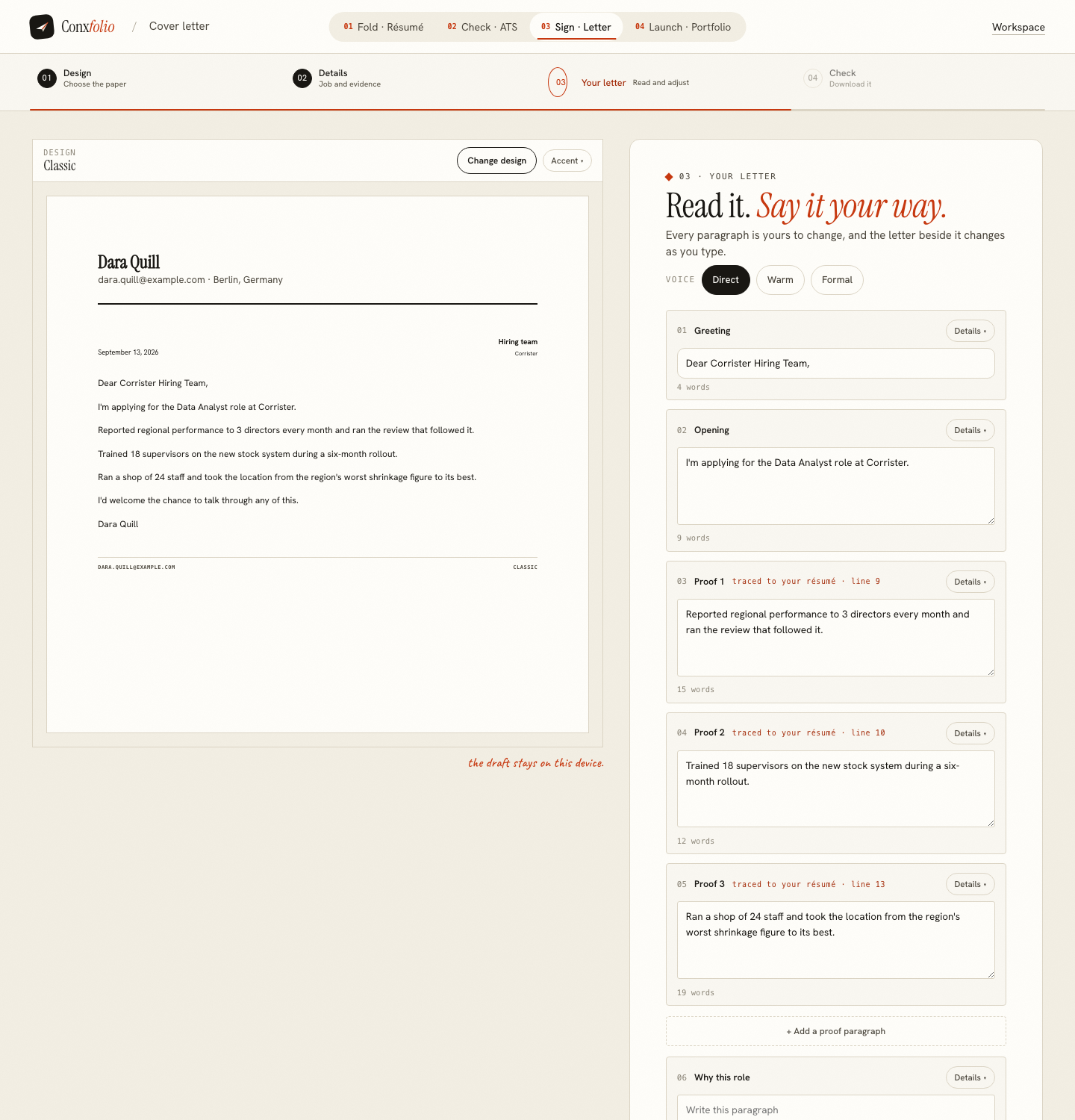
As a short letter. The builder has an own-lines mode, where the evidence is a list of facts you type rather than a selection from your résumé, which is the right shape for three sentences. Blocks are editable fields with word counts, so a note can be cut to length deliberately rather than by feel. Then copy the text into an email, because the product does not send.
What the original letter already established
The role and the company were named on it, the evidence was traced to lines you wrote, and nothing was asserted that your résumé did not show. A follow-up written against that record cannot contradict itself, which is the most common failure of follow-up notes written from memory a fortnight later.
The timing question, which has no answer here
There is no convention on this site about when to follow up, and none of the public guidance we cite elsewhere addresses it. Where the posting gives a timescale, that is the answer. Where it does not, this page is not going to invent a number of days and present it as a rule. Tailoring a letter to the posting covers reading a posting closely enough to find out.
What to do with the second application
More often than a follow-up, the useful next action is the next application, and the material is already here. A new posting costs one paste: the engine rebuilds the argument from the same evidence and lists what the new posting asks for that you cannot support. One résumé or one per job covers the master-and-exports model, and the résumé builder holds the document the letters are drawn from.
Why there is no tracker here
A tracker needs an account, an account needs a database, and a database of who applied where is the most sensitive record this whole product could hold. Conxfolio keeps your work in your own browser and asks for one email address for one purpose, which is claiming a portfolio address. Adding a tracker would mean giving that up, and the trade has been made the other way round deliberately.
The practical consequence is that the list of where you applied lives wherever you already keep lists. That is a spreadsheet or a notebook for most people, and it works. What this product holds is the documents and the record of what each one claimed, which is the part that is hard to reconstruct and the part a follow-up actually needs. The whole trade is set out in why there is no account.
The claim this page does not make
That following up improves your chances. Nothing here measures that, nothing here predicts an outcome, and no page on this site says a document or a note gets anybody hired. What is true is that the record of what you already claimed is still in front of you, and an honest note is easier to write from a record than from memory.
Open the letter you sent
The draft, its proof paragraphs and its gaps are still here. That is what a follow-up note is made of.
Open the cover letter builderRead the tailoring guideQuestions
- Does this product send emails
- No. Nothing in it sends anything to anybody. The only outbound message the product makes at all is the one-time code used to claim a portfolio address.
- Does it track applications or set reminders
- No. There is no tracker, no reminder and no schedule anywhere in it, and there is no account to hold them in.
- So what is useful here
- The letter you wrote is still in this browser, with its proof paragraphs and its gaps list. Those are the contents of an honest follow-up note.
- How do I write the note
- As a short letter. The letter builder has an own-lines mode where the evidence is what you type rather than what your résumé shows, which suits a note of a few sentences.
- When should I follow up
- There is no convention published on this site for it, and we are not going to invent one. Where the posting states a timescale, that is the answer.
Conxfolio is a free set of four career tools: a résumé builder with 37 rendered layouts, an ATS résumé checker that prints its own arithmetic, a cover letter builder that traces every proof paragraph back to the line it came from, and a portfolio builder with 20 authored designs. There is no account to create, nothing is held back for a paid plan, and no language model is used anywhere in the product, so the readers, the score and the letter are deterministic code you can check.