Whether the LinkedIn link earns its line, and when it costs you more than it gives
A profile link is an invitation to check your work against a second document. That is useful when the two agree and expensive when they do not.
— an empty profile is worse than no link.
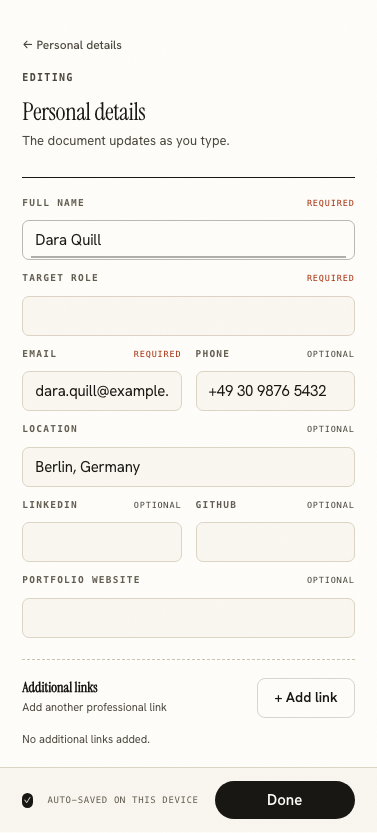
A LinkedIn link is a small decision with a predictable cost, and the cost is not the line it occupies. It is that you have invited a reader to compare two documents you wrote, and the one you updated less recently is the one they will find disagreements in. The résumé builder treats it as what it is: an optional field.
How the field behaves
LinkedIn, GitHub and a portfolio website sit together under a professional links heading, each optional, each rendered into the document only when it has a value. Further links can be added with names you choose. An empty field produces nothing on the page rather than a placeholder, which is the behaviour you want when three of the four are not ready.
What the checker does with it
Nothing. The ATS résumé checker has no rule about profile links. Its completeness dimension runs seven checks: identity, email, phone, experience, education, skills and summary. A link is in none of them, so adding one changes no number. The dimension is set out in how the ATS score is calculated.
When the link earns its line
When the profile is current, when it carries something the résumé cannot, and when the two documents agree on dates and titles. A recommendation, a longer project write-up, a set of endorsements from people a reader can see. That is a second document doing work, and it is worth a line.
When it costs you
When the profile is three years old, when the headline still names a job you left, or when the dates disagree with the page in front of the reader. A disagreement between two documents you wrote yourself is the most expensive kind, because it is the one that has no innocent explanation available at speed. Where the profile is not ready, leave the field empty and fix it later.
Write it as an address, not as a word
The line should be readable when printed, because it will be. A short custom profile address is easier to type from paper than a default one ending in a string of digits. The builder puts the link where the design places contact details, and the whole header is covered in résumé header and contact details.
The other two links
GitHub and a portfolio answer different questions from a profile, and they are not interchangeable with it. A repository is evidence for somebody who will open it. A written page is evidence for somebody who will not. That decision is worked through in portfolio or GitHub, and the page itself can be built in three steps in the portfolio builder.
Fix the profile or drop the line
The useful sequence is to decide which document is the current one and make the other agree with it. For most people the résumé is the one being edited this week, so the profile is the one to update: the headline, the current role, the dates and the two or three achievement lines that are now better written. That is twenty minutes and it removes the only real risk the link carries.
Where you are not going to do that this week, leave the field empty. An absent link raises nothing. A link to a profile that contradicts the page in the reader's hand raises the one question you cannot answer well by email. The field renders only when it has a value, which makes leaving it out a decision rather than an omission.
What is not claimed
That a link changes an outcome. Nothing here measures that and no page on this site claims a document gets anybody hired. What is true is mechanical: the field is optional, it renders only when filled, the scoring ignores it, and a stale profile is a contradiction you invited. References on a résumé and what not to put on a résumé cover the neighbouring lines, and the whole product is free with no account.
The same reasoning applies to any other link you add. The builder takes further named links beside the three it offers, which is useful for a publication, a talk, a professional register entry or a recognised profile in your sector. Each one is a promise that the thing at the other end is current and worth the click, and each one is a chance for a reader to find something that contradicts the page. Two live, relevant links are worth more than five that were accurate last year, and the field being optional is what makes leaving the others out the easy decision rather than the awkward one.
Add the links that are ready
LinkedIn, GitHub, a portfolio, or any link you name. Each one renders only when it has a value.
Open the résumé builderRead the header guideQuestions
- Where does the link go
- In the identity section, under professional links, beside GitHub and a portfolio website. The editor notes that these are shown only when provided.
- Does the checker read it
- No. There is no LinkedIn rule in the scoring. The completeness dimension checks for identity, email and phone, and a link is not one of the seven checks.
- Should the profile match the résumé exactly
- It should not contradict it. Dates and job titles that disagree between two documents you wrote are the one predictable cost of adding the link.
- What about a custom profile address
- A short custom address is easier to read and shorter on the page. There is no rule about it in the product.
- Is a link better than a portfolio
- They answer different questions, and there is a whole page on that decision.
Conxfolio is a free set of four career tools: a résumé builder with 37 rendered layouts, an ATS résumé checker that prints its own arithmetic, a cover letter builder that traces every proof paragraph back to the line it came from, and a portfolio builder with 20 authored designs. There is no account to create, nothing is held back for a paid plan, and no language model is used anywhere in the product, so the readers, the score and the letter are deterministic code you can check.