What still works when the connection goes, measured
Conxfolio has no service worker and makes no offline promise. We cut the connection during a real edit and wrote down exactly what survived.
— the honest answer is partly, and here is which part.
Most tools answer this question with a promise. This page answers it with a measurement, because the honest answer is partly, and which part matters.
The test
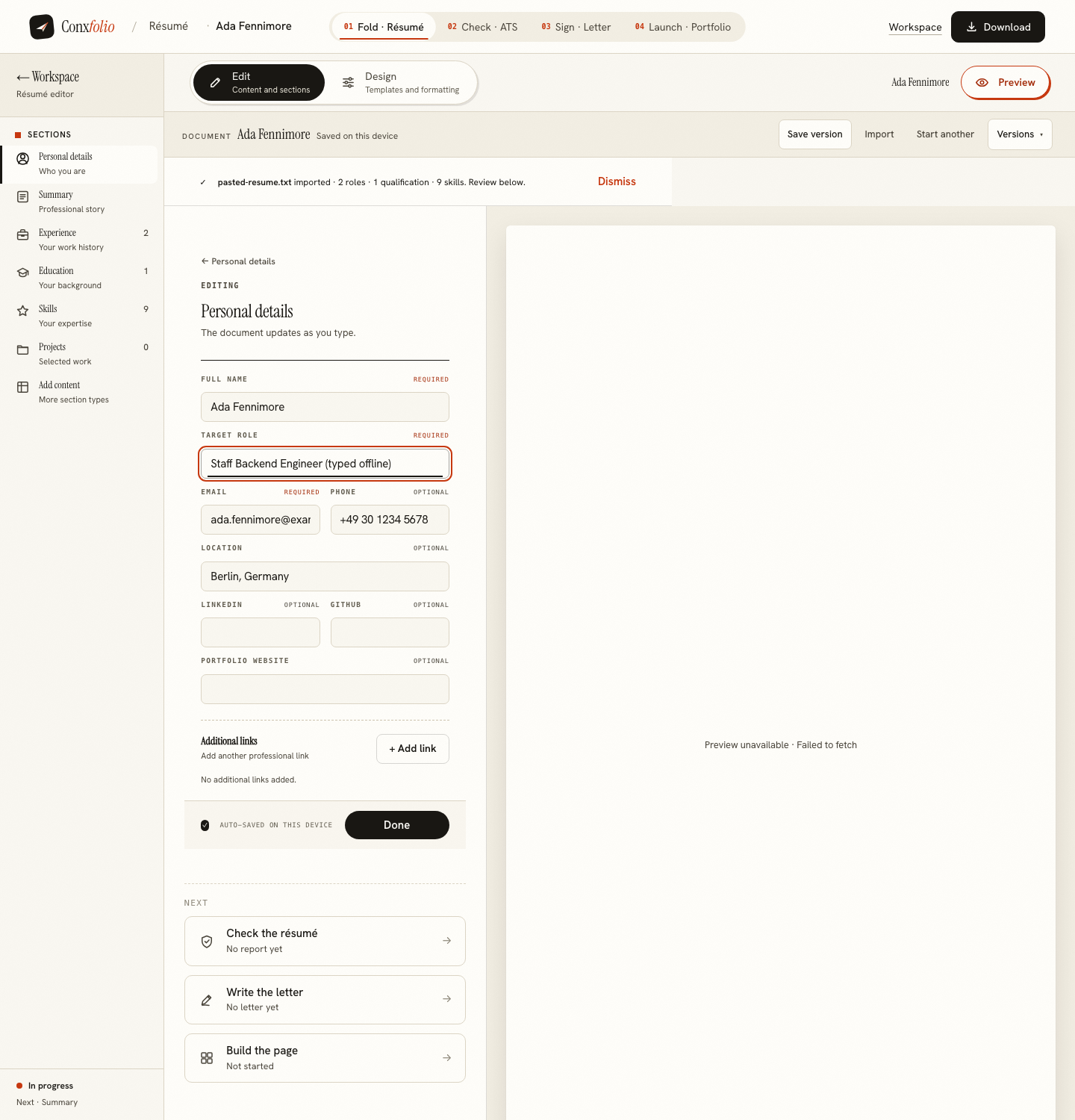
A résumé was imported into the résumé builder and a design chosen, so the editor held a real document. The browser's connection was then cut. Everything that follows was recorded after that point.
Typing carried on
The Personal details panel opened, the target role field accepted a new value, and the rendered document beside it updated. Nothing hung and nothing complained, because none of that needs a server: the editor and the renderer are code already running in the page.
Saving carried on too
The local record was read directly after the edit. It had grown from 7 882 bytes to 7 966 and it contained the words that had just been typed. Your work is written into this browser rather than sent anywhere, which is why losing the network does not lose the work. The mechanism, including a save that reads its own bytes back before reporting success, is in why there is no account.
A reload did not survive

With the connection still cut the page was reloaded, and it failed outright with a disconnected-network error. There is no service worker anywhere in this product, so there is no cached copy of the application for the browser to fall back on. This is the part a marketing page would leave out.
What needs the network, exactly
| Action | Needs a connection |
|---|---|
| Typing, editing, reordering sections | No |
| Saving into this browser | No |
| Changing design | No, once the design is loaded |
| Importing a file | Yes |
| The ATS check | Yes |
| A letter draft | Yes |
| The PDF export | Yes |
| Reloading the page | Yes |
What to do with a connection you do not trust
Load the page while you have signal and keep the tab open. Do the writing, which is the slow part, with the wire down if it comes to that. Save the network for the four things that need it, and run them together when you have a bar. Low-bandwidth applications has the measured cost of that first load, which is the expensive moment.
Why there is no service worker, and what that would cost
A service worker is the mechanism a site uses to keep working with no connection: it caches the application so a reload finds a local copy. There is none here, which is why the reload failed. Adding one is a real option and it carries a real cost, because a cached application has to be invalidated correctly or people run an old version of the product without knowing it. That is a trade a team makes deliberately rather than by accident, and until it is made the honest description is the one this page gives: an open tab keeps working, and a closed one needs the network. Saying otherwise would be a promise the code does not support.
What this page does not claim
That Conxfolio works offline. It does not, in the sense people mean when they say it. It keeps your work locally and its editor is client-side, so an interruption during a session costs nothing. A closed tab and no connection means no product until the connection comes back. If offline work is the requirement, export a DOCX while you have signal and write in a word processor, then import it again later through the import review.
One further detail worth knowing, because it decides what a dropped connection means for a deadline. The DOCX export takes no server call at all, so the code that writes it is already in the page. The PDF takes exactly one. If the connection is unreliable and the advert accepts either format, the DOCX is the export with fewer ways to fail, and PDF or DOCX, which to send weighs the rest of that choice.
A last practical note about the moment the connection returns. Nothing needs to be synchronised, because nothing was queued: your work was written locally throughout and no server holds a competing copy. You can simply run the check or the export when you have signal again. That is the quiet advantage of an arrangement with no account, and it is the same property described in why there is no account: with only one copy of your work there is no reconciliation to get wrong.
Load it once, then work
Your work is written into this browser as you type. Keep the tab open and a dropped connection costs you nothing you have already written.
Open the résumé builderLow-bandwidth applicationsQuestions
- Is there an offline mode
- No. There is no service worker in this product, so a reload with no connection fails the way any ordinary website fails. What survives is the tab you already have open.
- What was measured
- A real import and edit, then the browser context was switched to offline. Typing into the target role field carried on working, and the local record grew from 7 882 to 7 966 bytes and contained the new text. A reload then failed with a disconnected-network error.
- Does the DOCX export work offline
- The DOCX is assembled inside the browser and takes no server call, so the mechanism does not need the network. The PDF is rendered on our server and does.
- Can I run the ATS check offline
- No. The check sends the text of the résumé to our server and needs a connection, as does the letter draft and the PDF export.
- Will I lose work if the connection drops
- Nothing you have already typed. Your work is written into this browser, not held on a server, so a dropped connection does not take it with it.
Conxfolio is a free set of four career tools: a résumé builder with 37 rendered layouts, an ATS résumé checker that prints its own arithmetic, a cover letter builder that traces every proof paragraph back to the line it came from, and a portfolio builder with 20 authored designs. There is no account to create, nothing is held back for a paid plan, and no language model is used anywhere in the product, so the readers, the score and the letter are deterministic code you can check.