A research assistant cover letter, with two software gaps it would not paper over
One research assistant cover letter, printed exactly as the builder wrote it. The researcher and the institute are invented. The selection and the two gaps came out of the product.
— ninety-six participants across four authorities. that is fieldwork.
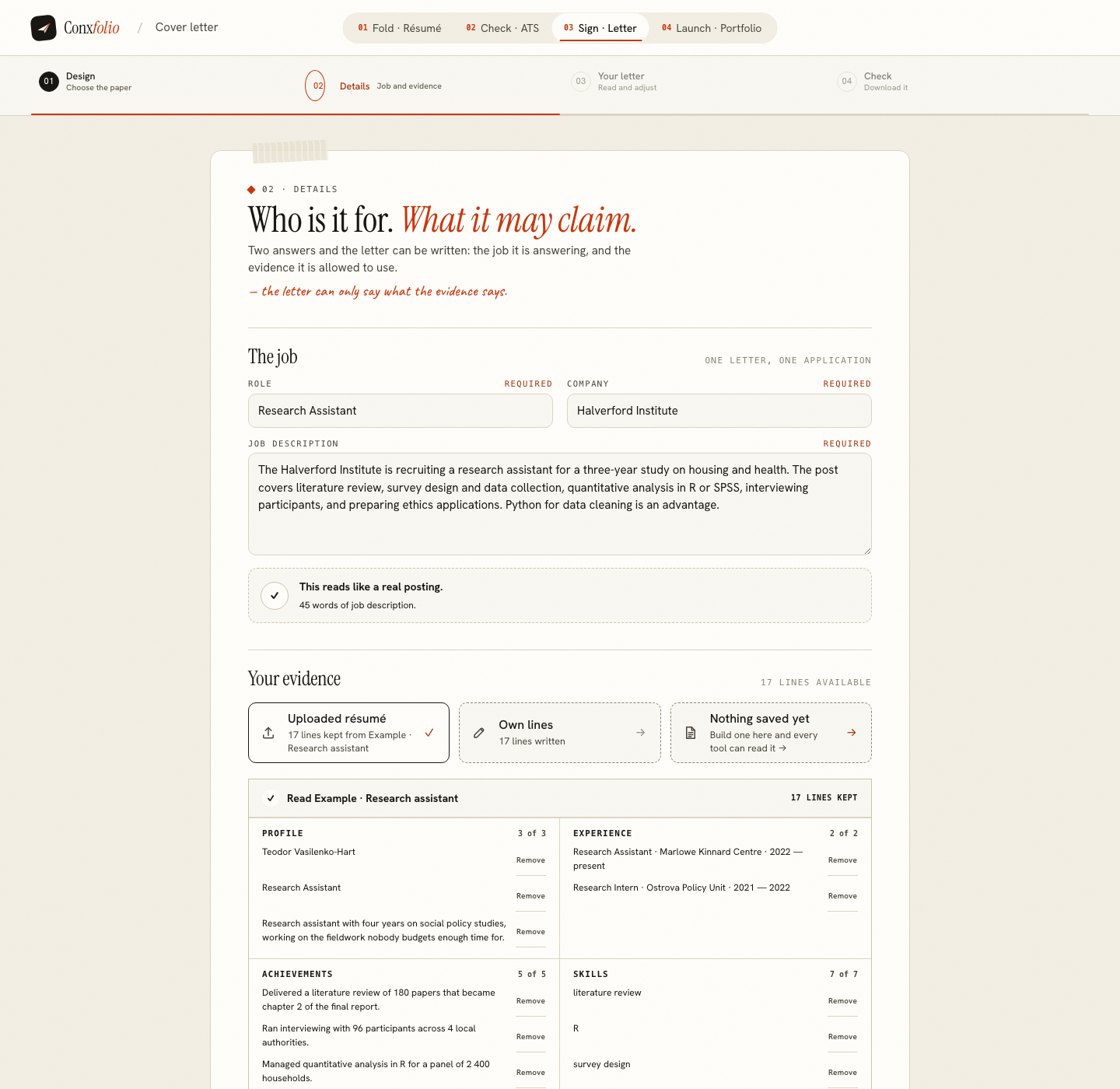
Research posts attract people who can write at length, which is exactly why a short letter reads well against them. Teodor Vasilenko-Hart is invented, the Halverford Institute is invented, and so are both of his posts. The letter is real output: the evidence below was handed to the cover letter builder and the reply is printed word for word.
The study, and the evidence the letter may use
An invented person. Not a real document, and not yours.
The role
Research Assistant · Halverford Institute
The posting
The Halverford Institute is recruiting a research assistant for a three-year study on housing and health. The post covers literature review, survey design and data collection, quantitative analysis in R or SPSS, interviewing participants, and preparing ethics applications. Python for data cleaning is an advantage.
What the letter may claim
- Delivered a literature review of 180 papers that became chapter 2 of the final report.
- Ran interviewing with 96 participants across 4 local authorities.
- Managed quantitative analysis in R for a panel of 2 400 households.
- Built the data cleaning routine that cut preparation time from 3 weeks to 4 days.
- Coordinated 2 ethics applications through committee without a resubmission.
Where it happened
- Research Assistant · Marlowe Kinnard Centre · 2022 — present
- Research Intern · Ostrova Policy Unit · 2021 — 2022
Skills it may name
- literature review
- R
- survey design
- qualitative interviewing
- academic writing
- data cleaning
- statistics
The letter the builder wrote
Direct voice, the one the door opens with. Three of the eight paragraphs are Teodor's own sentences.
Dear Halverford Institute Hiring Team,
I'm applying for the Research Assistant role at Halverford Institute.
Ran interviewing with 96 participants across 4 local authorities.
Built the data cleaning routine that cut preparation time from 3 weeks to 4 days.
Delivered a literature review of 180 papers that became chapter 2 of the final report.
The posting asks for Interviewing and Data Cleaning — all of which I've worked with directly.
I'd welcome the chance to talk through any of this.
Teodor Vasilenko-Hart
Where each paragraph came from
Lines 6, 8 and 5 of the evidence list. The interviewing line and the data cleaning line each matched a requirement the posting names. The literature review line went in on its figures and came third, which is a fair ordering: a hundred and eighty papers is impressive and ninety-six interviews is the thing the study actually needs done.
The R line and the ethics line stayed out. The ethics line is the sleeper on any research application, because two applications through committee without a resubmission tells a principal investigator that a whole class of delay will not happen. It sits in the evidence list waiting for the posting that asks. Evidence tracing shows the provenance inside the product.
What it refused to claim
Two gaps: Python and SPSS. The posting names R or SPSS for the analysis and Python for data cleaning. Teodor's evidence names R only. The engine did not offer R as near enough to either, and it did not turn the data cleaning routine into a Python claim. Both are exactly the questions a supervisor will open with. The gaps list is the interview.
No language model is involved. Selection is deterministic code over his own lines, and the reply says so in its own payload.
What a research letter has to prove
Fieldwork, analysis and the paperwork. Fieldwork is participants and sites, because recruitment is where studies die. Analysis is the panel size and the tool. The paperwork is ethics, which nobody puts on a letter and everybody worries about.
Name the software the posting names, in your own lines, or expect it in the gaps list. That is not keyword stuffing when it is true. Relevant coursework covers the equivalent problem for someone earlier in a research career.
The same evidence in the other two voices
Three voices ship with the builder, and changing one rewrites the connectors rather than the evidence. The ranking never sees the voice, so the same lines are selected in the same order in all three. Run on this page's own evidence, the warm voice opens "I'd like to be considered for the Research Assistant role at Halverford Institute." and closes "I'd be glad to walk through any of this with you." The formal voice opens "I am writing to apply for the position of Research Assistant at Halverford Institute." and closes "I would welcome the opportunity to discuss my application further." The middle connector changes with it: warm writes "You mention Interviewing and Data Cleaning; those have been the centre of my recent work." and formal writes "The role calls for Interviewing and Data Cleaning, each of which I have applied in practice." In the product, switching voice keeps the draft you already have as a version before it writes the new one, so nothing is lost by trying the other two.
The design, and what the door does
Academic sets a centred correspondence block, which is the register a university office reads. The paper changes and the words do not, across all 12 designs in the gallery.
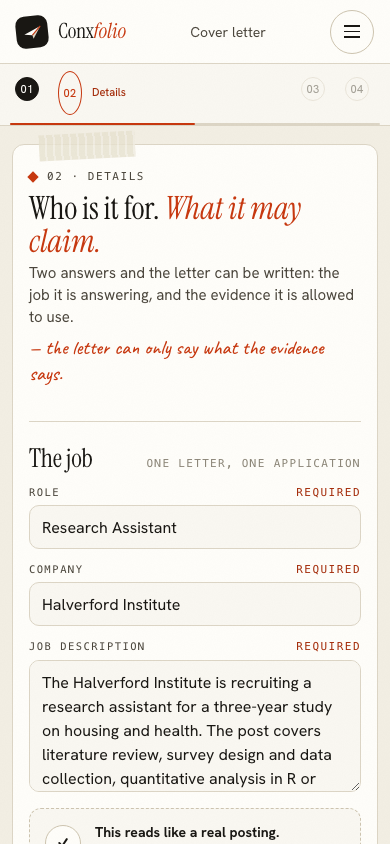
The door below opens 02 · Details with the role, the institute, the posting and the four evidence groups loaded and removable. Nothing is composed until you press Write the letter. Put your own fieldwork in, paste the real particulars, and the same ranking runs on your lines. The matching research assistant résumé example holds the document those lines come from.
Open it on the Details step
Loads Teodor's role, institute, posting and evidence into the cover letter builder in the Academic design. Nothing is written until you press Write the letter. Free, no account.
Use this exampleSee the letter designsQuestions
- Is Teodor Vasilenko-Hart a real person
- No. He is invented for this page, and so are the Halverford Institute, the Marlowe Kinnard Centre and the Ostrova Policy Unit. No real study is described and no hire is claimed.
- Did the product really write this letter
- Yes. The evidence list was posted to the same endpoint the Write the letter button posts to, and the reply is printed above unchanged. The engine reported three selected paragraphs, two matched requirements and two gaps.
- Why are Python and SPSS gaps when he analyses data in R
- Because the posting names all three and the evidence names one. R is not offered as a substitute for either of the others. On a research post this is the right behaviour: a principal investigator asking about SPSS wants an answer about SPSS.
- What does “Use this example” do
- It opens the cover letter builder on 02 · Details with the role, the institute, the posting and the four evidence groups already loaded. No letter and no application record exists until you press Write the letter.
- Should an academic letter be longer than this
- A research post usually asks for a supporting statement against the person specification, and that is a different document. This is the covering letter that goes with it, and eight paragraphs is the right length for one.
- Which design is this example in
- Academic, centred correspondence. Any of the 12 designs carries the same words.
Conxfolio is a free set of four career tools: a résumé builder with 37 rendered layouts, an ATS résumé checker that prints its own arithmetic, a cover letter builder that traces every proof paragraph back to the line it came from, and a portfolio builder with 20 authored designs. There is no account to create, nothing is held back for a paid plan, and no language model is used anywhere in the product, so the readers, the score and the letter are deterministic code you can check.