Every design in the gallery renders as a complete page, because that is what you are choosing
A résumé is a single page that someone looks at for six seconds. A gallery that shows you a grey rectangle has withheld the only information you needed.
— if you cannot read it in the grid, the grid is decoration.
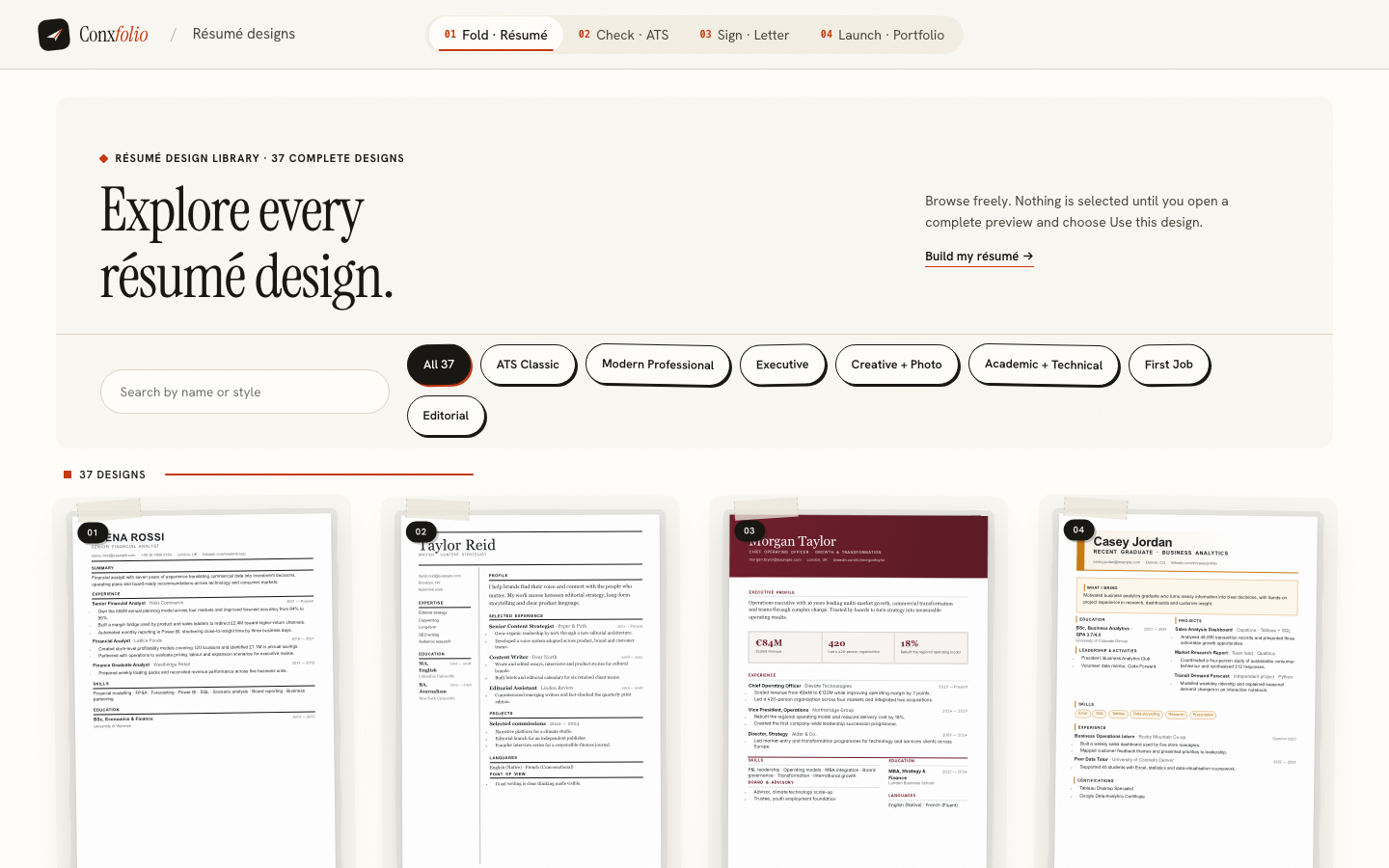
Open almost any résumé builder's template page and you are looking at postage stamps: grey blocks in the shape of a document, with a typeface too small to read and a layout you can only infer. You pick one on the basis of where the dark rectangle sits, then discover the actual design after your own words are inside it.
The gallery behind the résumé builder draws the pages instead.
What a card actually is
The same renderer that will draw your document, running on sample content, producing a full page. The headings are legible, the hierarchy is visible, the dates sit where they will sit. Opening a card fills the screen with the same page at full size, and a button takes it into the editor with your content in it.
Why a thumbnail cannot do this job
A résumé design is almost entirely a set of decisions about hierarchy: how much bigger the name is than the section headings, whether dates are aligned right or trail the employer, how far the bullets are indented, how much air sits between roles. All of that is invisible below a certain size. A thumbnail preserves only the silhouette, which is the one property that does not matter.
What it costs
Speed. A gallery of 37 rendered pages is heavier than a gallery of 37 images, and the cards arrive over a second or two rather than instantly. The alternative is a set of screenshots that drift out of date the first time a design is touched, and a gallery that quietly stops telling the truth is worse than a gallery that takes two seconds.
The gallery is also the step the builder puts you in after an import, rather than a settings screen buried behind the editor. That ordering is deliberate: you have just seen the reading of your own document, and the next thing you see is the set of pages it could become, each drawn in full. Choosing there takes a minute, and the note on the step says the choice is reversible.
The same rule inside the editor
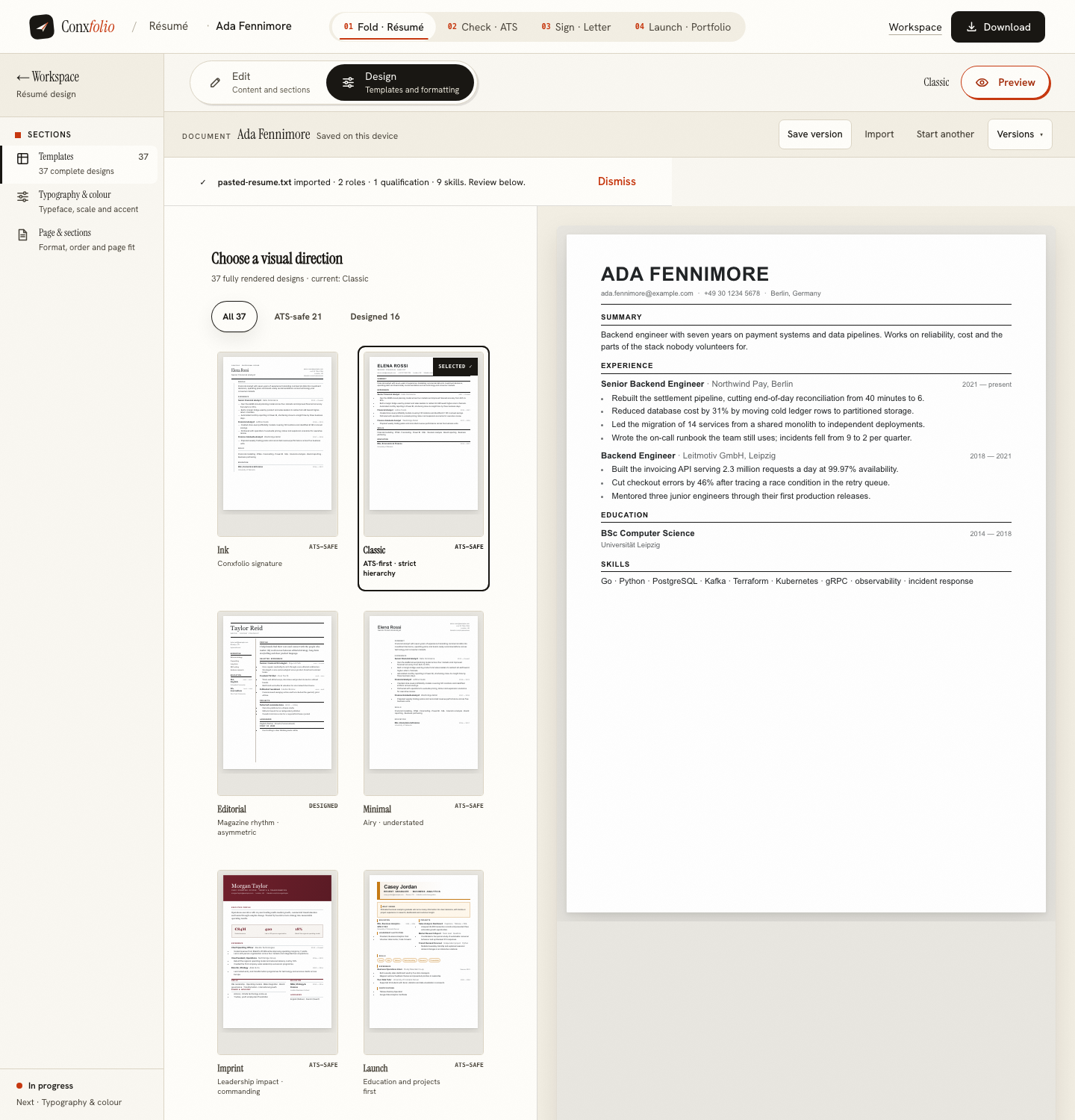
In the editor the page is always on screen beside the fields, so a change to a heading is visible as a change to the document rather than as a change to a form. The letter side of the product follows the same rule, for the same reason, which is why the letter gallery shows whole letters.
Choosing well, quickly
Filter to the marked layouts if the file is going into a portal, then pick on hierarchy: does the design lead with the thing you want read first. A career-changer's evidence sits in projects, a graduate's in education, an executive's in the first three lines. The typographic controls underneath are covered in typography on a résumé, and the marks themselves in what ATS-safe means on a design.
What to look at on a card
Three things, in order. Where the eye lands first: a design that gives the top third to a name and a headline is making a different bet from one that leads straight into experience. How dates are treated, since right-aligned dates make a career scannable and inline dates make it read as prose. And how much air sits between roles, which decides whether a two-role page looks confident or empty.
What is not worth looking at is the sample content, which is there to hold the typography up. Your own summary is a different length from the sample's, and the design that suits you is the one whose structure matches your evidence rather than the one whose placeholder text reads well. The marks under each card, and what they promise, are in what ATS-safe means on a design.
What the paper cannot do
It cannot carry a thin document. A beautifully set page with two bullet points is a beautifully set page with two bullet points, and the checker will score it accordingly, with the evidence dimension carrying 40 per cent of the total. Choose the design in a minute and spend the hour on the sentences.
Look at the pages, then choose one
Open any of the 37 designs full size, read it, and take it into the editor with your own content in it.
Open the résumé builderBrowse the résumé designsQuestions
- Are the gallery cards real renders
- Yes. Each card is the same renderer that draws your document, running on sample content, which is why the cards take a moment to appear and why what you see is what you get.
- How many designs are there
- 37, of which 21 are marked ATS-safe. Seven families group them: ATS classic, modern professional, executive, creative with photo, academic and technical, first job, and editorial.
- Why does the gallery take a moment to load
- Because it is drawing pages rather than loading pictures. The trade is deliberate: a picture would be faster and would go stale the first time a design changed.
- Will my résumé look exactly like the sample
- It will use the same structure with your content in it. A design that leads with projects will lead with yours, and a design built around a portrait will look different if you add none.
- Is any design held back for a paid plan
- No. Every design is available, both exports are free, and nothing carries a watermark.
Conxfolio is a free set of four career tools: a résumé builder with 37 rendered layouts, an ATS résumé checker that prints its own arithmetic, a cover letter builder that traces every proof paragraph back to the line it came from, and a portfolio builder with 20 authored designs. There is no account to create, nothing is held back for a paid plan, and no language model is used anywhere in the product, so the readers, the score and the letter are deterministic code you can check.