When a posting asks for a salary expectation, and why no tool here will write the number
A posting that asks for a salary expectation has asked a direct question, and the letter is where the answer goes. This page is about the sentence, not about the negotiation.
— one sentence, at the end, with a range.

Some postings ask for a salary expectation in the application, and ignoring the question is an answer too. Where you decide to give one, it belongs in the letter and nowhere else. This page is about that sentence and its position in the document. It is not advice about what to ask for, and there is nothing in this product that could give any.
The engine will not write the number
The cover letter builder selects sentences from your own résumé. Every figure it puts in a letter is a figure that already appears in your evidence, and the review step checks exactly that, reporting which numbers the draft carries. A salary expectation is not in your résumé, so nothing in the engine can produce it. There is no salary data anywhere in the product and no model to invent one.
Where the sentence goes
In the closing block, after the argument. The letter's blocks are editable fields, each with its own word count, and proof paragraphs can be added, removed and reordered around them. One sentence is enough, and it reads better at the end than anywhere else because everything before it is the reason the number is what it is.
Not on the résumé
The United Kingdom's nidirect government service lists salary among the things a CV does not need (nidirect.gov.uk). The résumé builder has no field for one either, and the same reasoning applies to a contractor's day rate, which is covered in a contractor's CV. A document that carries a number before it has carried the evidence has made the number the first thing read.
What the review will and will not check
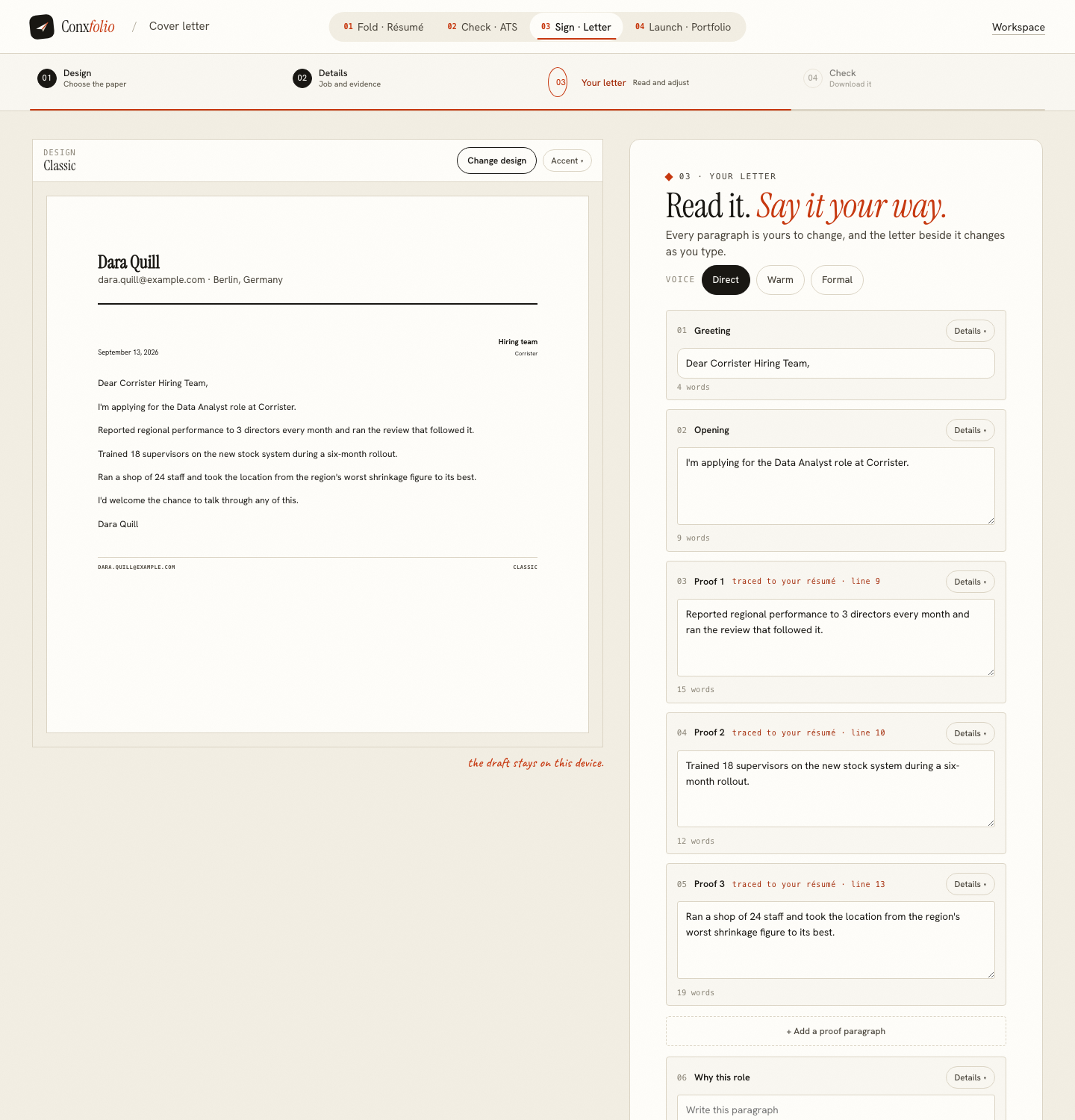
It checks that the letter is grounded, that the opportunity is named, that the draft carries figures your evidence also shows, and how long it is. A sentence you type in yourself is not traced to a source line, because it has none. That is the honest distinction and the product does not blur it. Why a cover letter only claims what the résumé shows covers the mechanism.
Range or figure
That is a judgement, and this page is not going to make it. What is worth saying is mechanical: whichever you write, write it once, in one sentence, in words rather than as a heading, and make sure the currency and the period are unambiguous. A number without a period attached is the most common avoidable ambiguity in this sentence.
When the posting does not ask
Leave it out. There is no convention on this site recommending an unprompted salary line, and the letter has three or four paragraphs in which to make an argument. Cover letter closing covers what the last paragraph is for, and what to include in a cover letter covers the rest.
What the product deliberately does not have
No salary benchmarks, no market data, no range suggestions, no comparison against a job title, and no model that could produce any of those. That is a deliberate absence rather than a missing feature: a figure generated from data we do not have would be a guess presented as an estimate, and it would be the single most consequential guess in the whole application.
The same principle runs through the rest of the product. The letter engine writes only what your evidence shows, the checker prints the arithmetic behind its own number, and a field the reader could not fill honestly is left empty and counted. Where a number is not ours to produce, nothing produces it. Why a cover letter only claims what the résumé shows covers the same rule applied to evidence.
The limits of this page
No salary benchmarks, no market data, no negotiation advice, and no tool here that does any of those things. The product builds documents. It has no model, it predicts nothing, and no page on this site claims a letter gets anybody hired or paid. Everything in it is free, and both letter exports carry no watermark.
Where the application is a form rather than a letter, the same discipline applies in a smaller box. A field asking for a salary expectation is a direct question and an empty field is an answer of sorts. What the product can do for you there is the part that sits underneath: a document whose evidence makes the figure look considered rather than hopeful. That is written in the résumé builder, checked in the checker, and it is the same work whether or not a number ever appears in a letter.
Write the letter, then the sentence
The engine builds the argument from your evidence. The closing block is a field, and the sentence is yours.
Open the cover letter builderRead the closing guideQuestions
- Will the tool suggest a figure
- No. There is no salary data in this product, no model, and nothing that estimates a market rate. The engine writes figures only where your own evidence already contains them.
- Where does the sentence go
- In the closing block, which is an editable field like every other block of the letter. One sentence, after the argument rather than before it.
- Does a CV carry a salary
- The United Kingdom's nidirect government service lists salary among the things a CV does not need (nidirect.gov.uk). The letter is the place for it when it is asked for.
- What does the review's figures note mean
- It reports that the draft carries a number and lists which ones, checking that each figure also appears in the evidence it drew from. A salary you type in is your own statement rather than a traced proof.
- Is this negotiation advice
- No. This page covers where a sentence goes in a document. Nothing here advises on what to ask for, and no tool here has any salary information.
Conxfolio is a free set of four career tools: a résumé builder with 37 rendered layouts, an ATS résumé checker that prints its own arithmetic, a cover letter builder that traces every proof paragraph back to the line it came from, and a portfolio builder with 20 authored designs. There is no account to create, nothing is held back for a paid plan, and no language model is used anywhere in the product, so the readers, the score and the letter are deterministic code you can check.