A free architect résumé example, beside the portfolio that decides
One complete architect résumé, written out in full. The person is invented. The reading and the score come from the product itself.
— consents won, drawings issued, details that stopped a query.
An architect's résumé is the least important document in an architect's application and the one that decides whether the rest is read. This example is written out in full so you can see what belongs on it, then put through the tools here so you can see what a parser takes from it. The candidate is invented.
The example, in full
An invented person. Not a real document, and not yours.
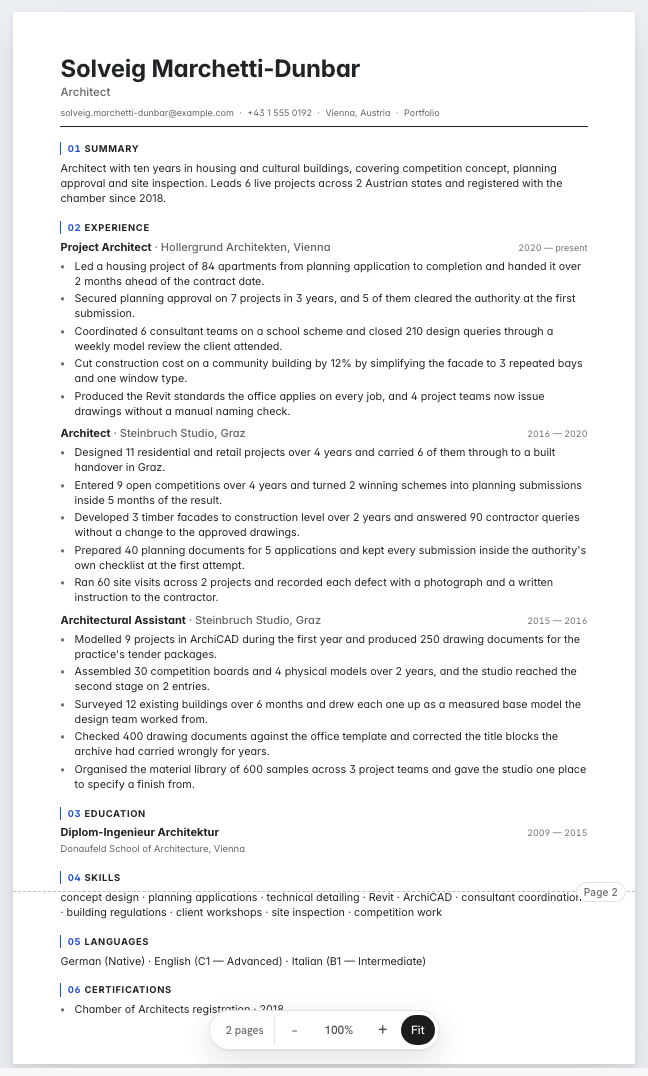
Solveig Marchetti-Dunbar
Architect
Vienna, Austria · [email protected] · +43 1 555 0192
Summary
Architect with ten years in housing and cultural buildings, covering competition concept, planning approval and site inspection. Leads 6 live projects across 2 Austrian states and registered with the chamber since 2018.
Experience
Project Architect · Hollergrund Architekten, Vienna · 2020 to present
- Led a housing project of 84 apartments from planning application to completion and handed it over 2 months ahead of the contract date.
- Secured planning approval on 7 projects in 3 years, and 5 of them cleared the authority at the first submission.
- Coordinated 6 consultant teams on a school scheme and closed 210 design queries through a weekly model review the client attended.
- Cut construction cost on a community building by 12% by simplifying the facade to 3 repeated bays and one window type.
- Produced the Revit standards the office applies on every job, and 4 project teams now issue drawings without a manual naming check.
Architect · Steinbruch Studio, Graz · 2016 to 2020
- Designed 11 residential and retail projects over 4 years and carried 6 of them through to a built handover in Graz.
- Entered 9 open competitions over 4 years and turned 2 winning schemes into planning submissions inside 5 months of the result.
- Developed 3 timber facades to construction level over 2 years and answered 90 contractor queries without a change to the approved drawings.
- Prepared 40 planning documents for 5 applications and kept every submission inside the authority's own checklist at the first attempt.
- Ran 60 site visits across 2 projects and recorded each defect with a photograph and a written instruction to the contractor.
Architectural Assistant · Steinbruch Studio, Graz · 2015 to 2016
- Modelled 9 projects in ArchiCAD during the first year and produced 250 drawing documents for the practice's tender packages.
- Assembled 30 competition boards and 4 physical models over 2 years, and the studio reached the second stage on 2 entries.
- Surveyed 12 existing buildings over 6 months and drew each one up as a measured base model the design team worked from.
- Checked 400 drawing documents against the office template and corrected the title blocks the archive had carried wrongly for years.
- Organised the material library of 600 samples across 3 project teams and gave the studio one place to specify a finish from.
Education
Diplom-Ingenieur Architektur · Donaufeld School of Architecture, Vienna · 2009 to 2015
Skills
concept design, planning applications, technical detailing, Revit, ArchiCAD, consultant coordination, building regulations, client workshops, site inspection, competition work
Languages
German · native · English · C1 · Italian · B1
Certifications
Chamber of Architects registration · 2018
Consents, coordination, standards
A housing project of 84 apartments carried from planning application to a completion two months ahead of the contract date. Planning approval on seven projects in three years, five of them cleared at the first submission. Six consultant teams coordinated on a school scheme, with 210 design queries closed through a weekly model review the client attended.
Those three lines describe an architect who takes a project the whole way. Concept work is what portfolios show, and consents, coordination and closed queries are what a practice is hiring a project architect to survive.
The office standards line is the one to copy
Writing the Revit standards the office now applies on every job, so that four project teams issue drawings without a manual naming check, is the rare case where an architectural contribution has a countable effect. Most technical improvements in a practice are invisible, and a candidate who has named one is making an argument nobody else in the pile is making.
The portfolio address sits in the contact row as plain text, which is the only form that survives extraction. The guide on linking a portfolio covers the placement, and the portfolio builder here will make a page from the same material if you want one.
Skills for an architect résumé, grouped
Solveig's skills group into design, delivery and practice. Design: concept design, competition work, client workshops. Delivery: planning applications, technical detailing, building regulations, consultant coordination, site inspection. Tools: Revit, ArchiCAD. A practice director reads the delivery group as proof you can take a scheme through consent and onto site.
The portfolio carries your design work; the résumé carries the delivery that a portfolio cannot show. In the free résumé builder you can group skills your own way and keep your registration in certifications.
From architectural assistant to project architect
An assistant's résumé proves drawing and modelling on real schemes: packages produced, models built, consultants' comments tracked. The Steinbruch assistant role shows that. An architect adds schemes you ran and the consents they received.
A project architect adds coordination and standards: the design team you led, the details you standardised for the office, the site issues you resolved. The office standards line is the one to copy. The portfolio linking guide shows where the portfolio address goes.
How it reads and scores
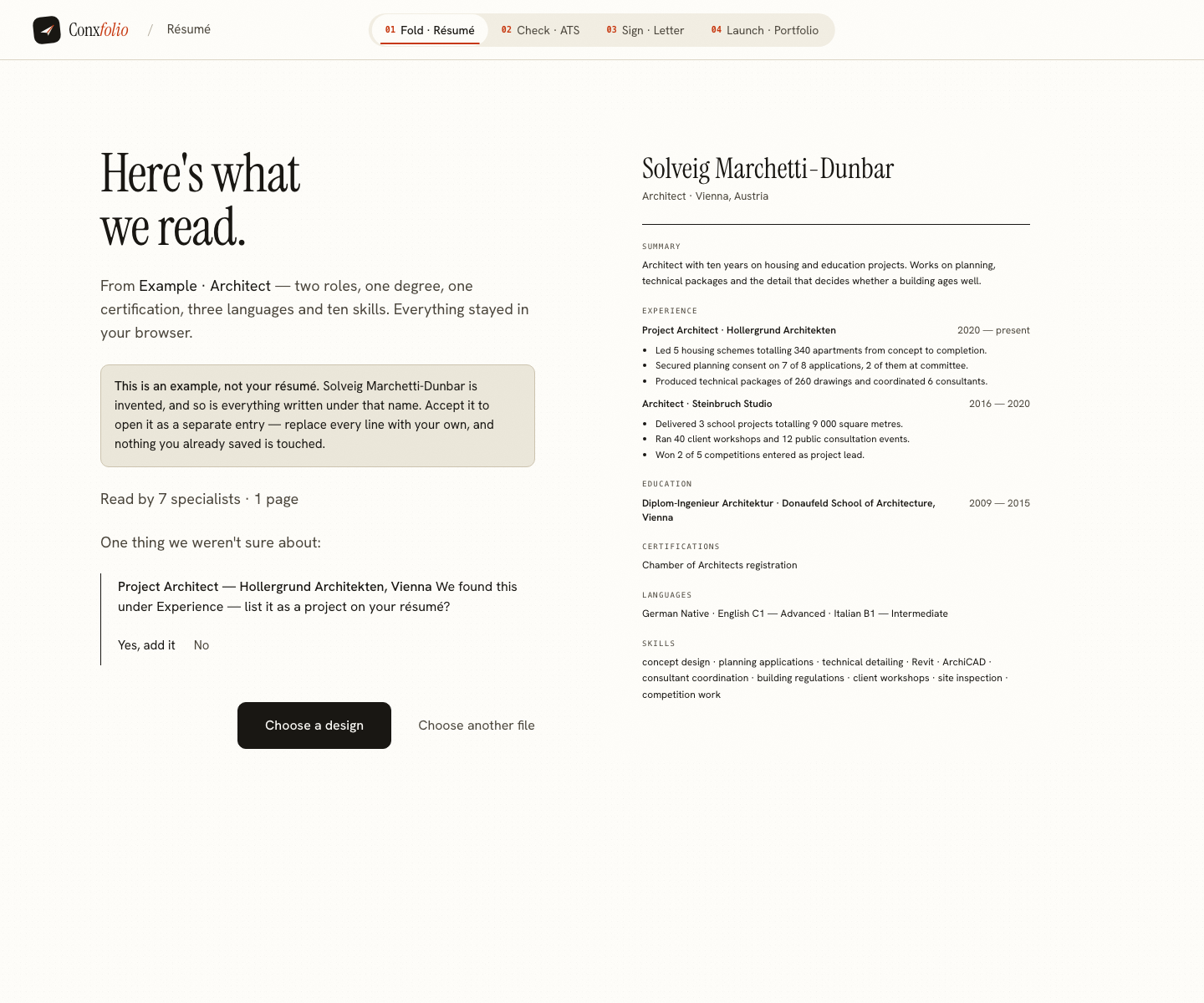
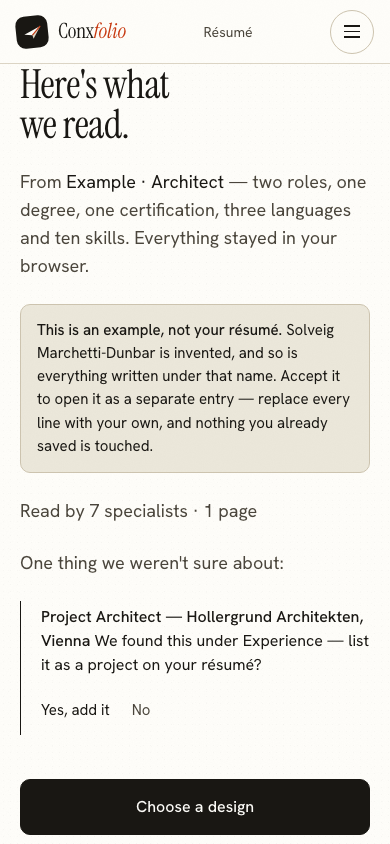
The import review read three dated roles with five achievement lines under each, one degree, ten skills, three languages, registration kept as the one certification, and the portfolio address kept in the contact row. The ATS checker scored it 99 out of 100, re-measured on 25 September 2026, with readable volume 3 points short: 100 × 30% for parseability, 100 × 30% for completeness and 97 × 40% for content. The writing check scored it 95, which is 91 of the 96 points that applied here, and the five points it withheld went to one rule. The method behind these numbers is written up once, in how our examples are made and checked.
What this example leaves off
No project images, no plan extracts and no sketches. Every one of those belongs in the portfolio, where they can be seen at the right size, and none of them survives extraction as information.
Competition entries that went nowhere are left off too, and so are unbuilt schemes presented as though they were built. A practice will ask which of your projects were completed, and a page that blurs the difference is a page that has to be explained.
What to change for your own
Change the sector and the stage. Conservation, commercial, healthcare and interiors all use this shape and weight the stages differently. Then put in your own unit counts, areas, consent records, drawing volumes and consultant coordination.
Keep registration with its year. Keep the portfolio address readable. The design gallery holds 37 layouts, and the UX designer example, the construction manager example and the head chef example show the same structure in neighbouring work.
Write yours beside it
Opens the builder with Solveig's example loaded, saved as its own entry in the Architect design. Replace every line with your own. Free, no account.
Use this exampleCheck a résumé insteadQuestions
- Is Solveig Marchetti-Dunbar a real architect
- No. She is invented for this page, and so are Hollergrund Architekten and Steinbruch Studio. The figures show a shape and describe nobody.
- Does an architect need a résumé at all
- The portfolio decides the hire and the résumé decides whether the portfolio is opened. The example keeps the portfolio address in the contact row as plain text so a parser can store it.
- What is the strongest line on an architect's page
- The consent record. Planning approval on seven projects in three years, five of them cleared at the first submission, is a measurable statement about how this architect handles planning, which is most of the risk in a project.
- What did the checker score it
- 99 out of 100, re-measured on 25 September 2026, with readable volume 3 points short. The arithmetic is 100 × 30% for parseability + 100 × 30% for completeness + 97 × 40% for content. The writing check beside it scored 95, which is 91 of the 96 points that applied, and the 427 readable words clear the volume rule's full band at 250.
- Should competitions be listed
- As a record rather than a list. Nine open competitions entered over four years with two winning schemes turned into planning submissions inside five months is honest and countable, and it says more than naming nine competitions.
- Which design is this rendered in
- Architect, one of the eight layouts shown as the ATS family. The eight were chosen on 2026-09-14 from a measurement of all 37 designs: each one exports a PDF whose text layer scores exactly what the pasted text scores, on both test documents, in one column, with the reading order kept and no graphics. The page used to be rendered in Galley, which is not in that family, and this page used to argue for the trade. The document moved on 2026-09-14 and the argument moved with it.
Conxfolio is a free set of four career tools: a résumé builder with 37 rendered layouts, an ATS résumé checker that prints its own arithmetic, a cover letter builder that traces every proof paragraph back to the line it came from, and a portfolio builder with 22 authored designs. There is no account to create, nothing is held back for a paid plan, and no language model is used anywhere in the product, so the readers, the score and the letter are deterministic code you can check.